Granger
Fahrenheit 451Granger is the leader of a small band of outcasts who have chosen to memorize entire books rather than carry physical copies, and he becomes the mentor who receives Montag into a community of living libraries after the fireman's flight from the city. He represents the culmination of Montag's journey from destruction to preservation, offering not only practical survival tactics but a philosophical framework for understanding what it means to be a keeper of knowledge in a world that has burned its own heritage.
Identity and Background
Granger is a former writer who authored a book titled The Fingers in the Glove; the Proper Relationship between the Individual and Society. Years before the novel's present, when a fireman came to burn his library, Granger struck the fireman and has been running ever since. He has spent decades on the abandoned railroad tracks, gathering others who, like him, have chosen to carry books in their heads rather than risk discovery with physical volumes. He describes the group as "bums on the outside, libraries inside," and explains that the network formed loosely over twenty years as these individuals met each other traveling and gradually established a plan. Granger himself has undergone plastic surgery on his face and fingerprints to avoid detection.
Role as Mentor and Guide
When Montag stumbles upon the campfire after escaping the city, Granger immediately recognizes him and welcomes him. He offers Montag a drink that will change the chemical index of his perspiration, explaining that with the Mechanical Hound after him, the best defense is to alter his scent. Granger then introduces the other men around the fire, each of whom represents a preserved author or thinker: Fred Clement, former occupant of the Thomas Hardy chair at Cambridge; Dr. Simmons, a specialist in Ortega y Gasset from U.C.L.A.; Professor West, who taught ethics at Columbia University; and Reverend Padover, who lost his congregation for his views. Granger himself identifies as the author of his own book. He tells Montag that the group has photographic memories and has developed methods to recall anything that has been read once, and he offers Montag the chance to become, himself, a book: the Book of Ecclesiastes, which Montag remembers fragments of from his stolen Bible.
Philosophy and Method
Granger articulates a philosophy of humble preservation. He insists that the members of the group are "not important," that they are "nothing more than dust-jackets for books, of no significance otherwise." Their method is to keep knowledge intact and safe, not to incite or anger anyone, because if they are destroyed, the knowledge dies with them. They are model citizens in their own way, walking the old tracks and lying in the hills at night, and the city people let them be. Granger explains that the organization is flexible, loose, and fragmentary, and that some members live in small towns, each holding a single chapter of a book: Chapter One of Thoreau's Walden in Green River, Chapter Two in Willow Farm, Maine, and the complete essays of Bertrand Russell in a Maryland town of only twenty-seven people. When the war is over, they will call people in one by one to recite what they know and set it in type, ready to do it all over again if another Dark Age comes.
The Phoenix and Human Memory
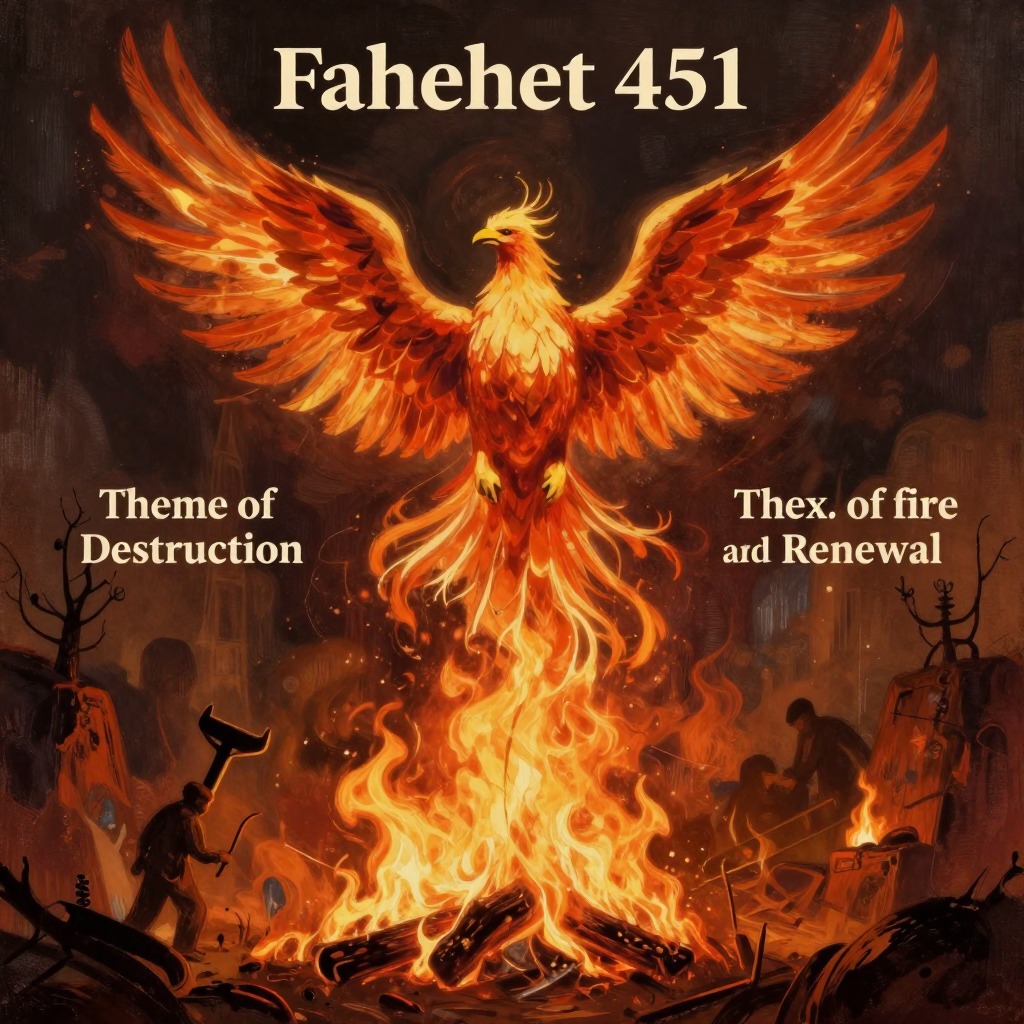
After the bombing of the city, as the men sit by a new fire, Granger tells the story of the Phoenix, a mythical bird that builds a pyre and burns itself up every few hundred years, only to spring from the ashes and be born again. He says that humans are like the Phoenix, but with one crucial difference: "We know the damn silly thing we just did. We know all the damn silly things we've done for a thousand years, and as long as we know that and always have it around where we can see it, some day we'll stop making the goddam funeral pyres and jumping into the middle of them." He then instructs the group to hold on to one thought: that they are not important, but that the load they carry may help someone someday. He tells them that when they meet lonely people, they can say, "We're remembering," and that this is where they will win out in the long run.
Final Guidance and Legacy
As dawn breaks, Granger leads the group north along the river. He lets Montag walk ahead, signaling that Montag has been accepted into the community. Granger shares a memory of his grandfather, a sculptor who shaped the world with his hands and left behind a legacy of actions and creations. He quotes his grandfather's advice: "Stuff your eyes with wonder, live as if you'd drop dead in ten seconds. See the world. It's more fantastic than any dream made or paid for in factories." He tells Montag that everyone must leave something behind when they die—a child, a book, a painting, a garden—so that their soul has somewhere to go. Granger's own grandfather, he says, touched him so deeply that the old man's thumbprint remains in the convolutions of his brain. The group walks on in silence, with everything to think about and much to remember, and Montag feels the slow stir of words inside him, ready to be spoken when the time comes.