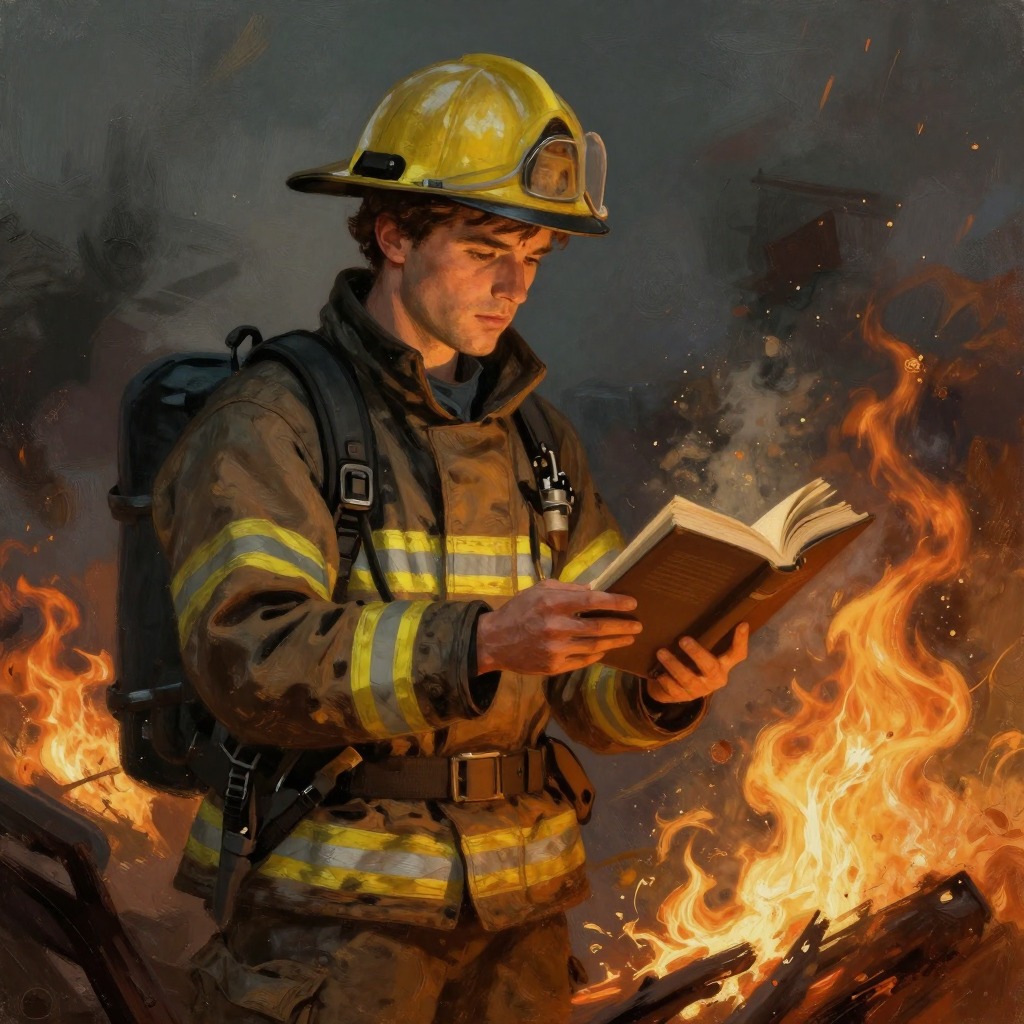
Guy Montag
Fahrenheit 451Guy Montag is the protagonist of Ray Bradbury's Fahrenheit 451, a fireman whose life is upended when he begins to question the very work that defines him. Over the course of a single week, he moves from a man who takes a fierce, almost sensual pleasure in burning books to a hunted fugitive who joins a community of exiles dedicated to preserving literature by memory. His transformation is the novel's central engine, a journey from complicit enforcer to conscious rebel, from hollow happiness to a painful, necessary awakening.
Identity and Background
Montag has been a fireman for ten years, since he was twenty, following a path laid by his grandfather and father, who were firemen before him. He wears the profession's symbols—the helmet numbered 451, the salamander on his arm, the phoenix-disc on his chest—with a pride that is almost instinctive. The work gives him a visceral thrill: "It was a special pleasure to see things eaten, to see things blackened and changed," and he feels the blood pound in his head as he plays "all the symphonies of blazing and burning." He grins the "fierce grin of all men singed and driven back by flame," a smile that never leaves him as long as he remembers. His home life is hollow. His wife, Mildred Montag, spends her nights with Seashell Radios tamped in her ears, staring vacantly at the ceiling, and her days absorbed by the three wall-sized television screens in the parlour, which she calls her "family." Montag himself has been sleepwalking through this existence, but the first crack appears when he meets his new neighbor, Clarisse McClellan.
Awakening and the First Cracks
Clarisse, a seventeen-year-old girl who describes herself as "crazy" and "anti-social," immediately unsettles Montag. She asks him questions no one else does: "Are you happy?" The question catches him off guard, and he later admits to himself, "He was not happy. He was not happy. He wore his happiness like a mask and the girl had run off across the lawn with the mask." Over several days, Clarisse walks with him, pointing out the dew on the grass, the man in the moon, the stretched-out billboards, and the way people no longer talk about anything real. She tells him about her uncle, who was jailed for driving slowly, and about a time when children didn't kill each other. Montag finds himself both irritated and fascinated. He feels he has known her for years, and she makes him feel "very old and very much like a father." But then, after only a week, Clarisse vanishes. Mildred casually informs him that the McClellan family moved out and that Clarisse was "run over by a car. Four days ago." Montag is stunned, and the loss deepens his growing unease.
The Turning Point: The Old Woman and the Stolen Book
The decisive break comes during a routine alarm. The firemen arrive at a house where an old woman refuses to flee. As the men pour kerosene, Montag catches a book that falls into his hands and reads a single line: "Time has fallen asleep in the afternoon sunshine." Without thinking, his hand—"with a brain of its own, with a conscience and a curiosity in each trembling finger"—hides the book under his arm. The old woman, rather than leave, strikes a kitchen match and burns herself alive with her books. Montag is horrified. He tells Mildred, "There must be something in books, things we can't imagine, to make a woman stay in a burning house; there must be something there." He begins to hoard books he has secretly taken over the past year, hiding them behind the ventilator grille. He feels his hands have been "infected" with a hunger he cannot control, and he realizes he has never really thought about the men behind the books he has burned.
Confrontation and Mentorship
Captain Beatty, who suspects Montag's crisis, visits him at home and delivers a long, sophisticated defense of the firemen's role. He explains that the system arose not from government decree but from mass culture, technology, and minority pressure—a desire to avoid offense and ensure happiness. "A book is a loaded gun in the house next door," Beatty says. "Burn it." He warns Montag that every fireman gets an itch to read, but that the books themselves are worthless. Montag, however, is not convinced. He seeks out Professor Faber, a retired English professor he met in a park a year earlier. Faber agrees to help, giving Montag a two-way "Green Bullet" radio so they can communicate secretly. Faber identifies three things missing from society: quality of information, leisure to digest it, and the right to act on what one learns. Together, they hatch a plan to plant books in firemen's homes and turn in alarms, hoping to sow suspicion and destroy the firemen from within.
The Final Break and Murder
Montag's rebellion comes to a head when he reads Matthew Arnold's "Dover Beach" to Mildred's friends, Mrs. Phelps and Mrs. Bowles. The poem reduces Mrs. Phelps to tears, and the women leave in outrage. Mildred, terrified, has already begun burning the hidden books. That night, Montag goes to work, and the alarm he answers leads him to his own house. Mildred has turned him in. Beatty forces Montag to burn his own home with a flamethrower, then arrests him. When Beatty discovers the Green Bullet and threatens to trace it to Faber, Montag—in a moment of desperate fury—turns the flamethrower on Beatty and kills him. He also knocks out the other two firemen and destroys the Mechanical Hound that attacks him, though not before it injects procaine into his leg. He flees into the night, a fugitive.
Escape and Rebirth
Montag's escape is a harrowing ordeal. He crosses a wide boulevard under the headlights of a car full of teenagers who try to run him down for sport. He reaches Faber's house, where the old man gives him clothes and a plan: follow the abandoned railroad tracks out of the city. Montag plants a book in a fireman's house along the way, then douses himself in whisky and plunges into the river to throw off the Mechanical Hound's scent. The river carries him out of the city and into the countryside, where he encounters a group of wandering men led by Granger. These men are "book-burners" in a different sense: they have memorized entire books to preserve them. Granger tells Montag, "You are the Book of Ecclesiastes," and explains that their mission is to wait for the war to end and then rebuild civilization from memory. As the city is destroyed by bombs, Montag walks north with the group, carrying the words of Revelation in his mind: "And on either side of the river was there a tree of life, which bare twelve manner of fruits, and yielded her fruit every month; And the leaves of the tree were for the healing of the nations." He has moved from being a destroyer to a keeper of the word.
Narrative Role and Significance
Montag is a classic round character, undergoing a profound and convincing transformation from a passive cog in a repressive system to an active, conscious agent of change. His journey mirrors the novel's central themes: the conflict between ignorance and knowledge, the emptiness of a pleasure-driven society, and the redemptive power of memory and literature. Through Montag, Bradbury explores the cost of conformity and the courage required to think for oneself. His final act—walking toward the ruined city with the intention of rebuilding—is not a triumphant victory but a quiet, determined beginning, a testament to the human capacity for renewal.