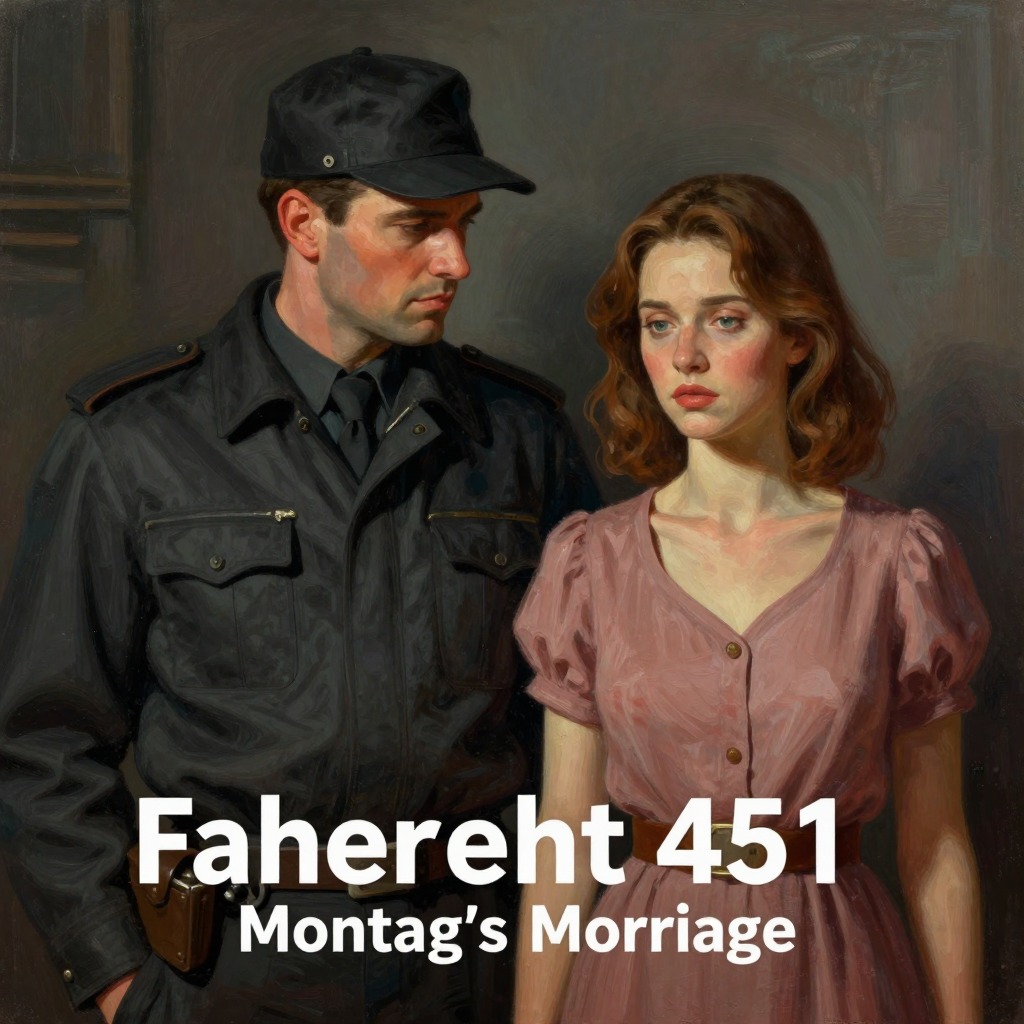
Guy Montag and Mildred Montag
Fahrenheit 451The marriage of Guy Montag and Mildred Montag is a central relationship in Fahrenheit 451, embodying the emotional emptiness and societal dysfunction of their world. Their union is characterized by profound disconnection, a lack of genuine communication, and the absence of love or shared meaning, serving as a personal catalyst for Montag's rebellion against a repressive society.
Identity and Background
Guy Montag and Mildred Montag have been married for ten years, yet their relationship is defined by a startling lack of intimacy and shared history. When Montag asks Mildred where they first met, she cannot remember, replying, "It's been so long" and laughing oddly at the fact that she cannot recall such a fundamental detail. Montag himself, pressing for an answer, is only able to remember later, during the bombing of the city, that they met in Chicago. This inability to recall their origins underscores the hollow foundation of their marriage. Mildred is thirty years old, while Montag is thirty, and Clarisse McClellan observes that Mildred seems younger than her seventeen years, while Montag seems older, highlighting a mismatch in their emotional ages. Montag reflects that Mildred has been staring vacantly at the ceiling for the past ten years or so, suggesting a long-standing pattern of emotional absence. The couple has no children, a fact that Montag explains by saying, "my wife, she... she just never wanted any children at all." Their home is filled with the constant noise of the "parlour walls" and Mildred's Seashell Radios, which she uses to drown out any possibility of genuine connection.
Life and Plot Trajectory
The marriage is immediately tested by Mildred's overdose, which Montag discovers on the night he first meets Clarisse. He finds her in bed, her Seashell Radios in her ears, and an empty bottle of sleeping pills on the floor. The medical technicians who arrive to pump her stomach treat the event as routine, and Mildred herself later denies any memory of the incident, insisting, "I wouldn't do a thing like that. Why would I do a thing like that?" This denial establishes a pattern of avoidance and emotional repression. Montag, increasingly disturbed by his encounters with Clarisse and the burning of the old woman, tries to share his turmoil with Mildred, but she is unreceptive. When he tells her about the woman who burned with her books, she responds, "She's nothing to me; she shouldn't have had books. It was her responsibility, she should have thought of that." Montag's growing unhappiness and his secret reading of books create a widening rift. He confesses, "I'm so damned unhappy, I'm so mad, and I don't know why I feel like I'm putting on weight." Mildred, in contrast, declares, "I am" happy, "And proud of it." When Montag reveals his hidden collection of books, Mildred reacts with horror, trying to burn them and screaming, "You'll ruin us! Who's more important, me or that Bible?" Her ultimate betrayal comes when she reports Montag to the fire department, leaving him with a suitcase as the firemen arrive to burn their house. She flees in a beetle-taxi, mumbling, "Poor family, poor family, oh everything gone, everything, everything gone now." Montag later reflects on her departure, realizing he does not miss her and feels little sadness, a recognition that disturbs him.
Key Actions and Objectives
Mildred's primary objective is the maintenance of her comfortable, distraction-filled existence. She immerses herself in the "parlour families," participating in interactive television scripts and driving at high speeds for thrills. She tells Montag, "I always like to drive fast when I feel that way. You get it up around ninety-five and you feel wonderful. Sometimes I drive all night and come back and you don't know it. It's fun out in the country. You hit rabbits, sometimes you hit dogs." Her actions are consistently aimed at avoiding any form of genuine thought or emotional engagement. Montag, in contrast, begins to seek meaning and connection. He tries to engage Mildred in conversation about their past, about Clarisse, and about the books he has stolen, but she consistently deflects or dismisses him. His objective shifts from maintaining the status quo to understanding the world and himself, a journey that Mildred cannot and will not join.
Relationships and Conflict
The central conflict of the marriage is the fundamental incompatibility of their values and desires. Montag craves authentic connection and understanding, while Mildred is content with the superficial pleasures provided by their society. This conflict is dramatized in their interactions. When Montag reads Matthew Arnold's "Dover Beach" to Mildred's friends, Mrs. Phelps is moved to tears, but Mildred is bewildered and angry. Montag's attempt to share something meaningful is met with hostility and incomprehension. The marriage is also marked by a profound physical and emotional distance. Montag feels that there is "a wall between him and Mildred," not just one but three, referring to the parlour walls that consume her attention. He describes their relationship as being on "a winter island separated by an empty sea." Even in their bed, they are separate, with Mildred plugged into her Seashell Radios, listening to "far people in far places." Montag reflects that he is "in someone else's house, like those other jokes people told of the gentleman, drunk, coming home late at night, unlocking the wrong door, entering a wrong room, and bedding with a stranger." This sense of estrangement is complete.
Change and Ending
The marriage ends not with a confrontation but with a quiet, devastating betrayal. Mildred, having called in the alarm, leaves Montag without a word as the firemen arrive to burn their house. Montag, watching her flee, feels a strange absence of emotion. He later tells Granger, "It's strange, I don't miss her, it's strange I don't feel much of anything. Even if she dies, I realized a moment ago, I don't think I'll feel sad. It isn't right. Something must be wrong with me." Mildred's fate is implied in the bombing of the city. Montag, in his final vision of her, sees her in her hotel room, leaning toward the "great shimmering walls of colour and motion where the family talked and talked and talked to her," and then the bomb strikes. The marriage, which was already a hollow shell, is finally and irrevocably destroyed by the very society that shaped it.
Narrative Role and Evaluation
The Montag-Mildred marriage serves as a microcosm of the novel's critique of a society that has traded genuine human connection for manufactured happiness. Mildred represents the fully assimilated citizen, content with her distractions and incapable of critical thought or emotional depth. Her inability to remember her own past, her denial of her suicide attempt, and her ultimate betrayal of her husband all illustrate the dehumanizing effects of a culture that suppresses individuality and intellectual curiosity. Montag's journey away from Mildred is a journey toward humanity. The marriage is not a partnership but a mirror reflecting the emptiness of their world, and its dissolution is a necessary step in Montag's transformation from a passive cog in the system to an active seeker of truth.