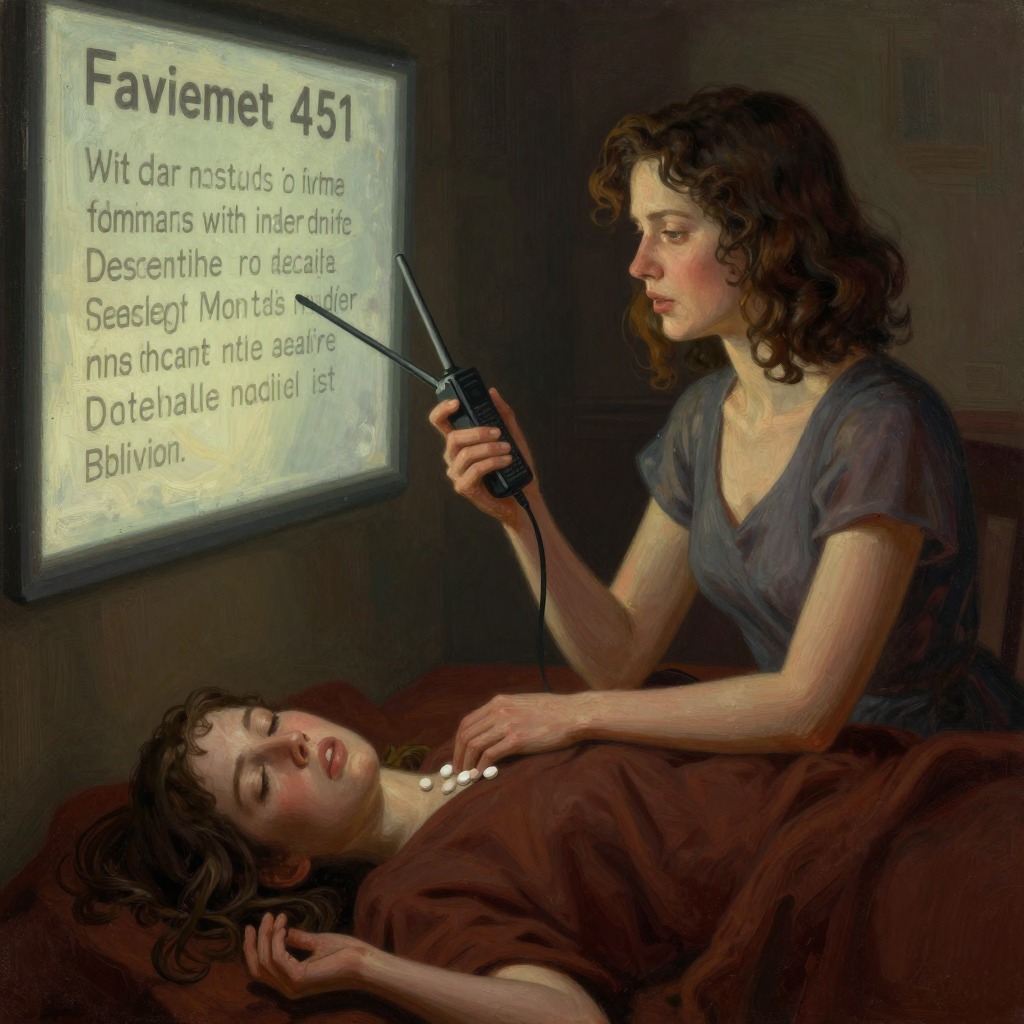
Montag discovers Mildred's overdose
Fahrenheit 451On the night he first meets Clarisse McClellan, Guy Montag returns home to find his wife Mildred unresponsive in bed, having overdosed on sleeping pills. The discovery is the first crack in the foundation of his life as a fireman, exposing the profound isolation and despair that lie beneath the surface of his seemingly ordered world. It is a moment that initiates his long, painful awakening, linking the personal void in his marriage to the larger cultural emptiness he has been paid to enforce.
The Discovery in the Dark
Entering his bedroom, Montag finds it like a mausoleum, completely dark, the windows tightly shut, and the only sound the faint hum of Mildred's Seashell ear radios. He feels his smile, the habitual expression of a contented fireman, slide away and collapse, and he recognizes for the first time that he is not happy. An instant before his foot strikes an object on the floor, he knows he will hit it. The object gives a dull clink and slides off into the darkness. Using his igniter, he sees two pale moonstones looking up at him: Mildred's eyes, glassy and unseeing. Her face is like a snow-covered island, feeling no rain, no shadow. The small crystal bottle of sleeping tablets, which had been filled with thirty capsules, now lies uncapped and empty.
The Emergency Response
Montag calls for medical help, his voice a terrible whisper into the phone. The sky screams overhead as jet-bombs pass, and he feels cut in half, his chest split apart. The medical department sends two cynical, uncaring technicians who operate a machine they call the "Black Cobra," a stomach pump that slides down into the stomach like a snake, drinking up the poisons. A second machine replaces all of Mildred's blood with fresh blood and serum. The operators are impersonal, smoking cigarettes, treating the procedure as routine. They explain that such cases are common, nine or ten a night, and that no M.D. is needed, only handymen with special machines. Montag's anger does not touch them. They leave, and he is left alone with a woman whose blood is now someone else's, whose mind he wishes could be taken to the dry-cleaner's and emptied of its pockets.
The Aftermath and the Unspoken Truth
Half an hour later, Mildred's cheeks are pink and her lips are fresh, but she has no memory of the event. The next morning, she eats breakfast, plugged into her Seashells, and when Montag tries to tell her what happened, she assumes they had a wild party. She denies taking the pills, saying she would never do a thing like that. Montag does not press the issue, but the knowledge of her attempted suicide, and her complete denial of it, creates a wall between them. He realizes that she is a stranger to him, and he to her. The event becomes a recurring, haunting thought, mingling in his mind with the image of Clarisse, the fire that night, and the disposable tissue philosophy of the age. It is the first concrete evidence of the sickness at the heart of his world, a sickness that he will later try to cure with books.
Thematic Significance: The Empty Vessel
The overdose is not merely a personal crisis but a symptom of a society that has replaced genuine human connection with empty entertainment and chemical escape. Mildred's attempt to erase herself is the logical endpoint of a culture that values happiness above all else, a happiness that is hollow and unsustainable. For Montag, the discovery is the beginning of his moral and emotional education. It forces him to question the nature of his own happiness and the value of the life he has been living. The event is a direct challenge to the fireman's creed, and it plants the first seed of doubt that will eventually grow into full-blown rebellion. The memory of the empty pill bottle and the two moonstone eyes will stay with him, a constant reminder of the void he must fill.