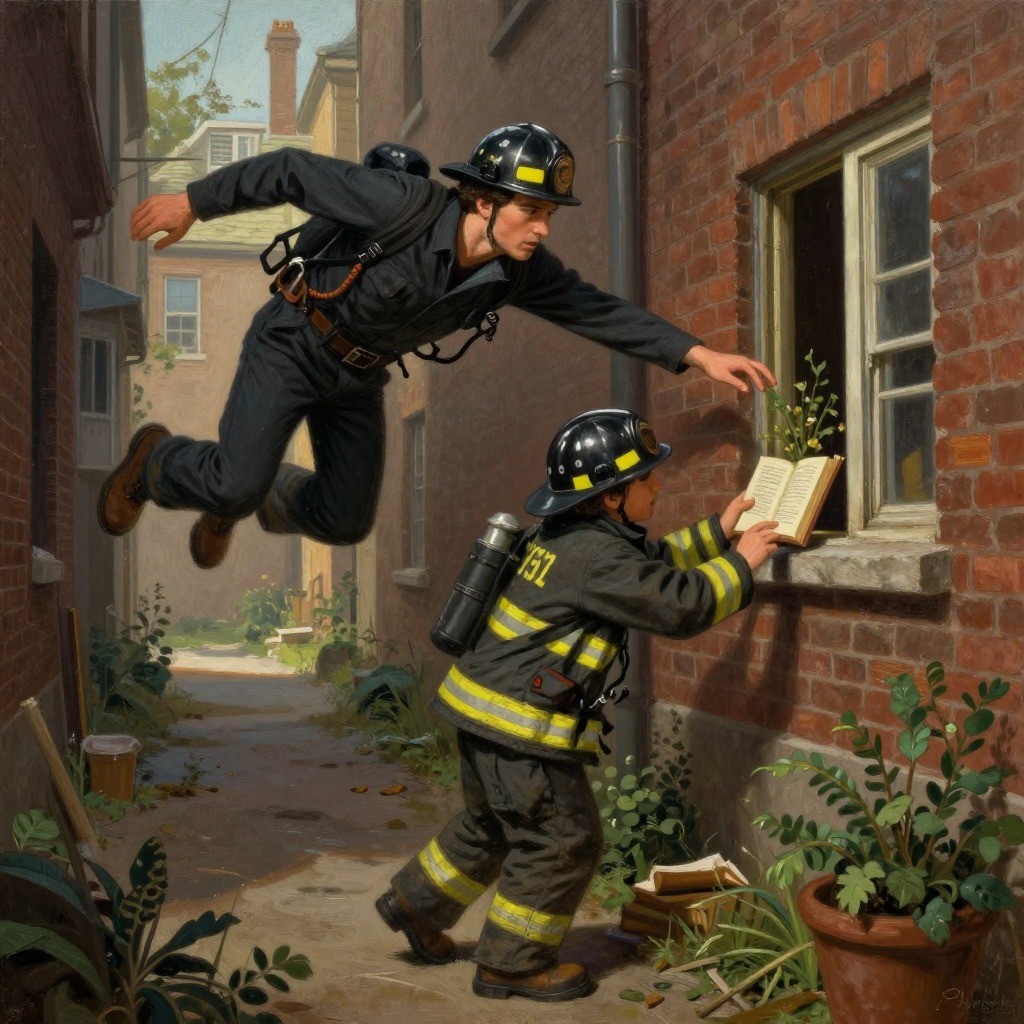
Montag plants books in a fireman's house
Fahrenheit 451After killing Captain Beatty and destroying his own home, Montag flees through the city's back alleys, wounded and hunted. In the chaos of his escape, he remembers the books he had hidden near his garden fence and retrieves four that Mildred had missed. Carrying them through the dark, he approaches the house of a fireman named Black, whose wife is asleep inside. Montag slips through the back door, moving through a thick night-moistened scent of daffodils and roses, and hides the books in the kitchen. He justifies the act to himself with a bitter thought: "this isn't good, but your husband did it to others and never asked and never wondered and never worried. And now since you're a fireman's wife, it's your house and your turn, for all the houses your husband burned and the people he hurt without thinking." The house does not reply; it remains dark and quiet, sleeping.
The Alarm and the Consequence
From a lonely phone booth outside a closed store, Montag phones in an alarm. He stands in the cold night air, waiting, and at a distance he hears the fire sirens start up and run, the Salamanders coming to burn Mr. Black's house while he is away at work, to make his wife stand shivering in the morning air while the roof lets go and drops in upon the fire. Montag's thought is a grim farewell: "Good night, Mrs. Black." The act is a direct inversion of his former role: instead of burning books for the state, he uses the state's own alarm system to destroy a fireman's home, planting the seeds of suspicion among the arsonists themselves.
The Plan's Origin and Significance
This tactic was not Montag's own invention. Earlier, during his meeting with Professor Faber, Faber had suggested a radical plan: "The only way I could possibly listen to you would be if somehow the fireman structure itself could be burnt. Now if you suggest that we print extra books and arrange to have them hidden in firemen's houses all over the country, so that seeds of suspicion would be sown among these arsonists, bravo, I'd say!" Montag immediately grasped the implication: "Plant the books, turn in an alarm, and see the firemen's houses burn." Though Faber initially claimed he was joking, Montag took the idea seriously. Now, alone and on the run, he executes the plan on a small scale, planting books in Black's house and triggering the alarm. It is a desperate, improvised act of war against the firemen's own institution.
Thematic Resonance: From Passive Guilt to Active Rebellion
Montag's action represents a crucial turning point in his arc. Earlier, he had stolen a book almost involuntarily, his hand acting "with a brain of its own, with a conscience and a curiosity in each trembling finger." That theft was a furtive, instinctive act. Now, he deliberately uses the books as weapons. The act is also a response to the emptiness he felt after Clarisse's dandelion test revealed he was "not in love with anyone," and to his growing conviction that "there must be something in books, things we can't imagine, to make a woman stay in a burning house." By planting books in a fireman's home, Montag forces the regime to confront its own contradictions, turning the firemen's tools—the alarm, the Salamander, the kerosene—against them. It is a small, symbolic gesture, but it signals his full commitment to the rebellion, a commitment that will lead him to the river and to Granger's band of book-people, who have their own, more patient strategy for preserving knowledge.