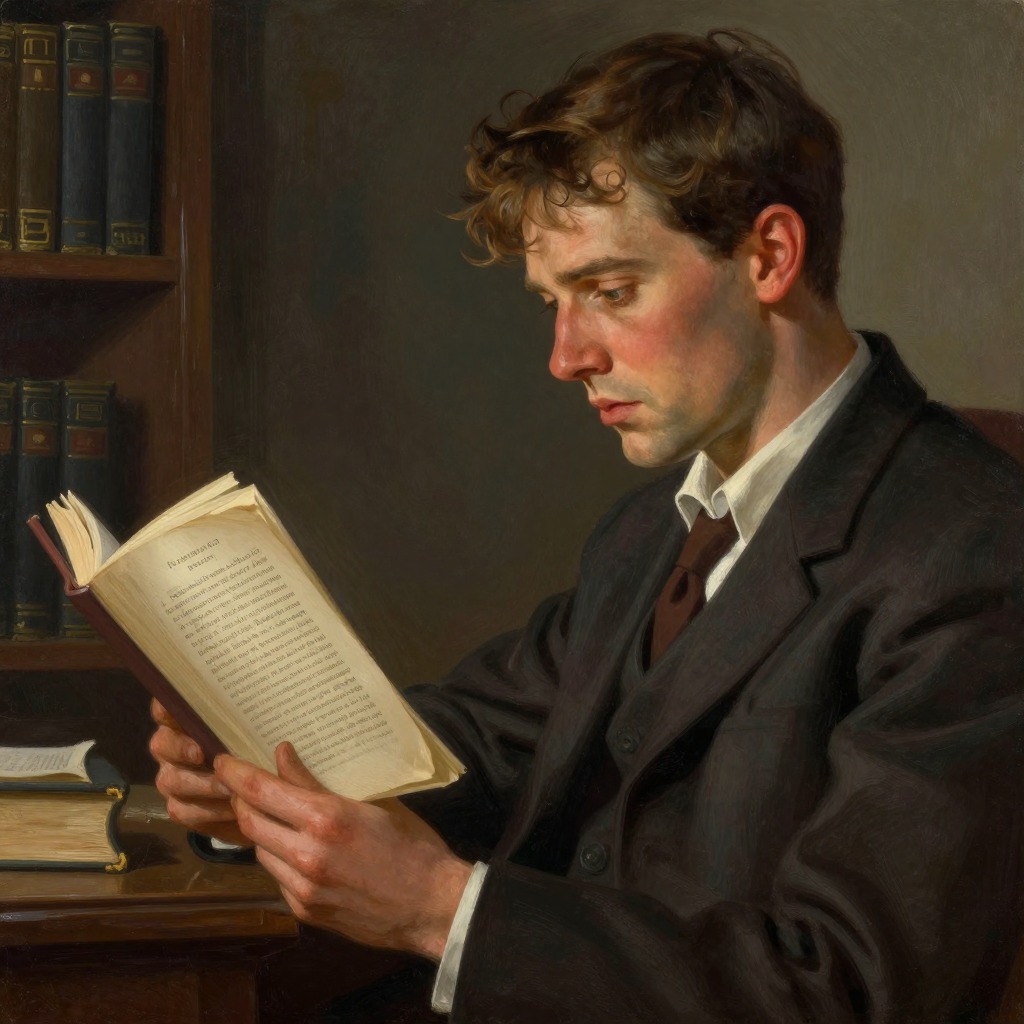
Montag steals a book
Fahrenheit 451Montag steals a book during a fire raid, an impulsive act that marks his first concrete step toward rebellion and sets the entire plot of Fahrenheit 451 in motion. The theft occurs at the burning of an old woman's house, where a book alights in his hands "almost obediently, like a white pigeon, wings fluttering." In that instant, his hand acts with a brain of its own, crushing the book "with wild devotion, with an insanity of mindlessness to his chest." This single, involuntary gesture transforms Montag from a dutiful fireman into a fugitive and a reader, initiating the chain of events that will lead to murder, escape, and rebirth.
The Theft and Its Immediate Context
The theft takes place during a raid on a century-old house in the ancient part of the city. As Montag climbs the sheer stairwell, books bombard his shoulders, arms, and upturned face. One book falls open, and he reads a single line: "Time has fallen asleep in the afternoon sunshine." The line blazes in his mind "as if stamped there with fiery steel." Immediately, another book falls into his arms. His hand closes like a mouth, and he hides the book under his arm, pressed tight to his sweating armpit, then rushes out with a magician's flourish, pretending innocence. The old woman, who refuses to leave her books, strikes a kitchen match and burns herself alive, a spectacle that deepens Montag's guilt and resolve.
The Hand's Autonomy and Montag's Divided Self
Montag experiences the theft as something done by his hand, not by his conscious will. He gazes at his white hand, shaken, holding it far out as if far-sighted, then close as if blind. The hand has "a brain of its own, with a conscience and a curiosity in each trembling finger." Later, he reflects that "it was the hand that started it all," and that his hands had been "infected," with the poison working up his wrists and into his elbows and shoulders. This division between his rational self and his rebellious body becomes a central motif: his hands act on their own, snatching books, darting off with them, and later, pulling the trigger of the flamethrower that kills Captain Beatty.
The Book as a Catalyst for Change
The stolen book—a copy of the Bible—becomes a physical and psychological burden. Montag hides it under his pillow, and Mildred discovers its outline with her fingers. He later reads from it, haltingly, and tries to memorize its lines on the subway, but the words fall through his mind like sand through a sieve. The book represents not just forbidden knowledge but a new way of seeing: Montag realizes that "a man had to think them up. A man had to take a long time to put them down on paper." This recognition of the human labor behind books fuels his desire to understand what they contain and to find a teacher, leading him to Professor Faber.
The Theft as a Turning Point in Montag's Arc
The theft is the first of many actions that separate Montag from his former life. It follows his encounters with Clarisse McClellan, who asked him if he was happy, and his discovery of Mildred's overdose. The stolen book becomes a symbol of his growing discontent: he feels "fat" with saved-up feelings and admits he might start reading books. When he finally reveals his hidden library to Mildred, he says, "I didn't really think. But now it looks as if we're in this together." The theft thus marks the moment when Montag moves from passive dissatisfaction to active rebellion, a trajectory that culminates in his killing of Beatty, his escape across the river, and his joining Granger's group of book-people.
The Theft's Thematic Significance
Montag's theft embodies the novel's central theme: the power of books to awaken individual consciousness in a society that suppresses thought. The act is not premeditated but instinctive, suggesting that the desire for knowledge is innate and cannot be entirely extinguished. The book he steals—the Bible—later becomes the text he tries to memorize and the one he offers to Faber, who says, "I'd give my right arm" to own it. The theft also echoes the novel's broader critique of censorship: the old woman's suicide, the burning of her library, and Montag's secret possession of a book all illustrate the stakes of intellectual freedom. In the end, Montag becomes a living book, carrying the Book of Ecclesiastes in his memory, a direct consequence of that first, furtive act of theft.