The Salamander
Fahrenheit 451The Salamander is the primary vehicle of the firemen in the dystopian world of Fahrenheit 451, a roaring, dragon-like machine that embodies the destructive power of the state and the perverse pleasure Montag once took in his work. More than a mere fire engine, it is a living symbol of the firemen's mission, its name and design echoing the mythical salamander that was believed to live in fire. The Salamander carries the firemen and their kerosene to the scenes of book-burning, and its presence marks the beginning and end of Montag's journey as a fireman, from his initial enjoyment of his work to his final act of rebellion.
Design and Symbolism
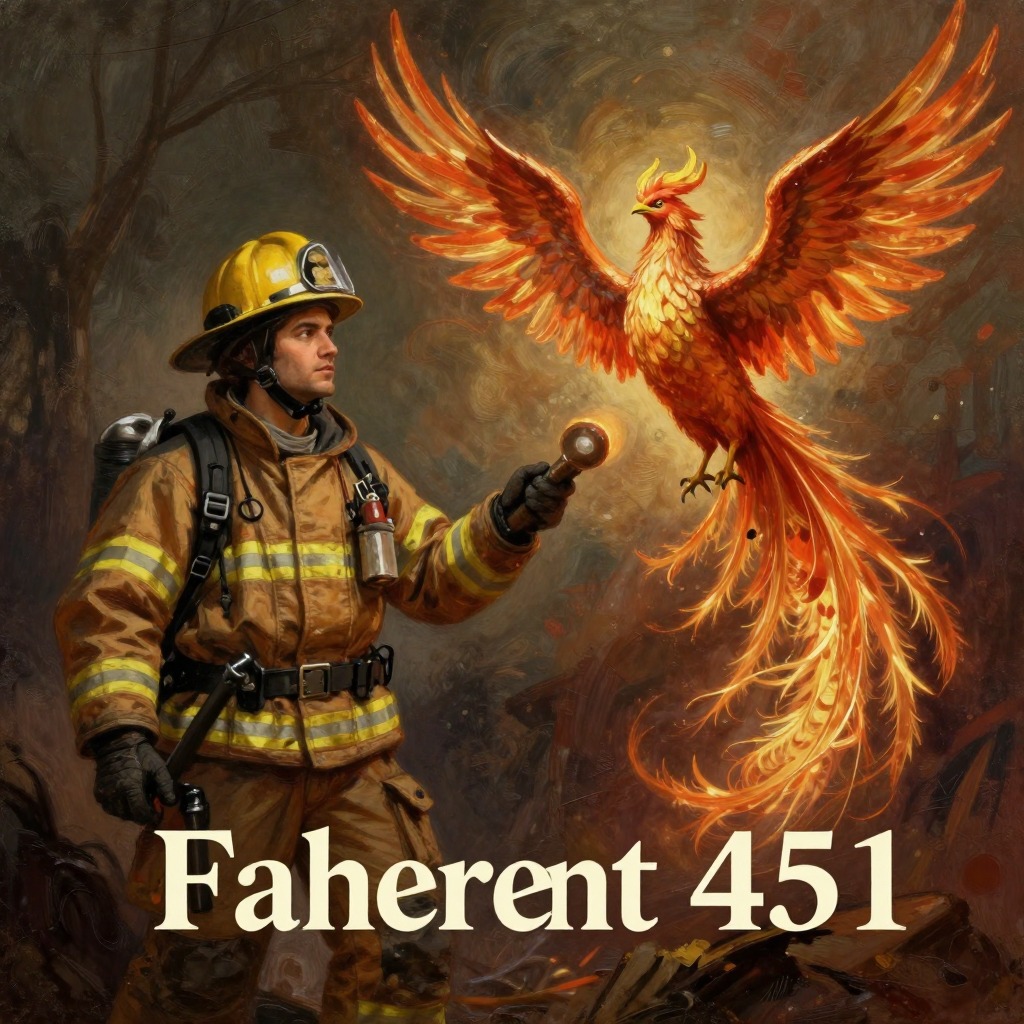
The Salamander is described as a "great salamander" and an "orange dragon" that "coughed into life" . Its color scheme is consistently associated with fire: the engine itself is a gleaming yellow-flame color with black, char-colored tires, as seen when Captain Beatty drives away in his personal "gleaming yellow-flame-coloured beetle" . The firemen wear the salamander as a badge of office: Montag puts on his "badge with the orange salamander burning across it" before going to work. The mythical salamander, a creature that could live in fire, is an apt symbol for the firemen, who are themselves immune to the flames they create. The Salamander is also a "Phoenix car" , linking it to the mythical bird that rises from its own ashes, a symbol that becomes increasingly important as the novel progresses. The machine is a "glittery brass tank" that carries kerosene, the fuel of destruction, in its belly.
Role in the Firemen's Work
The Salamander is the central tool of the firemen's trade. When an alarm sounds, the men "slid down the pole like a man in a dream" and the engine roars to life. The Salamander is described as a "gaseous dragon roaring to life" as it speeds through the streets, its siren screaming. The firemen ride on the engine, with Montag's "fingers jolting off the silver rail" as they race to their destination. The engine is a symbol of the firemen's power and their ability to bring destruction anywhere. It is also a source of pride and identity for Montag, who once felt a "special pleasure" in his work. The Salamander is the instrument of that pleasure, the "great python spitting its venomous kerosene upon the world" .
Montag's Changing Relationship with the Salamander
Montag's relationship with the Salamander mirrors his transformation from a loyal fireman to a fugitive. Initially, he is a part of the machine, sliding down the brass pole and riding the engine with a sense of purpose. He wears the salamander badge with pride. However, as he begins to question his work, the Salamander becomes a symbol of his oppression. When he is forced to burn his own house, he is ordered to do the job "all by your lonesome, Montag. Not with kerosene and a match, but piecework, with a flamethrower" . The Salamander is present at his own destruction, a witness to his fall. After killing Beatty, Montag realizes that the Salamander "would have to go, too" , and he destroys it. The machine that once carried him to his work is now an obstacle to his escape.
The Salamander as a Symbol of the State
The Salamander is not just a vehicle; it is a symbol of the state's power to enforce conformity. The firemen are the "Happiness Boys" , and the Salamander is their instrument of happiness, bringing the cleansing fire that eliminates dissent. The machine is a "great black bat flying above the engine" when Beatty drives it, a sinister image that underscores the oppressive nature of the firemen's work. The Salamander is also a tool of surveillance and control, as it is used to hunt down Montag after he becomes a fugitive. The machine is a "great nuzzling gout of flame" that destroys books and homes, a physical manifestation of the state's power to erase history and thought.
The Salamander's Destruction and Rebirth
Montag's final act of rebellion involves destroying the Salamander. After killing Beatty, he turns the flamethrower on the engine, symbolically destroying the old order. The Salamander, like the phoenix, is consumed by fire, but its destruction is not an end. It is a necessary step in Montag's journey toward a new life. The Salamander's destruction is a violent act of liberation, a rejection of the role he once played. The machine that once carried him to burn books is now itself burned, a fitting end for a symbol of destruction. The Salamander's destruction is also a prelude to the bombing of the city, a larger conflagration that will ultimately destroy the society that the Salamander served.