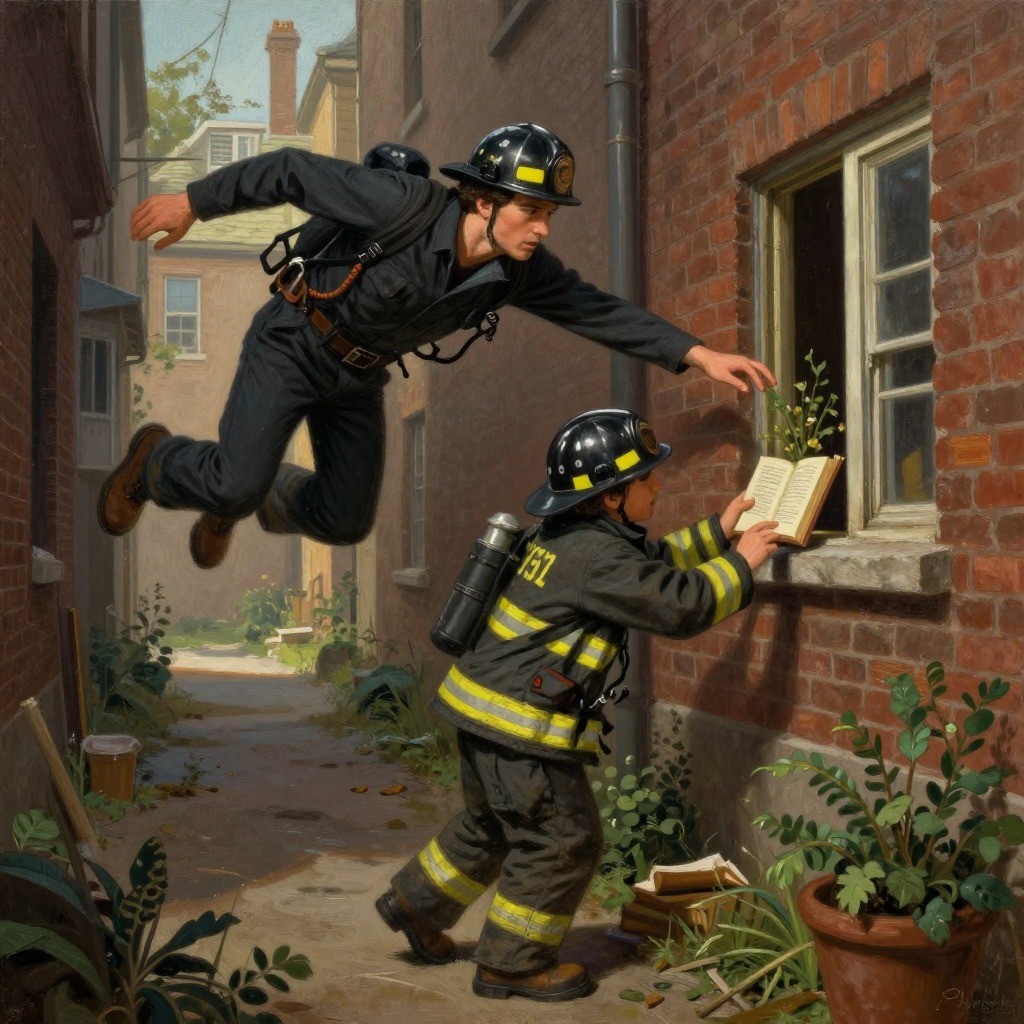
the alley
Fahrenheit 451The alley is a narrow, shadowed passage that runs behind the houses of Montag's neighborhood and extends into the wider city, a marginal space where the fugitive fireman hides books, evades pursuit, and confronts the consequences of his actions. It is a place of transition between the public, surveilled streets and the private, vulnerable backyards, and it becomes the physical and symbolic corridor through which Montag moves from his old life into the unknown.
Location and Character
The alley is defined by its darkness and its position at the edges of domestic space. It is where Montag, after hiding the books he has stolen behind the refrigerator, carries them into the backyard and conceals them in the bushes near the alley fence, hoping to keep them safe from Mildred's burning. It is also the route he takes when, after killing Captain Beatty and destroying the Mechanical Hound, he stumbles away from the ruins of his house, his leg wounded by the Hound's needle, and makes his way along the alley in the dark. The alley is a place of pain and desperation: each step sends a "shotgun blast" through his leg, and he weeps as he drags himself forward, cursing himself as a fool. It is a space where he is alone with his guilt and his physical suffering, a narrow channel of escape that offers no comfort, only the grim necessity of movement.
Key Events and Actions
The alley is the setting for several crucial moments in Montag's flight. After the burning of his house, he hobbles through the alley, carrying the four books that Mildred missed, and falls, sobbing, his face pressed to the gravel. It is here that he realizes the truth about Beatty: "Beatty wanted to die." The alley is also where he pauses to listen for pursuers, hears running feet in the far end, and forces himself to get up and continue. Later, after planting a book in the kitchen of a fireman's house, he returns to the alley and looks back at the dark, quiet house, knowing that the Salamanders will soon come to burn it. The alley is thus a space of repeated departure and return, a liminal zone where Montag's past and future collide.
Narrative and Thematic Significance
The alley functions as a counterpoint to the open, brightly lit boulevards and the enclosed, surveilled parlours of the city. It is a place of concealment and vulnerability, where Montag is hidden from the helicopters and the Hound but also exposed to the raw reality of his own body and conscience. The alley's darkness and narrowness mirror his psychological state: he is trapped between the life he has destroyed and the uncertain future he must create. It is also a space of memory and reflection, where he thinks of Clarisse, of Mildred, and of the chain of events that has brought him to this point. The alley, like the railroad tracks that later guide him out of the city, is a path of transition, but it is a harsh and unforgiving one, demanding that he confront his own weakness and resolve before he can move on.