the garden
Fahrenheit 451The garden is a small, private outdoor space adjacent to Montag's house that becomes a site of concealment, loss, and symbolic rebirth. Initially a place where Montag hides his stolen books, it later witnesses the collapse of his marriage and the destruction of his home, and ultimately serves as a threshold to the wilderness where he finds a new community.
Concealment and Discovery
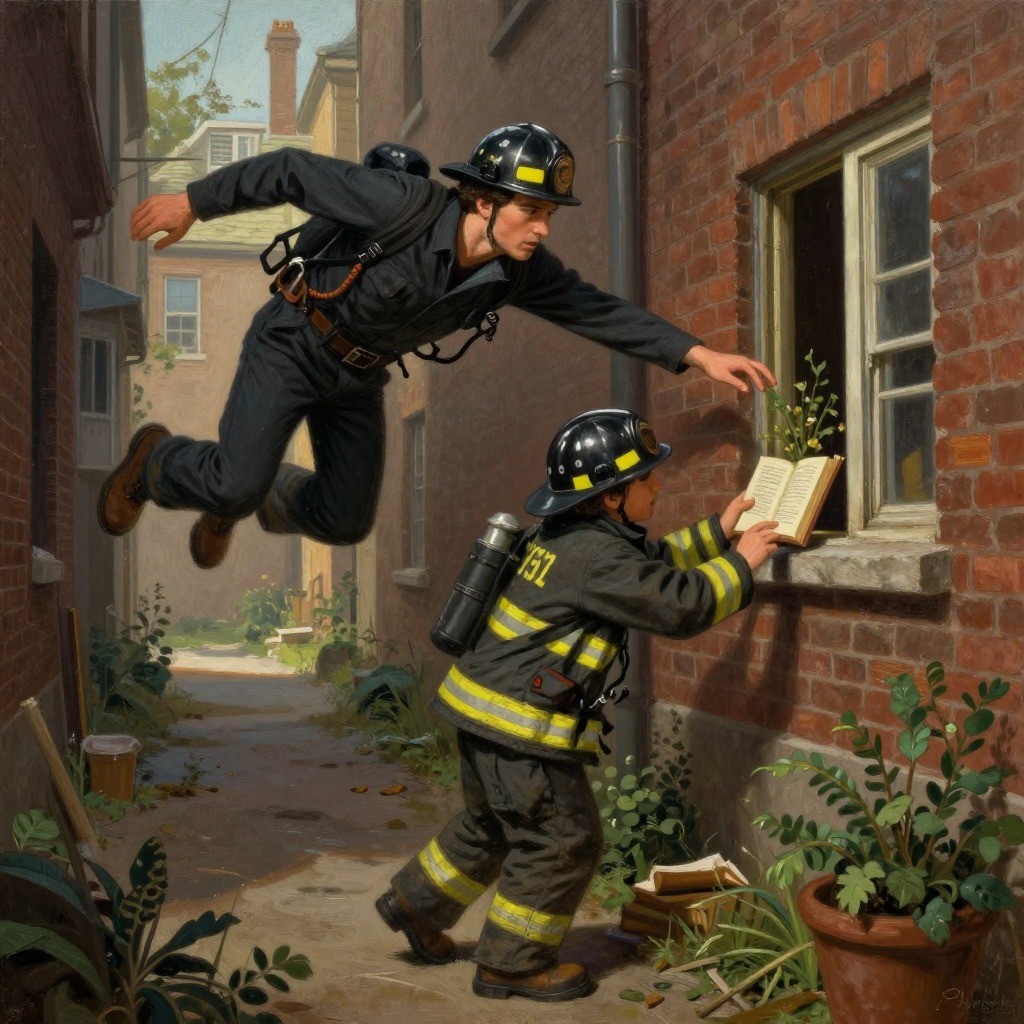
After the disastrous evening when Montag reads poetry to Mrs. Phelps and Mrs. Bowles, he searches the house and finds the books where Mildred has stacked them behind the refrigerator. Some are missing, and he knows she has begun her own slow process of dispersing the dynamite in the house, stick by stick. Not angry now, only exhausted and bewildered with himself, he carries the books into the backyard and hides them in the bushes near the alley fence, thinking, "For tonight only, in case she decides to do any more burning." The garden thus becomes a temporary refuge for the contraband that has already cost him his peace of mind. Later, after he has killed Captain Beatty and fled his burning house, Montag remembers the books and turns back. He finds a few books where he had left them, near the garden fence. Mildred, God bless her, had missed a few. Four books still lie hidden where he put them. The garden, in its modest way, preserves a fragment of the knowledge the city is determined to destroy.
A Place of Loss and Transition
The garden is also the setting for one of Montag's most painful realizations. When Clarisse McClellan asks him, "Are you happy?" she does so as she starts up her walk, and then she seems to remember something and comes back to look at him with wonder and curiosity. She runs off across the lawn, and Montag feels that she has run off with the mask of happiness he wore. The garden, with its lawn and flowers, is the boundary between his house and Clarisse's, and it is across this lawn that he later stands in the shadows, listening to the voices from her brightly lit house, thinking he might tap on their door and whisper, "Let me come in. I won't say anything. I just want to listen." The garden thus marks the distance between his world of enforced conformity and the world of genuine human connection that Clarisse represents. When Mildred betrays him and the firemen come to burn his house, Montag stands on the lawn, watching the flames consume everything he had. The garden, once a hiding place, becomes a stage for the final act of his old life.
Threshold to the Wilderness
After the bombing of the city, Montag and the other wanderers, including Granger, move along the bank of the river, going south. Montag tries to see the men's faces, the old faces he remembers from the firelight, lined and tired. He is looking for a brightness, a resolve, a triumph over tomorrow that hardly seems to be there. The garden, with its familiar boundaries of fence and lawn, is left behind as Montag steps into the vast, trackless country. The garden, which once held his secret books, now gives way to the railroad tracks and the forest, where he will become a living book himself. The garden is thus a transitional space: a place of hiding and loss that prepares him for the open road and the communal memory of the book people.