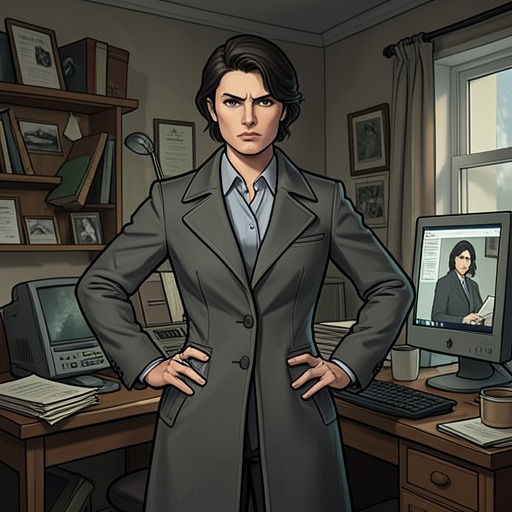
Aiden Pierce
Fake Dating Mr. CEO: A Billionaire, Enemies to Lovers RomanceAiden Pierce is the CEO of Pierce Publishing Inc., described from the outset as the largest publishing company in Manhattan and as an exceptionally difficult employer. His decisive significance lies in the contrast between the power he exercises at work and the vulnerability he struggles to express in love: the same man who can treat every threat as a corporate emergency must eventually admit that fear, pride, and mistaken judgment have damaged his relationship with Bianca Lily Summers. His trajectory is therefore both romantic and ethical, turning authority into a test of whether he can learn trust, responsibility, and open commitment.
Identity and Position
Aiden occupies the highest executive position at Pierce Publishing Inc. and has held the company’s reins for eight years, following the moment when his father handed the business over to him. That history places him within a family succession as well as a corporate one. His identity is closely tied to the publishing house’s prestige, scale, and competitive exposure, and his decisions are shaped by the expectation that he must protect what he inherited and built.
His material surroundings reinforce this image of command. At his eight-acre property, he begins one workday in a garage choosing between a Jaguar XJ and a Porsche Panamera. The Jaguar is not merely a luxury vehicle but part of a personal ritual: he drives it whenever Pierce Publishing Inc. unveils a new book, a tradition established after the publication of his first book under his leadership. The ritual links his private wealth, professional milestones, and carefully maintained sense of continuity.
To Bianca, however, Aiden’s authority first appears as aggression. She regards him as the “biggest bosshole known to women,” a judgment presented as an understatement rather than a passing complaint. Her job description had sought an assistant with little or no personal ties who could handle anything thrown at her, and the extremity of that requirement reflects the demands of working for him. Aiden is thus introduced through the pressure he creates around other people: he is not simply a successful executive but an employer whose temperament makes personal resilience part of the job.
From Employer to Reluctant Suitor
Aiden’s relationship with Bianca begins within an unequal professional structure. She is his assistant, while he controls the office and the terms under which she works. That imbalance gives their attraction an element of danger and complication, particularly because their growing intimacy cannot be separated from the workplace in which his authority operates. The relationship develops not through a clean change of setting but through repeated crossings between professional obligation and private feeling.
At one stage, Aiden adopts the name Hunter Huntington, a disguise Bianca immediately recognizes as unconvincing. She calls it the fakest fake name she has ever encountered and mocks the lack of effort behind it. His response is not a triumphant performance of secrecy; he effectively concedes that the situation is not his scene. The exchange punctures the formidable image surrounding Mr. Pierce. Behind the executive persona is a man capable of awkward improvisation, exposed by Bianca’s refusal to be impressed by status or concealment.
His direct proposal that Bianca become his girlfriend is equally abrupt. While driving her home, with Celine Dion’s “My Heart Will Go On” playing in the car, Aiden states the request without preparation or explanation. The bluntness suits his habit of dropping emotional demands with the force of a business decision, but Bianca responds by pretending not to have heard him and continuing to scroll through her phone. Her refusal to reward the suddenness of the approach establishes an important pattern: Aiden can issue commands, but intimacy cannot be secured by executive force.
Suspicion, Competition, and Misjudgment
Aiden’s protective instincts become inseparable from his suspicion when Mia Nolan establishes Emperor Penguin Publishing directly across from Pierce Publishing Inc. He confirms that Mia owns the rival company and immediately tells Bianca that the discovery is a serious problem. In his view, Mia may devise schemes legally and monitor every move Pierce Publishing Inc. makes if the company relaxes its vigilance. Bianca initially does not understand why the rival’s location should affect them, but Aiden insists that it affects everything they do going forward.
This response reveals how thoroughly competition governs his perception. A nearby office is not neutral space; it is a strategic position from which an opponent can observe, pressure, and outmaneuver him. His fear of Mia’s schemes may be grounded in the rivalry, but it also shows the cost of his defensive mindset. Aiden approaches uncertainty as something to contain, and that habit later becomes disastrous when he applies assumption instead of investigation to Bianca herself.
The private feelings he conceals from his family expose a different kind of conflict. When Emma Pierce asks who Bianca is, Aiden finally admits that Bianca is incredible, that they have worked together for almost three years, and that he has fallen for her more deeply than he ever expected. The confession is nearly whispered, suggesting that emotional disclosure is harder for him than corporate confrontation. Emma’s surprised but understanding response confirms that Bianca has become central to his inner life even before Aiden can publicly or fully acknowledge it.
Recognition, Apology, and Repair
Aiden’s most consequential change comes through an admission of failure. After Bianca confronts him about having had weeks to find and speak with her, he does not defend his absence. He calls himself a coward and explains that he watched the security footage she sent him; he also says that the footage will be placed in the police’s hands by the end of that day. The evidence matters because it converts his response from private regret into an action with institutional consequences.
He then recognizes the specific harm behind the separation. Aiden says that he should have trusted Bianca more and acknowledges that his assumptions clouded his judgment because he failed to investigate further. The apology is not a generalized declaration of sadness: it names the broken trust, identifies the mechanism of his mistake, and accepts responsibility for the consequences. His hands shake as he reaches toward her, a physical hesitation that contrasts with the decisiveness usually associated with his executive identity.
This recognition reframes earlier aspects of his character. The intimidating employer, the suspicious corporate strategist, and the abrupt suitor are not separate men, but versions of one person whose instinct is to control uncertainty. His development depends on recognizing that Bianca cannot be managed as a problem or protected through unilateral judgment. Trust becomes an active discipline requiring evidence, listening, and accountability rather than an assumption that his authority will eventually make matters right.
Proposal and Narrative Role
Aiden’s public proposal completes the movement from concealed feeling to visible commitment. He lowers himself onto one knee before a crowd, takes a small box from his pocket, and opens it to reveal the ring inside. The gesture reverses the hierarchy that defined his introduction: instead of standing above Bianca as her employer, he places himself in the vulnerable position of asking for her answer.
His proposal names the qualities he values in her, including her strength, resilience, and unwavering support through everything they have faced together. He says that he cannot imagine his life without her and asks her to become his wife. Bianca answers yes, repeating it with emphatic certainty. The ring therefore functions as more than a romantic object; it makes his changed priorities tangible and transforms private feeling into a public promise.
Aiden’s role in the narrative is built around the tension between power and dependence. He begins as the feared head of a major Manhattan publishing company, surrounded by cars, property, inherited responsibility, and professional rivalry. He ends as a man who must confess love to Emma Pierce, accept blame from Bianca, submit his assumptions to evidence, and ask rather than command. His romance is consequently also a maturation arc: the decisive victory is not simply winning Bianca’s agreement, but becoming someone whose apology and promise can carry moral weight.