Emperor Penguin Publishing Corporate War
Fake Dating Mr. CEO: A Billionaire, Enemies to Lovers RomanceThe Emperor Penguin Publishing Corporate War is the book’s central struggle over control of authors, reputation, and legitimacy in the publishing field. It begins when Mia Nolan brings Emperor Penguin Publishing to the building directly across from Pierce Publishing Inc., apparently to compete with her former colleague and ex-partner, Aiden Pierce. Her campaign quickly moves beyond ordinary rivalry: Pierce Publishing faces a plagiarism lawsuit, clients receive competing recruitment offers, authors are poached, and Aiden must defend not only revenue but the company’s claim to be a trustworthy literary institution.
Causes and Background
The conflict is rooted in the history between Aiden Pierce and Mia Nolan. Local gossip presents Mia’s decision to establish her company across from Pierce Publishing Inc. as deliberately personal, describing her as someone who came to compete with her former colleague and ex. The location gives the rivalry a physical intensity: Emperor Penguin Publishing is not a distant competitor but a neighbor positioned where its staff can observe and pressure Pierce Publishing’s operations.
Aiden verifies the rumor rather than relying on hearsay. After hearing that Mia owns the new company, he hides behind a pillar near the corner of Maddison Avenue, waits for Mia to leave in her car, and then asks the building concierge about the businesses operating there. The concierge confirms that Mia owns Emperor Penguin Publishing and that the company has only recently established itself in the building. This verification changes the situation from speculation into an immediate corporate threat.
The war also follows an earlier failure within the publishing industry: seven books have been plagiarized after Bengali originals were translated into English and presented as original works. The discovery exposes the weakness of searches limited to American and English-language novels. Aiden confronts the acquisition team in the conference room, demanding to know how seven plagiarized books escaped detection. That earlier scandal supplies the conflict with a wider institutional context: publishing authority depends on accurate research, language access, editorial diligence, and the ability to distinguish genuine cultural production from commercially repackaged work.
Opening Offensive
Once Mia’s ownership is confirmed, Aiden tells Bianca Lily Summers that the company across the street belongs to Mia and that the discovery affects everything Pierce Publishing does from that point onward. He expects Mia to monitor the company’s movements and exploit any lapse in vigilance while remaining technically within legal limits. The rivalry therefore operates through surveillance, timing, contractual pressure, and public credibility rather than through a single openly declared confrontation.
The first visible strike is a plagiarism lawsuit against Aiden. His longtime friend and business partner, Mark, calls after receiving an email asking what is happening. Aiden gives only the compressed explanation that Mia is in town, and Mark immediately understands the significance. Soon afterward, another client contacts Aiden about the same crisis and reports that a rival firm is offering authors an extravagant signing bonus while presenting itself as a legitimate and ethical company. The flood of correspondence makes the office feel like a war zone: the legal attack and the recruitment campaign arrive together, binding reputational damage to the practical threat of losing authors.
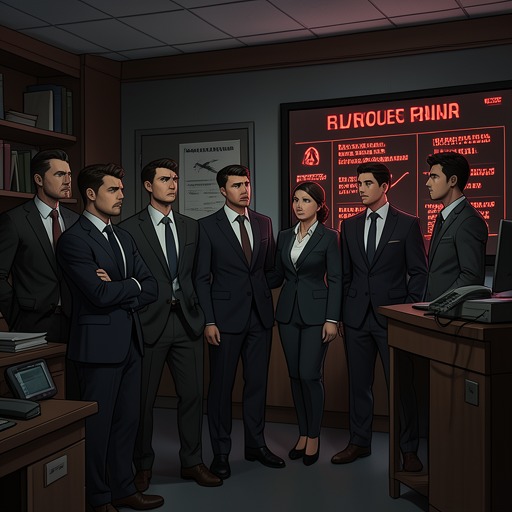
Mia also makes the conflict personal and theatrical. The concierge calls to report that a woman identifying herself as Aiden’s favorite person in the entire world has arrived to see him and gives her name as Mia Nolan. Her self-description converts their past intimacy into a public intrusion at the workplace. The encounter is followed by a tightly controlled response inside Pierce Publishing: the next morning, the head of IT and Legal, their assistants, and selected team members gather at six o’clock in the conference room for Aiden’s briefing. He orders those present to keep the matter quiet and identifies the immediate priority as repairing the company’s reputation in the eyes of its clients.
Recruitment and Counterstrategy
Aiden’s defense depends on competing for authors through more than money. When he approaches Leah Roberts, he offers a proposal in which 15 percent of Pierce Publishing’s profits will go to a charity of her choice. The offer is designed around Leah’s humanitarian commitments, which Bianca Lily Summers recognizes through an obscure logo in a photograph. Aiden frames literacy as a basic necessity rather than a privilege, presenting Pierce Publishing as an organization with a social purpose as well as a commercial one.
Leah reveals that Emperor Penguin Publishing has made another proposal whose incentive is slightly more impressive. Aiden recognizes the rival immediately and suggests that the issue goes beyond an ordinary flaw in Mia’s company. His approach turns the corporate contest into a struggle over the meaning of ethical publishing. Emperor Penguin offers financial attraction and exposure; Pierce Publishing attempts to answer with transparency, charitable commitment, and a claim that literary institutions owe something to readers and society.
This argument extends the book’s broader concern with the publishing chain. A manuscript must be found, researched, translated or evaluated, edited, contracted, promoted, and received by readers. The plagiarism discovery shows what happens when the research stage is narrowed too severely, while the corporate war shows how every later stage can become a site of competition. Authors are treated as clients whose allegiance can be purchased, but Aiden’s counterstrategy insists that loyalty can also be rebuilt through direct contact, institutional responsibility, and renewed creative work.
Crisis and Reversal
The rival campaign produces measurable damage. Dwayne Jameson tells Aiden that writers are leaving Pierce Publishing one after another because they have decided to take their business elsewhere. When Aiden asks why, Dwayne explains that Emperor Penguin Publishing has poached them. The loss threatens a major source of revenue at the same time that the economy is struggling and competition across the industry is intensifying. Aiden feels the responsibility as a corporate leader: retaining the remaining staff becomes a matter of protecting the company’s future rather than merely winning an argument with Mia.
The crisis is especially severe because Aiden believes he has already tried to prevent Mia from contacting his staff. Her continued success suggests that ordinary defensive barriers are insufficient. Emperor Penguin’s offers combine competitive pricing, appealing perks, and promises of greater exposure, giving uncertain writers practical reasons to leave even if they have no personal commitment to Mia. The conflict therefore exploits both resentment and economic insecurity, making the rival’s campaign difficult to defeat through moral condemnation alone.
The war also exposes a contrast between the two companies’ methods. Aiden regards Mia’s tactics as underhanded and barely legal, yet he refuses to answer by adopting the same standards. His restraint is strategic as well as ethical: if Pierce Publishing responds through intimidation or equivalent manipulation, it risks surrendering the very legitimacy it is trying to preserve. The company’s reputation becomes both the object of the attack and the instrument of its defense.
Recovery and Continuing Conflict
Over the following weeks, Aiden and Bianca Lily Summers contact departing writers personally. They reassure each author of Pierce Publishing’s commitment and offer new incentives to encourage a return. The response is mixed at first, but their refusal to abandon the effort gradually changes the balance. Writers who had left for Emperor Penguin Publishing begin returning because they are drawn to Pierce Publishing’s renewed energy and dedication.
The recovery is not limited to staff retention. Aiden and Bianca Lily Summers revise the company’s content strategy, introduce fresh ideas, explore new genres, and accept creative risks intended to recover the audience’s attention. Clients notice the changes, and new clients begin arriving because they want to join the revitalized brand. As contracts and confidence return, revenue increases, finances stabilize, and Pierce Publishing can invest in additional talent and resources.
The improvement does not end the corporate war. Emperor Penguin Publishing remains a formidable opponent and continues devising ways to attract authors. Its competitive prices, enticing benefits, and promises of wider exposure still appeal to writers who are uncertain about Pierce Publishing’s future. The ending is therefore a recovery rather than a final victory: Pierce Publishing survives the first major offensive, but its position must be maintained through continuing work, ethical discipline, and attention to the needs of authors and readers.
Narrative Significance
The corporate war gives commercial rivalry the structure of a personal feud while preserving its institutional consequences. Mia Nolan’s presence turns an old relationship into a campaign conducted through neighboring offices, legal pressure, author recruitment, and public claims of legitimacy. Aiden Pierce’s response demonstrates that the decisive contest is not simply between two executives but between competing models of publishing: one built around aggressive leverage and another seeking to connect profit with responsibility.
The conflict also proves a clear cause-and-effect premise: when publishing institutions treat trust, research, and relationships as expendable, failures in one part of the literary system create openings for larger attacks. The seven-book plagiarism scandal reveals editorial negligence; Mia’s campaign weaponizes the resulting vulnerability; the loss of writers threatens the company’s finances; and recovery becomes possible only when Aiden reconnects institutional reputation to concrete actions, including personal outreach, creative renewal, and the literacy-centered charitable proposal to Leah Roberts.
In that sense, the war is both a business crisis and a test of values. Pierce Publishing cannot rely on its past success or its formal defenses. It must prove its legitimacy repeatedly, in front of authors deciding where to sign, clients judging whether to remain, employees watching the leadership response, and readers whose confidence gives publishing its ultimate purpose. The rival company’s proximity keeps that test permanently visible, while Aiden’s refusal to stoop to Mia’s methods turns survival into an ethical choice as well as a commercial one.