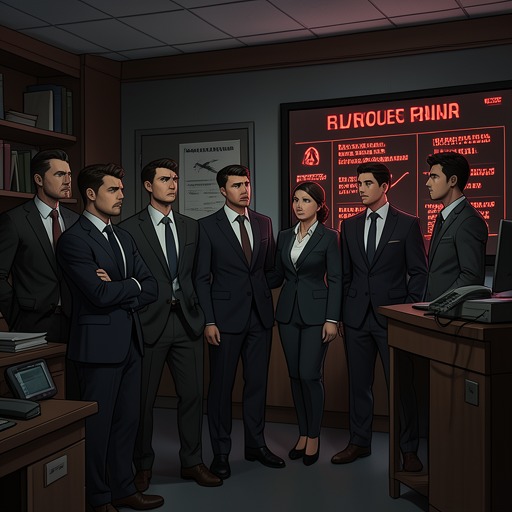
Publishing company competition
Fake Dating Mr. CEO: A Billionaire, Enemies to Lovers RomancePublishing-industry rivalry is not merely background competition in the book; it is a force that reorganizes professional loyalties, exposes institutional weaknesses, and turns literary judgment into a contest over authors, legitimacy, and public trust. The rivalry between Pierce Publishing Inc. and Emperor Penguin Publishing begins as a personal and commercial threat from Mia Nolan, then expands into an industry-wide battle in which manuscripts, signing bonuses, charitable commitments, plagiarism allegations, and reader recognition become competing forms of power.
Origins and Structure
The conflict becomes visible when Aiden Pierce learns that the new publishing firm across from Pierce Publishing Inc. is owned by Mia Nolan, his former colleague and ex. A couple at Nora’s Kitchen describe Mia’s decision as a deliberate attempt to compete with Aiden, and Aiden’s own knowledge of Mia leads him to expect a campaign that will be anything but civilized. He verifies the rumor by waiting for Mia to leave the building and asking the concierge to confirm that she owns Emperor Penguin Publishing, which has only recently established itself there. The physical arrangement matters: the rival is not an abstract corporate presence but a company positioned directly across from Pierce Publishing Inc., close enough to watch and respond to its every move.
Aiden immediately interprets Mia’s arrival as a strategic danger. He tells Bianca that the new company affects everything Pierce Publishing Inc. will do from that point forward because Mia can devise schemes while remaining within the law and may monitor the company’s every move. The rivalry therefore operates through surveillance, anticipation, and defensive maneuvering as much as through the publication of books. The neighboring offices create a compressed arena in which commercial competition acquires the intimacy and volatility of a personal feud.
Manuscripts, Gatekeeping, and Institutional Failure
The book presents competition through the entire chain by which writing becomes a marketable book. Aiden’s own editorial routine reveals the gatekeeping power of a major publisher: he sits in his office with an Armani briefcase nearby, drinks coffee, and sorts through a mountain of manuscripts. Yet that system is shown to be fallible. For years, a manuscript titled Rendezvous at Midnight by Eve Calloway has been repeatedly slipped into his pile under different names, demonstrating how an unpublished work can circulate through editorial procedures while remaining outside the official list of materials he is supposed to review.
The same institutional weakness becomes more damaging when Nadia Rahman’s work is discovered among Amber Finley’s supposed originals. Nadia’s seven books were all published in Bengali, and Amber had translated them into English and presented them as her own. The breach exposes a narrow model of editorial verification: searches had been limited to America and novels published in English. Aiden condemns the acquisitions team for allowing seven plagiarized books to pass undetected, not because one isolated mistake occurred, but because the company’s method systematically excluded literature outside its chosen linguistic and geographic field.
That failure converts rivalry into a reputational and financial crisis. Nadia Rahman sues Pierce Publishing Inc. for fourteen million dollars and demands a public admission and apology. Amber offers approximately five million dollars from her savings and promises to claim sole responsibility, but Aiden rejects the idea that the company can plausibly escape blame after publishing seven novels. The scandal shows that a publisher competes not only by finding successful writers but also by maintaining the credibility of its selection process. Once that credibility is damaged, the company’s commercial identity is threatened along with its legal position.
Poaching and the Battle for Authors
Emperor Penguin Publishing’s most direct attack is its recruitment of Pierce Publishing Inc.’s writers. Dwayne Jameson reports that authors are leaving “left and right” because they have decided to take their business elsewhere, and he identifies the cause plainly: Emperor Penguin has poached them. The losses are not symbolic. Aiden understands that losing writers means losing a significant portion of the company’s revenue, while a struggling economy and fierce industry competition intensify the pressure.
The poaching campaign is accompanied by aggressive financial incentives. Aiden receives emails from clients asking about another firm’s unusually large signing bonus and its claim to be a “legit and ethical” company. The language of ethics becomes part of the competitive branding, allowing Emperor Penguin to present itself not simply as a higher bidder but as a morally preferable alternative. Aiden’s reaction suggests that he sees the campaign as an escalation into open conflict, while the flood of messages shows how quickly a rival’s offer can destabilize existing relationships between publisher and author.
The struggle also reveals the limits of defensive control. Aiden believes Pierce Publishing Inc. has blocked Mia from contacting his staff, yet writers continue to leave. Competition moves through professional networks and individual decisions that corporate barriers cannot fully contain. Authors are treated as the central resources of the publishing business, but their movement also gives them leverage: the company’s income, prestige, and future catalog depend on retaining people who can transfer their creative and commercial value elsewhere.
Counterstrategy and the Conversion of Values into Leverage
Aiden responds by competing for major publishing opportunities rather than relying only on institutional protection. When he approaches Leah Roberts, he brings a detailed proposal and uses knowledge of her private humanitarian commitments to shape the offer. Pierce Publishing Inc. promises to donate fifteen percent of its profits to a charity of her choice, framing literacy as a basic necessity rather than a privilege. The proposal makes social purpose part of the commercial contest and presents the publisher as capable of converting financial success into public benefit.
The offer is also calculated. Leah Roberts has another proposal whose incentive is superior, and Aiden recognizes that it likely comes from Emperor Penguin Publishing. His advantage is not simply a larger sum but information: he has researched Leah’s commitments and can offer a partnership aligned with them. The scene makes publishing rivalry a contest over both economic capital and cultural legitimacy. A company can bid for an author with money, but it can also compete by claiming a more persuasive relationship to literacy, charity, and the public role of books.
Aiden’s broader commercial identity rests on the same mixture of authority and reader-centered legitimacy. He insists that writers depend on readers and argues that access to the chief executive gives Bianca a responsibility to promote her friend’s work, while still requiring a detailed reading before making a professional judgment. That tension is central to the field: personal advocacy can open a door, but editorial approval is supposed to remain a separate act of evaluation. The book repeatedly tests whether publishers are mediators of literary value or brokers who turn access, reputation, and personal connections into competitive advantage.
Consequences and Narrative Significance
The rivalry ultimately makes the publishing company a battlefield in which every weakness can become an opponent’s opportunity. Mia Nolan’s presence across the street produces suspicion before any specific maneuver is confirmed; the signing-bonus campaign turns suspicion into direct commercial pressure; and the loss of authors makes the threat measurable in revenue and institutional survival. Against that pressure, Pierce Publishing Inc. relies on research, strategic proposals, brand reputation, and the promise of ethical or humanitarian commitments.
The book nevertheless refuses to separate commercial success from moral accountability. Pierce Publishing Inc. has access to influential authors and a history of achievement, including a book that reached the New York Times bestseller list, was named Oprah Winfrey’s best read of 2014, and sold more than ten million copies worldwide. Such success produces symbolic capital and family pride, but the plagiarism scandal shows how quickly prestige can become liability when the systems beneath it fail. The same public visibility that attracts authors and readers also magnifies legal and reputational damage.
The final contrast is between institutional competition and the reader relationship that gives publishing its purpose. At Bianca’s book celebration, fans approach her in an elegant ballroom, and she takes time to thank them and sign their copies. Their enthusiasm demonstrates that books ultimately circulate through readers, not only through corporate strategies. Publishing rivalry determines who controls manuscripts, contracts, and promotion, but reader recognition remains the resource that makes those contests worthwhile. In this sense, the conflict drives the plot while also exposing the industry’s governing paradox: publishers compete to possess literary value, yet that value is confirmed publicly by people no publisher can completely control.