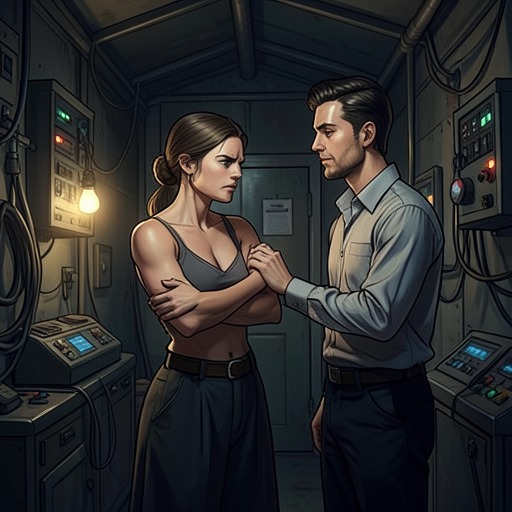
Diana Jones's claustrophobia
Falling For The CEO: BAD BOY ROMANCEDiana Jones's claustrophobia is a fear of enclosed spaces that turns the elevator power outage into both a physical emergency and an exposure of her deeper vulnerability. The condition makes breathing difficult when escape is impossible, yet the narrative places it beside attraction, grief, family history, and dependence, showing that confinement is not merely a situational inconvenience but a pressure point in Diana's emotional life.
Definition and First Manifestation
Diana's fear is revealed when the elevator carrying her and William King stops abruptly and the lights go out. She loses her balance, strikes the back of her head, and is lowered to the floor in William's arms. After the initial dizziness, she recognizes that the enclosed space itself is making her feel unable to breathe. She tells William, "I'm a little...claustrophobic," identifying the condition directly rather than disguising all of her distress as the result of the injury.
Her immediate symptoms include heavy breathing, unsteady knees, dizziness, and the need to regulate each breath deliberately. She insists that she is all right and explains the injury as merely "a bump on the head," while reminding herself to inhale and exhale slowly. This partial minimization does not erase the fear; it shows her trying to maintain control while the darkness and lack of escape threaten to overwhelm her.
The Elevator Crisis
The outage intensifies Diana's claustrophobia through a combination of darkness, uncertainty, and delayed rescue. William's phone provides only a dim light, and he has no reception. Diana therefore points out the red emergency button, helping them contact the hotel through the intercom. The hotel explains that the entire grid has lost power and that the generator has also failed, leaving them potentially trapped for up to thirty minutes.
The scene makes the elevator a confined chamber in which fear and intimacy become difficult to separate. Diana's breathing eases only when she avoids concentrating on being trapped, and she does not trust her knees enough to stand. William's physical proximity is simultaneously reassuring and overwhelming: he has caught her, but his presence, scent, and closeness heighten her bodily awareness. Her fear thus operates alongside attraction rather than replacing it, creating an unstable mixture of panic, embarrassment, dependence, and desire.
Diana also tries to redirect attention toward the imagined panic downstairs, asking about what is happening beyond the elevator. The effort is a form of mental escape when physical escape is unavailable. The enclosed space narrows her world to breath, darkness, bodily balance, the emergency control panel, and William's concern, while her comments about the wider hotel attempt to restore an ordinary social perspective.
Origins in Loss and Abandonment
The text connects Diana's vulnerability to the deaths of her parents in a car crash. Their deaths occurred the day before her final first-year university examination, and although she forced herself to sit the exam and appeared to manage the funeral, she later fell into deep depression. She lost a university scholarship and several friendships after failing to return for her second year, entering a period she remembered as months of complete chaos.
Her fear of enclosed spaces is therefore presented within a larger history of being left without the people who had made the world feel secure. Six years after her parents' deaths, she still feels that she has not fully grown into independence and admits that she feels alone and abandoned, even though she knows her parents did not leave her willingly. The claustrophobic crisis gives bodily form to that contradiction: she understands intellectually that abandonment was not intended, yet her body reacts as though being trapped and left alone are immediate dangers.
Diana's family history reinforces this pattern. Connor Jones is her brother and becomes the person who intervenes after the crash, refusing to leave her at home and bringing her to work at the hotel. Their father, Derek Jones, had also been left to care for Connor after Luna Jones, diagnosed with bipolar disorder, divorced him and left the child with him. The narrative does not establish that Diana's claustrophobia is medically inherited from this history; rather, it places her fear in a family story marked by illness, disrupted caregiving, bereavement, and the recurring threat of someone important disappearing.
Coping, Dependence, and Relationships
Connor's intervention helps Diana recover a working life. He brings her into the hotel, asks Kate and the other concierges to train her, and later arranges a trial period in which she plans trips for guests. Her enjoyment of communication, city research, and guided tours allows her to begin living again rather than merely surviving. Work becomes a structure that counters depressive collapse, but the continuing importance of Connor also reveals how much her stability depends on a relationship formed through rescue and caretaking.
This emotional dependence affects her relationship with William. At first, she refuses to pursue him because he is Connor's boss and her own employer, saying that she cannot become involved with him. Later, William discovers that Diana herself works at the hotel and interprets her concealment through the wound left by Julia Brown's deception. Diana's fear of exposure and William's distrust produce a cycle in which both withhold information while fearing the consequences of abandonment or betrayal.
The relationship between physical confinement and relational confinement becomes especially clear after William learns that Diana has hidden her employment status. He feels that she lied to him just as Julia did, while Diana later understands that her hesitation was rooted in more than job insecurity. The deaths of her parents had planted a fear of being alone, and the prospect of losing a promising relationship threatens to reopen that earlier wound. Her claustrophobia thus belongs to the same emotional pattern as her difficulty trusting intimacy: closeness can protect her, but dependence also makes separation terrifying.
Narrative Significance
Diana's claustrophobia is used as a concrete psychological state rather than a decorative trait. The elevator scene makes inner distress observable through breath, dizziness, unstable knees, and the search for an emergency button. It also creates a controlled setting in which William must respond to her vulnerability and Diana must acknowledge it aloud.
The condition carries a broader metaphorical force without ceasing to be physically real. Diana is confined by the elevator, by grief, by fear of being left, and by the workplace boundary separating her from William. The mountain that usually makes her feel small but peaceful cannot calm her during the later storm; she feels like the turbulent sea inside her. That contrast links the external landscape to an internal state in which familiar sources of perspective no longer provide relief.
William's own unresolved relationship trauma parallels Diana's fear. Gloria explains that he has not dealt with the pain caused by Julia and has instead allowed it to follow him into his relationship with Diana. Her advice is that he must acknowledge the pain and wrongdoing before love can help him move beyond it. In this structure, Diana's claustrophobia and William's distrust are different expressions of unfinished injury: one produces bodily panic in enclosed space, while the other produces emotional suspicion in intimate space. Both must be recognized rather than denied if their relationship is to become more than another repetition of abandonment and betrayal.