Diana Jones's job insecurity
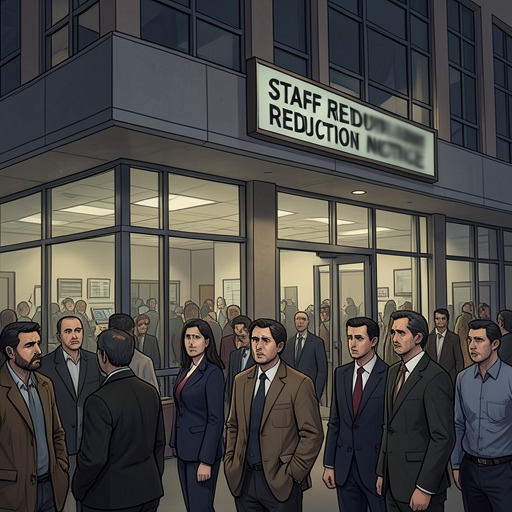
Falling For The CEO: BAD BOY ROMANCEDiana Jones's job insecurity is not a minor workplace worry but a central condition of her emotional life. When William King arrives at the Grace Hotel to reduce staff, Diana immediately believes that her position is among those most vulnerable. The threat is intensified by the fact that the job rescued her from the chaos following her parents' deaths, so the possibility of dismissal feels like the possible loss of her independence, routine, identity, and future all at once.
Definition and Immediate Cause
Diana's fear begins with the hotel's downsizing policy and William's appointment as its new general manager. At the welcoming event, she learns that the man she has been flirting with is William King, the executive who has come to trim the staff. The discovery changes him in her eyes: a possible romantic partner becomes the boss who may decide whether she remains employed. She leaves the event in embarrassment, conscious that she has flirted with the person she expects to fire her and that their future encounters will therefore be awkward as well as professionally dangerous.
The insecurity is made more concrete by the unusual nature of Diana's position. Connor Jones created the role of Specialised Concierge for her, and Diana worries that William will regard it as unnecessary. Even if Connor's decision was ethically defensible, she reasons, the existence of a role that the hotel may not need gives William an obvious justification for eliminating it. Her fear is therefore not simply a general anxiety about retrenchment: it is attached to the precarious institutional status of a job that was specially designed around her abilities.
Work as Recovery and Identity
The force of the threat comes from Diana's history. After the car crash that killed her parents, she fell into such severe disorder that she lost a university scholarship and several friendships and could not motivate herself to return for her second year. Connor eventually came to her home and refused to leave until she accompanied him to work. For the first month, she went mainly to avoid feeling guilty about keeping him from his own job, but the hotel gradually gave her a way back into ordinary life.
Diana discovered that she liked communicating with guests, entertaining them, and advising them about Cape Town. Connor first arranged a trial period in which she planned excursions, and the response was strong enough for him to authorize her to concentrate on that work. She researched Cape Town's history and culture in depth, led guests through the city, and learned to live rather than merely survive. Her job insecurity consequently threatens a recovery achieved through daily practice. The fear is not only that income will disappear; it is that the structure that taught her to face each morning may be removed.
Fear, Secrecy, and William King
Diana's employment anxiety governs her romantic choices. Before a date with William, she recognizes that fear is the simple explanation for her evasiveness. She has relied so heavily on the job that she does not know whether life would still feel purposeful without it, yet she also understands that she must become more than her work. Her attraction to William makes honesty harder, because revealing that she is his employee could expose both her job and the relationship she has begun to value.
At first, Diana presents the conflict as a matter of professional boundaries. When William asks when he will speak to her again, she tells him that their relationship is a bad idea because he is Connor's boss, while withholding the equally important fact that he is her own boss. The distinction shows how insecurity distorts an otherwise truthful person: she does not invent an elaborate scheme, but she suppresses the fact most likely to change William's judgment of her.
William eventually discovers the truth through the hotel's employee files. While reviewing staff profiles and photographs, he recognizes Diana and realizes that her office is her workplace. He concludes that her explanation was a lie and connects it to his earlier experience with Julia. Diana then fears that William sees her as someone who deliberately deceived him to protect her employment. She knows that her motives changed during the relationship, but William can only see that the concealment began while his decision-making power over her job remained in the background.
Professional Competence and Value
Diana's conduct as a concierge provides the strongest evidence against the assumption that her position is dispensable. She knows the city's landmarks and histories so thoroughly that she can explain them even while distracted by concern over William's opinion. On a tour for Jasmine and Dorian, she guides the visitors to the Bo-Kaap Museum and explains that the abolition of slavery in 1834 was followed by the area's occupation by now-free Muslim people. She also describes the museum's later design as resembling a typical Muslim home of the nineteenth century and directs attention to the surrounding colourful houses.
Her work combines information, interpretation, and careful attention to individual guests. She recommends the Bo-Kaap food market as a place where Jasmine and Dorian can find both good food and people willing to discuss their research. She notices Dorian's discomfort, gives him permission not to participate, offers to answer questions by email, and waits until he approaches her on his own. His eventual thanks for an enlightening tour confirms the personal effect of her method. Diana does not merely deliver a standard itinerary; she adapts the experience so that an enthusiastic guest and a shy one can both find a place within it.
The job also gives Diana a reciprocal relationship with the city. She enjoys meeting people from different backgrounds, learning from their stories, and showing them one of the world's most beautiful cities. Familiar sights do not become empty through repetition because she sees them again through visitors' eyes. This capacity to renew a place for others is both an emotional vocation and a practical form of value that the hotel's efficiency calculations risk overlooking.
Consequences and Significance
Diana's job insecurity converts workplace hierarchy into a problem of trust. William is simultaneously an unknown man, Connor's employer, Diana's employer, and the person whose affection she hopes to retain. Connor's protection helped create the position and earlier forced Diana back into work, but his intervention also leaves her feeling exposed: she cannot rely indefinitely on the brother who arranged the role, especially when the new manager may judge it unnecessary.
The insecurity also reveals the unequal power behind the romance. Diana worries that William could mistake her affection for a strategy to preserve her employment, while William interprets her concealment through the wound left by Julia's deception. The result is a shift from attraction to suspicion, even though Diana's feelings become genuine. Her later distress is tied to both losses at once: William has withdrawn from her, and his withdrawal confirms her fear of abandonment as well as her fear that professional dependence has made her untrustworthy.
Yet the narrative gives Diana a resource stronger than the job's formal title: demonstrated competence, cultural knowledge, and an ability to make guests feel welcomed without erasing their differences. Her insecurity therefore functions as a measure of what is at stake when an institution treats efficiency as the only form of value. The position may have begun as Connor's intervention, but Diana turns it into meaningful work through research, emotional labour, and sustained attention. Her central challenge is to preserve that recovered sense of self without allowing employment, family protection, or romantic approval to become the sole proof that her life has purpose.