Fear of abandonment
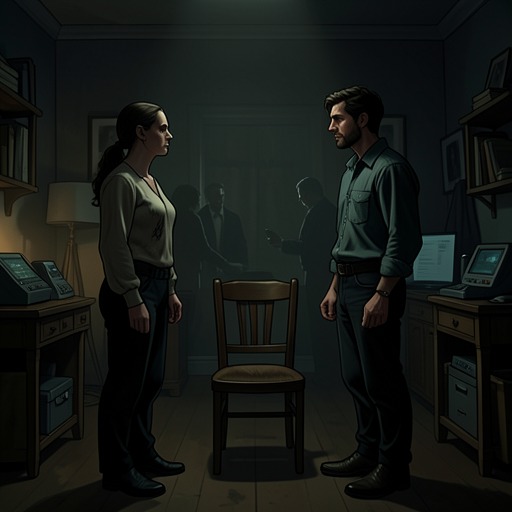
Falling For The CEO: BAD BOY ROMANCEFear of abandonment is the emotional pattern that connects the novel's family histories with its central romance. For Diana Jones, the deaths of her parents leave an enduring wound that makes separation feel like a return to catastrophe; for William King, his mother's departure establishes an earlier model of being left by someone who should have remained. Their love therefore carries more than present attraction. Each person responds to intimacy through the memory of a previous loss, and the relationship becomes a test of whether love can be trusted without being used as protection against solitude.
Origins in Loss
Diana Jones's fear is rooted in the car crash that ended the lives of Cora Jones and Derek Jones. Her parents died just before her final first-year examination, yet she insisted on writing it, holding herself together through the funeral and the immediate support of relatives. The deeper collapse came afterward, when the coffins had descended into the ground and everyone else returned to ordinary life. She lost a university scholarship, several friends, and the motivation to return for her second year. The delayed nature of the grief matters: public farewell does not end private abandonment, and the absence becomes most powerful once communal attention has moved elsewhere.
Cora Jones had represented unconditional care, while Derek Jones had loved her with an intensity that confirmed Diana's belief in the security of her family. Their deaths were therefore not merely bereavements but the destruction of the structure in which she had understood herself. Six years later, she can acknowledge that her parents did not leave willingly, yet she still feels that they left her. The distinction between intention and experience does not remove the wound. Her fear is produced by the fact of absence, not corrected by the knowledge that the absence was accidental.
The family history of Connor Jones gives Diana another vocabulary for abandonment. Connor's mother, Luna Jones, left after her bipolar diagnosis and divorce, leaving Connor with Derek Jones when he was still young. Diana believes that Connor's experience helped make him family-oriented and explains why he became such a dependable older brother. The parallel is painful: Connor was abandoned by a living mother, while Diana lost both parents through death, but both histories teach the same lesson about the sudden removal of a primary bond. Their differing responses also shape the siblings' relationship. Connor builds a life and brings Diana into it; Diana remains grateful for that care while fearing that his independent life may eventually leave her behind.
Work as Recovery and Shelter
Connor Jones's intervention gives Diana a practical route back into life. After recognizing that grief had left her in chaos, he effectively forces her to accompany him to work at the hotel, refusing to leave her house until she agrees. The arrangement begins in guilt rather than vocation: Diana goes because she does not want to keep Connor from his job. Yet the hotel gradually becomes a recovery structure. With help from Kate and the other concierges, she discovers that she enjoys communicating with guests, advising them about Cape Town, and planning excursions.
Connor establishes a trial period for Diana's proposed tour work after hearing how much interest it has generated. The experiment becomes popular, and she receives permission to specialize in guiding guests through the city's history and culture. Researching Cape Town in depth transforms the city from a backdrop into a field of knowledge and activity. Her tours require her to move toward other people, respond to both pleasant and difficult guests, and remain useful in the present. Before meeting William King, this work has already enabled a movement from merely surviving to living again.
That recovery remains vulnerable when William's professional decisions threaten the security of the hotel and Diana's job. In her conflict with Connor, she admits that she is afraid of losing her employment and resents needing him to save her. The fear of abandonment thus overlaps with job insecurity: employment is not only income but the place where she rebuilt a functioning identity. When she later calls in sick and remains alone at home, she uses television noise to avoid feeling entirely deserted, while her remembered dependence on Connor exposes how far independence still feels from her.
Fear Inside the Romance
Diana's attraction to William begins under a boundary that makes intimacy dangerous: he is Connor's boss and also her own superior. She initially tells him that their relationship is not a good idea because she cannot become involved with her brother's employer. Even while she tries to withdraw, his taking her hand and squeezing it produces an immediate bodily reaction, showing how desire and self-protection operate at once. The fear is not simply fear of love; it is fear of the consequences that love could bring if the professional relationship collapses.
When William learns the truth about her connection to the hotel, Diana's anxiety becomes the reason she failed to disclose it earlier. She realizes that she was afraid he would leave if he knew, although she had never understood herself as dishonest. In her mind, the original motive may have involved protecting her job, but her feelings changed the meaning of the concealment: William had become one of the most important people in her life, and the prospect of losing him made her act out of character. She knows that he may see her as someone who deliberately deceived him for personal gain, while she experiences the secrecy as a frightened attempt to keep a new attachment from disappearing.
The resulting separation reopens the older wound. Diana experiences William as another person who has abandoned her, even though his withdrawal follows a conflict rather than a literal departure. Her grief over her parents supplies the emotional scale by which she measures the present loss. She recognizes that the holes created by earlier deaths have only been patched, not erased, so the rupture with William feels like another opening in the same place. Her anger that he did not fight for her and her late realization that she had not properly apologized show how fear can turn pain outward before it can be understood inwardly.
William King's Inherited Pattern
William King carries his own abandonment history into the relationship. His parents divorced because his mother did not want children, and she remained only until he was ten before deciding that she could no longer continue as a parent. He hears from her only on his birthday, if she remembers. The irregularity is crucial: the connection is not entirely severed, but it is unreliable enough to keep the possibility of being forgotten permanently active. William's father and stepmother provide a contrasting household, yet the earlier departure remains part of the way he approaches romantic trust.
William's response is shaped further by his marriage to Julia. He believes he loved Julia, but the relationship left him feeling burdened, and he associates its dishonesty with the final collapse of the marriage. When Diana's secret emerges, he reacts not only to her actions but through the injury caused by Julia. He initially treats the situation as proof that another woman is untrustworthy, repeating the judgment formed by his previous relationship rather than attending to Diana's particular explanation. His unresolved trauma turns present uncertainty into evidence of an old pattern.
Later, William recognizes that his anger has been directed partly at himself for trusting someone he considered as unreliable as the women who came before. He also recalls checking at night that his father was still there after his mother's departure. This childhood behavior clarifies why Diana's fear is intelligible to him once he stops defending himself. Her parents' deaths occurred when she was older, but William understands that the loss of someone deeply loved can feel catastrophic at any age. The insight does not excuse the harm caused by his suspicion, but it breaks the assumption that their fears are unrelated.
Recognition, Separation, and Healing
William's realization that he loves Diana changes the meaning of the conflict. He contrasts his feelings for her with his relationship with Julia: love with Julia had felt oppressive, whereas being with Diana feels like breathing freely on the first day of spring. He regards Diana as kind, caring, genuine, and unable to counterfeit the light he sees in her. This recognition allows him to believe that her fear was real, even though he had previously interpreted her silence as deliberate manipulation.
The novel does not present recognition as an instant cure. William understands that he must decide about Diana both professionally and personally, and he has been avoiding her by working late while remaining acutely aware of her presence at the hotel. When Diana comes to his penthouse to speak, his hard expression and abrupt request to get dressed make the emotional danger tangible. She enters hoping that an explanation and an apology can heal the breach, but his coldness confirms that the old fear of rejection has not vanished merely because the truth is now visible.
Their separation eventually becomes a deliberate condition for recovery rather than a simple abandonment. Diana tells herself that she does not want William unless he is ready to be with her as himself, not as someone still governed by what Julia did. She misses him intensely, avoids him at work, and notices that their brief encounters threaten her resolve. Still, she refuses to call and beg him to return before he has confronted his unresolved pain. Her decision marks an important change: she remains vulnerable, but she no longer lets the fear of being left dictate every action.
Gloria helps William name the problem. She tells him that he has not dealt with the hurt left by Julia and that he brushed aside the pain instead of acknowledging it. She also connects his reaction to the earlier wound of his mother's departure and argues that admitting pain and wrongdoing is necessary before love can do its healing work. Gloria's own relationship with John King offers William a family example of love after emotional damage, while Tara King's welcome and the family's concern remind him that withdrawing from those who love him only deepens his isolation.
Diana's progress is equally explicit. She recognizes that, had the crisis occurred only a few months earlier, she would have refused William the time needed to heal because she would have been too afraid that he never would. Now she can wait without surrendering entirely to panic. She tells him that she will wait, accepting that this makes her unusually vulnerable, but she also understands that the love she feels will remain meaningful even if life eventually changes. Her self-consolation is partly a lie she needs in order to endure the uncertainty, yet it is also evidence of a new capacity to remain present without demanding immediate reassurance.
Narrative Significance
Fear of abandonment operates as both backstory and plot mechanism. It explains Diana's movement between concealment, pursuit, resentment, and restraint, while William's corresponding history explains his suspicion, withdrawal, and eventual willingness to reconsider. The pattern produces a pursuit-and-retreat cycle: Diana hides because she fears losing William, William withdraws because her concealment confirms his expectation of betrayal, and the withdrawal then intensifies the loss she was trying to prevent.
The narrative repeatedly places bodily intensity beside belated understanding. Diana's nausea, tears, racing heart, and sense of an ache in her chest register abandonment before she can name its source. William's physical feeling of pressure and relief similarly distinguishes the oppressive legacy of Julia from the freer sensation of loving Diana. These sensations turn attachment into something experienced through breath, weight, heat, and absence before it becomes a coherent explanation.
The concept also links grief to restoration without claiming that restoration erases loss. Diana's work at the hotel, her city tours, gardening at her home in Camps Bay, and willingness to consider a new job interview belong to recovery-oriented activity, while memories, crying, avoidance, and longing return her to loss. She moves between these modes rather than progressing neatly beyond them. Her love for William fills some of the gap left by her parents' deaths and relieves the ache that had accompanied every heartbeat, but she knows the original wound is not gone.
By the end of the supplied arc, fear of abandonment has not disappeared; it has been made speakable and therefore negotiable. Diana can distinguish waiting from helpless dependence, and William can distinguish Diana from Julia and present trust from inherited suspicion. Their possible future depends not on proving that no one will ever leave, but on learning that intimacy requires truth, accountability, and the ability to survive uncertainty without turning fear into deception or punishment.