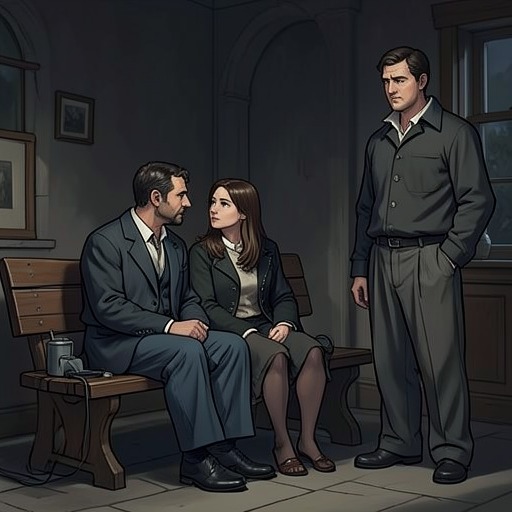
Julia Brown
Falling For The CEO: BAD BOY ROMANCEJulia Brown is William King's former wife, a human-resources professional, and the narrative catalyst for the revelation that destabilizes William King's relationship with Diana Jones. Her significance lies less in her sustained presence than in the identities she carries across the plot: ex-wife, mother of a young son, former Grace Hotel consultant, and the woman whose disclosure makes William's concealed history impossible for Diana to ignore.
Identity and Professional Background
Julia Brown first appears when Diana Jones attends an interview at another hotel. She introduces herself simply as Julia, rejecting the more formal address Mrs Brown because that is her mother-in-law's name. She is conducting the interview with Uma Thornton, the floor manager, and Helga Florence, a concierge, in her capacity as the Atom Hospitality Group's human-resources recruitment agent. Her manner combines professional authority with warmth: although the interviewers question Diana closely and maintain stern expressions, Julia offers encouraging smiles and winks, then walks Diana out afterward and explains that the others may have been testing how she would respond to a challenging guest.
Julia's professional history connects her directly to Grace Hotel and to the employment pressures surrounding Diana Jones. She says that she worked for Grace about four and a half years earlier, consulting in human resources across different locations, particularly in recruitment and retrenchment. The mobility of that work had allowed her to spend more time with her husband, though she corrects herself to call him her ex-husband. Her experience also makes her an apparent professional counterpart to Diana, who is seeking a specialised concierge position while worrying about the possible loss of her existing job.
The Disclosure of William King's Marriage
Julia's decisive action is not a planned confrontation but a personal disclosure that transforms an ordinary interview into a revelation. After Diana asks about her past, Julia explains that the husband she had mentioned was William King. The information shocks Diana because William has been presenting himself to her as a romantic possibility and as the executive whose authority threatens her employment, while his marital history has remained undisclosed.
The revelation reassigns every role in the earlier relationship. Diana had believed that William's connection to her was complicated because he was Connor Jones's boss; she had not yet admitted that she also worked for William. William, meanwhile, had interpreted Diana's failure to identify Grace Hotel as deliberate deception. Julia's appearance makes the hidden identities overlap: William is no longer only Diana's flirtation, colleague, and boss, but also Julia's former husband. The discovery therefore changes the balance of trust before William can explain his own version of events.
Marriage, Pregnancy, and the Broken Timeline
William later tells Diana that he remained in the marriage after Julia became pregnant. Julia had arranged a doctor's appointment for the twelve-week stage of the pregnancy, and William went without suspecting that the child might not be his. At the appointment, he learned that the timeline did not fit his paternity: he had been away at a conference for two weeks during the possible period of conception. He did not challenge Julia in front of the doctor, then left the office, packed his bags, contacted his lawyer, and did not see her again after the divorce.
The account complicates Julia's place in the story without erasing the damage associated with her. She initially begged William to stay, claiming that she had made a mistake and loved him. When he refused, she lashed out and blamed him for not giving her enough attention. William rejects that explanation because he believes he had been trying to give her the attention she demanded. His description presents the marriage as a relationship in which a concealed betrayal was followed by competing accounts of responsibility, leaving him emotionally wounded even after the legal separation.
Relationship to William and the Child Question
Julia's disclosure also creates a false impression that William is a father. When Diana confronts him after meeting Julia, she asks whether he had intended to tell her about his ex-wife and child. William responds that he is not a father. The distinction is central: Julia has a son who is about to turn five, but William discovered that the child was not biologically his and left the marriage after learning this. The apparent fatherhood attached to William's public and romantic identity is consequently dismantled by the hidden chronology.
William's reaction shows that Julia's past remains active inside his present. He recognizes Diana's omission about her employment as a lie because it recalls what Julia did to him, even though Diana explains that she is genuinely a tour guide and had merely failed to say that the hotel was her workplace. His suspicion turns an employment-related omission into a test of romantic loyalty. Julia is therefore not only a former spouse in the backstory; she is the measure against which William interprets new intimacy, causing him to punish Diana for an injury she did not cause.
Narrative Function and Aftermath
Julia functions as an agent of involuntary truth. She does not merely supply biographical information about William; she forces Diana to confront the gap between the man she believes she knows and the history he has withheld. Her role contrasts with Diana's own delayed confession about working at Grace Hotel and with William's eventual explanation of the marriage. Each revelation exposes a different form of concealed identity, but Julia's disclosure is the one that makes the others emotionally explosive.
The consequences extend beyond the interview. William admits that he has never properly dealt with what Julia did and that he dismissed the pain too quickly after the divorce. Gloria recognizes that his unresolved hurt has been carried into his relationship with Diana, where it becomes distrust and resistance to forgiveness. Julia thus remains an absent but powerful presence: the marriage has ended, the child is not William's, and Julia is no longer part of his household, yet the emotional pattern she left behind governs William's decisions until he acknowledges it.
Julia's brief encounter with Diana also gives the novel a structural contrast between professional competence and private damage. In the interview, Julia appears composed, perceptive, and capable of evaluating how people respond under pressure. In the personal history she reveals, however, she is tied to a marriage marked by pregnancy, disputed paternity, divorce, and recrimination. That contrast makes her more than a plot device. She embodies the way a polished social identity can conceal a history whose consequences continue to shape other people's capacity for trust.