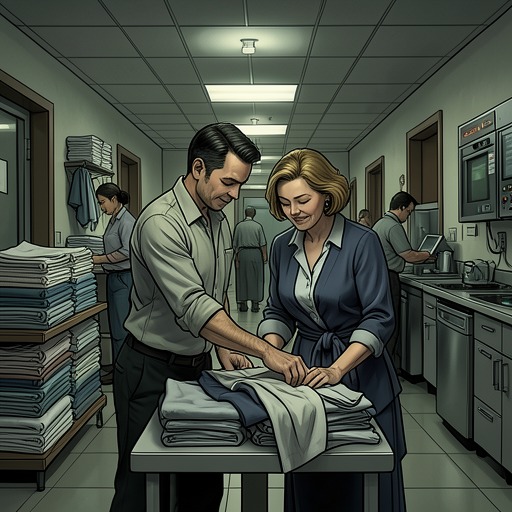
Miranda King–Jim Kruger marriage
Falling For The CEO: BAD BOY ROMANCEMiranda King–Jim Kruger marriage is a new but unmistakably affectionate partnership at the Grace Hotel. Miranda King and Jim Kruger have been married for only a few months, yet their relationship is already woven into the practical rhythms of work, meals, shifts, and family life. Their easy tenderness offers a domestic counterpoint to the secrecy, abandonment, and unresolved hurt surrounding Diana Jones and William King, while Miranda's recollection of the mistakes that preceded the marriage shows that their happiness has survived uncertainty rather than emerging from a perfectly uncomplicated past.
Identity and Early Marriage
Miranda King is a Grace Hotel employee who combines front-desk professionalism with an openly romantic attachment to Jim Kruger, the hotel's chef. Jim Kruger is presented as shy and sparing with words, but his reserve does not indicate emotional distance. In the staff lounge, he smiles, answers Diana Jones briefly, prepares to begin the breakfast rush, and then leans down to kiss Miranda King before giving Diana a reassuring squeeze on the shoulder. His actions communicate a warmth that his concise speech leaves unstated.
The marriage is still sufficiently new to be a subject of delighted attention. Miranda King calls Jim Kruger her husband of a few months and reacts to him with theatrical embarrassment and pleasure when Diana Jones encounters them having breakfast together. The scene makes their intimacy visible through small domestic details rather than grand declarations: Miranda King moves her chair closer to him, and the couple share food from the same plate and fork. Diana Jones finds the display excessive but affectionate, and her teasing recognizes that the couple's closeness is genuine.
Domestic Intimacy and Daily Life
Their relationship is built into mundane acts that make marriage tangible. Miranda King jokes about feeding Jim Kruger bacon from her plate, while Jim Kruger responds in his characteristically understated manner and leaves for work after kissing her. Miranda King then prepares coffee for herself and Diana Jones while continuing to speak about him with unmistakable fondness. The contrast between her animated enthusiasm and his quiet gestures gives the marriage a complementary structure: she verbalizes the romance that he expresses through touch, presence, and dependable action.
Work does not simply compete with their marriage; the couple organize their employment around it. Miranda King has changed from a morning shift so that she can go home with Jim Kruger after his shift ends. She admits that the arrangement may leave her dependent on coffee before a three-day conference, but the inconvenience is worth the prospect of sharing the end of the day with her husband. Carina's unusual permission to alter the schedule becomes important because it allows Miranda King and Jim Kruger to coordinate their working lives rather than treating professional obligations as separate from their marriage.
The adjustment is supported by the hotel's management. Miranda King says that Carina has been fair and has made an exception by allowing the couple to coordinate their schedules. Carina has also postponed a meeting with the new general manager so Miranda King can settle after returning from her honeymoon. These accommodations place the marriage within the institutional life of the Grace Hotel: private happiness requires negotiation with shifts, meetings, and managerial decisions, but the workplace can also make room for the relationship.
History, Mistakes, and Commitment
Miranda King's marriage is not portrayed as the reward for an error-free romantic history. When Diana Jones later discusses her own damaged relationship, Miranda King reminds her that Jim Kruger asked her to marry him even though she had previously left him to find herself. The recollection establishes a pattern of rupture followed by renewed commitment. Miranda King and Jim Kruger therefore embody a relationship in which separation did not necessarily erase affection or make reconciliation impossible.
That history gives Miranda King's cheerful domesticity greater weight. Her excitement over the marriage is not naïve ignorance of difficulty; it follows a period in which the relationship was placed under strain. By mentioning her earlier departure while comforting Diana Jones, Miranda King turns her own marriage into evidence that mistakes can be acknowledged without becoming the final definition of a couple. The marriage's stability is consequently linked to persistence and forgiveness rather than to the absence of fear or failure.
Relationships with the Hotel Community
Miranda King and Jim Kruger are not isolated from the Grace Hotel's social world. Diana Jones encounters them in the staff lounge and participates in their playful exchange, teasing Miranda King about the couple's intense love. Jim Kruger's brief greeting and friendly touch toward Diana Jones position him as a quiet, accepted member of the workplace community, while Miranda King's exuberant comments make the marriage part of everyday conversation among colleagues.
Their relationship also helps Miranda King support Diana Jones. When Diana Jones confesses that William King discovered the truth about her professional and personal life, Miranda King places an arm around her shoulders and reminds her that everyone makes mistakes. The gesture connects the marriage's private history to its public emotional function: Miranda King does not offer abstract reassurance, but draws on the fact that her own relationship has included abandonment, return, and a proposal that followed uncertainty. Her marriage thus becomes a source of empathy for someone confronting the consequences of secrecy.
Narrative Function and Significance
The Miranda King–Jim Kruger marriage supplies one of the novel's clearest portraits of affection expressed through routine. The couple's breakfast, shared fork, coordinated shifts, kiss, and teasing conversation create a pattern of intimacy that is immediate and legible. Against relationships marked by parental abandonment, bereavement, divorce, withheld information, and fear of being left, their partnership shows what emotional security can look like in ordinary practice.
At the same time, the marriage is not reduced to a flawless romantic model. Jim Kruger is quiet and awkward around people, Miranda King has previously left him, and their current happiness depends partly on deliberate scheduling and institutional flexibility. The narrative therefore presents their bond as both tender and maintained. Its significance lies in that combination: love appears not as a magical escape from difficulty, but as a relationship sustained through return, accommodation, physical affection, and the willingness to make room for another person in the middle of working life.