Truth and Trust in Romantic Relationships
Falling For The CEO: BAD BOY ROMANCETruth and Trust in Romantic Relationships is the central ethical pressure shaping Diana Jones and William King’s romance. Their attraction develops through incomplete knowledge: Diana conceals that William King is her employer, while William conceals his marriage to Julia and the betrayal that ended it. Each secret initially protects its holder from immediate pain, but each also changes the balance of power between the lovers. The relationship ultimately shows that love can survive confession and even permit forgiveness, but it cannot be securely restored while either partner remains governed by an unresolved past.
Identities Hidden Behind Intimacy
Truth in the relationship is repeatedly complicated by social roles. When Diana Jones first understands that the man before her is William King, she also understands that he is not merely a possible romantic interest but her brother Connor Jones’s boss and, soon, her own boss. Her disclosure that Connor Jones is her brother therefore becomes an important correction to the scene’s apparent identities, while William’s discovery of Diana’s workplace identity later reveals that her earlier explanation was incomplete. She had told him that she could not pursue him because he was Connor Jones’s boss, although he was also her own employer.
The concealment is not presented as a wholly calculated deception. Diana Jones is a tour guide, but she does not tell William King that the work is at the hotel he controls. After their flirtation and the elevator incident, she fears that he will believe she deliberately manipulated him or that her interest was connected to her job. Her attempt to preserve emotional and professional safety instead creates the suspicion that she used romance to protect her position. The distinction between a technically true statement and a materially misleading omission becomes crucial: Diana Jones has not invented her occupation, but she has withheld the fact that gives the occupation its greatest consequence.
William King’s reaction is intensified by the fact that he recognizes the pattern through his own history. When he finds Diana Jones’s employee photograph while reviewing staff profiles for the hotel’s retrenchment process, details of their first meeting fall into place. Her surprise at seeing him in the office, her refusal to date him, and her explanation about Connor Jones’s position all acquire a second meaning. The discovery therefore damages more than factual confidence; it makes William King reconsider the emotional reality of the relationship and wonder whether the woman he loved is the same person he thought he knew.
The Cost of Partial Disclosure
Diana Jones’s secret carries an immediate professional stake. William King is responsible for decisions affecting hotel employees, and she knows that her future is vulnerable to the restructuring underway. Her fear that he might suspect her of using their connection to avoid dismissal gives the omission a practical motive, but it also creates precisely the appearance she hoped to avoid. The story thus makes secrecy an unstable form of self-protection: it may postpone exposure, yet the eventual revelation makes earlier tenderness look strategically motivated.
Diana Jones eventually accepts responsibility without accepting William King’s interpretation of her motives. She explains that she did not plan the relationship and that she fell into it after they were trapped together in the elevator. She acknowledges that withholding the workplace connection was wrong, but insists that it arose from fear rather than a scheme to influence his employment decisions. Her later apology is similarly direct: she visits William King because she wants to say she is sorry for lying and for hurting him, while also explaining that she acted to save herself from being hurt.
William King initially treats the matter as a simple breach of truth. He asks how the fact that Diana Jones worked for him could have remained outside their conversations and accuses her of allowing him to believe a false explanation for her refusal. Yet the narrative later exposes the limits of his certainty. After admitting his love, he recognizes that he has also postponed a revelation because he fears losing her. He had opportunities to tell her about Julia, but Diana’s happiness at hearing that he wanted to marry her made him hesitate. His silence is therefore not identical to hers, but it belongs to the same emotional economy: both lovers allow anticipated loss to overrule disclosure.
Confession, Recognition, and Forgiveness
The contrast between the two confessions gives the concept its strongest dramatic form. Diana Jones’s truth concerns her job and the power imbalance within the romance; William King’s concerns a marriage, an ex-wife, and a child he believed might be his. Diana learns about Julia not from William but from Julia herself, who reveals that William King was her husband. The disclosure is followed by a further shock when Diana assumes that William is a father and he answers that he is not.
William King explains that he stayed with Julia long enough to attend a medical appointment marking the supposed twelve-week point of her pregnancy. At the doctor’s office he learned that the timeline made paternity impossible because he had been away at a conference for two weeks during the possible conception period. He avoided humiliating Julia in front of the doctor, then packed his bags, contacted his lawyer, and did not see her again after the divorce. Julia first begged him to accept her explanation and then blamed him for not giving her enough attention when he refused. The betrayal became the emotional source of his later distrust, not merely a piece of background information.
This history changes the meaning of William King’s anger toward Diana Jones. Diana can understand why he found it difficult to speak about the marriage and why Julia’s deception remains painful. She even says that she can try to forgive the lie, recognizing that refusing forgiveness would make her a hypocrite after her own concealment. But forgiveness does not erase the significance of what was hidden. William King’s marriage and the betrayal surrounding Julia are not incidental facts; they shape his understanding of love, truth, and danger.
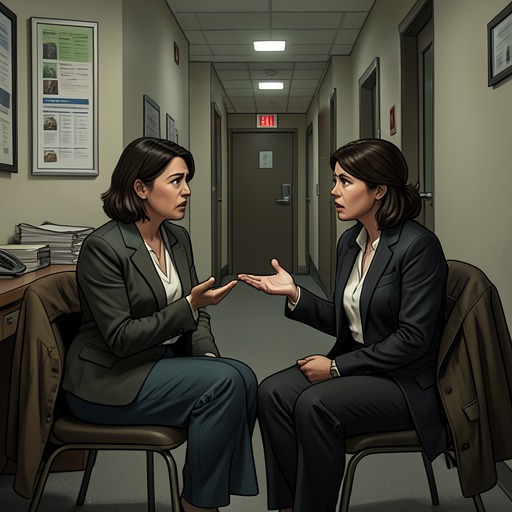
Diana Jones therefore asks whether William King’s prolonged anger toward her was directed at her or was a repetition of his anger toward Julia. His inability to answer becomes more damaging than an outright denial. The uncertainty suggests that he has not fully separated the present relationship from the earlier betrayal. Truth has been spoken, but trust has not automatically returned, because knowledge alone cannot undo the emotional pattern produced by the past.
Trust as a Condition of Reconciliation
The relationship’s most important principle is that reconciliation requires more than mutual attraction or mutual admission. William King asks Diana Jones to start over without the lie between them, presenting renewed intimacy as a possible answer to the damage. His request follows a period of reflection in which he recognizes similarities between her grief and his own experience of loss. The renewed kiss and his appeal for another beginning show that confession can reopen desire, but they do not prove that the underlying injury has been resolved.
Diana Jones’s response establishes a stricter standard. She tells William King that she is not Julia, yet fears that until he works through what Julia did, he may treat Diana as though she were. She makes the distinction between forgiving dishonesty and accepting a relationship still organized by unresolved suspicion. Her boundary is not a rejection of love: she says that she loves him and does not want to lose him. It is a refusal to let love become a substitute for healing.
The physical distance in the confrontation reinforces this ethical distinction. William King is close enough to hold Diana Jones’s hands and move toward her, but she experiences him as emotionally distant; when she steps back, their proximity becomes a measure of how far trust has fallen. She ultimately opens the door and asks him to leave, turning separation into a condition for possible repair rather than a final denial of feeling. The story consequently defines trust as an active process: it depends on complete information, accountable speech, and the willingness to confront old wounds before demanding renewed closeness.
Narrative and Thematic Significance
The romance repeatedly turns identity into a question of context. Diana Jones is Connor Jones’s sister, a tour guide, an employee, and William King’s lover; William King is first a stranger, then a boss, a beloved partner, and the former husband whose history he has withheld. Each role redistributes knowledge and power. The central problem is not simply that either person has lied, but that a concealed role changes what every earlier gesture appears to mean.
The story also rejects a symmetrical but simplistic moral equation. Diana Jones’s omission and William King’s silence are not interchangeable: her secret concerns employment and fear of being misread, while his concerns a failed marriage, non-paternity, and betrayal. Nevertheless, the parallel structure forces William King to recognize that truth is not always easy to tell once emotional dependence has formed. His own hesitation makes him understand why Diana feared disclosure, even as Diana insists that understanding cannot excuse the damage.
Truth and Trust in Romantic Relationships therefore functions as both a romantic ideal and a practical test. Love generates the desire for confession, but fear repeatedly delays it; confession produces the possibility of forgiveness, but forgiveness remains conditional when trauma is still active. The decisive lesson is that a new beginning cannot be secured by passion alone. It requires the lovers to know one another in full, to distinguish present partners from past betrayers, and to make honesty strong enough to bear the risk of losing the relationship it seeks to save.