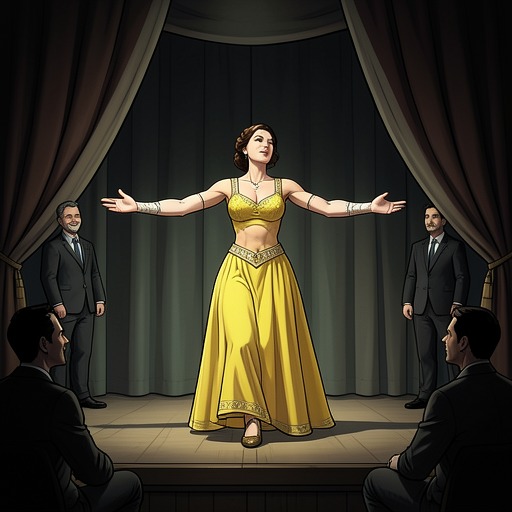
William performs at Tara’s talent show
Falling For The CEO: BAD BOY ROMANCEWilliam performs at Tara King’s talent show as an act of family loyalty that becomes a decisive romantic gesture. He is not presented as a naturally accomplished performer; the significance lies in his willingness to look ridiculous in public for Tara’s sake. The performance exposes a tender, self-sacrificing dimension of William that contrasts with his polished authority as the executive overseeing Grace Hotel Cape Town and helps shift Diana Jones’s feelings from attraction toward deeper emotional commitment.
Causes and Background
William becomes involved because Tara has come to believe that Diana will perform the routine with her. Tara had persuaded Diana to learn the dance and part of the lyrics to a Taylor Swift song, even though Diana understood that she was being drawn into a performance before William and his family. William remembered that Diana had been promised she would not have to take part, but he also recognised that Tara’s expectation had become important to her. Gloria’s admission that she had encouraged the idea left him responsible for resolving the situation.
Rather than allow Tara to be disappointed, William offers to take Diana’s place. His decision is explicitly framed as a willingness to embarrass himself in front of an unknown audience. The choice matters because William is normally associated with control, sophistication, and professional authority: at the Grace Hotel welcoming event he arrives in a perfectly tailored suit, takes charge of a troubled situation, and views the gathering through the eyes of a manager. The talent show requires the opposite posture. It asks him to surrender polish and control in order to fulfil a child’s hope.
Preparation and Stakes
William follows through on his promise and attends the rehearsal process, where he has to put on the outfit that has become the source of his dread. The tracksuit is in various shades of pink, and its excessive, ill-fitting appearance makes him feel conspicuous before the show has even begun. He is also nervous because he is unsure whether he remembers the dance moves Tara patiently taught him a week earlier.
His anxiety is sharpened by the knowledge that he dances badly. William recalls having taken dance lessons as a teenager, when he enjoyed being admired by girls who thought he was impressive, but he later realised how poor his dancing actually was. That memory turns the performance into more than a simple family favour: he knows the audience may see his lack of ability, yet he chooses to continue. The risk is social rather than physical, but the loss of dignity is real, and accepting it makes the gesture legible as care rather than display.
The Performance
The programme announces Tara as one of the school’s star students, performing a dance with the help of a surprise guest. When the familiar Taylor Swift music begins, Diana immediately recognises William beneath an oversized tracksuit with the hood pulled over his head. Tara wears an identical outfit and stands in front of him in the same position, while William’s costume makes him look markedly less at home in the role.
William cannot dance well, and Diana laughs before the routine has properly begun. He nevertheless tries his best to keep up with Tara. His movements are comic, and he knows that he looks ridiculous, but he gives the performance his full effort rather than retreating from the spectacle. The audience joins in, clapping with the music, while Gloria and John King laugh from their seats. The scene transforms humiliation into communal pleasure: William’s failure as a dancer becomes his success as a brother because he gives Tara a performance she can enjoy and remember.
At the end of the dance, William pulls a beaming Tara onto his shoulders. The family’s laughter turns into loud cheering, and Diana shouts her support. The final image completes the emotional logic of the act: William has not merely endured the routine; he has made Tara visibly happy and allowed her triumph to become the centre of the scene.
Effects on Diana and the Family
For Diana, the performance reveals William more clearly than his appearance or professional confidence had done. She had first been captivated by his dark hair, blue-green eyes, height, smile, and tailored clothing, and later remained unsettled by the attraction he could summon even when she barely knew him. At the talent show, however, his appeal no longer rests on controlled elegance. He is dressed in an oversized pink tracksuit, dances badly, and knowingly makes a fool of himself, yet the deliberate vulnerability makes her fall harder for him.
The performance also connects Diana to William’s family. Tara had already drawn Diana into learning the routine, praising her voice and seeking her participation. William’s substitution does not erase that bond; instead, it places his care for Tara beside Diana’s growing care for the family. Gloria and John’s laughter and cheering make the act a shared domestic occasion rather than a private romantic display, while Diana’s shouted encouragement confirms that she is emotionally invested in William’s happiness and in Tara’s joy.
Narrative Significance
The talent-show performance marks a value shift from William’s public authority to his private vulnerability. Earlier, his expensive surroundings, managerial role, and controlled appearance connect him with power; his attraction to Diana is initially filtered through workplace boundaries, concealed identities, and fears of ethical overstepping. The performance offers a contrasting image of masculinity. William remains the adult responsible for protecting Tara’s happiness, but he fulfils that protective role through play, embarrassment, and physical closeness rather than command.
The scene therefore makes care visible through failed performance. William’s dance is not impressive in conventional terms, and the family’s laughter does not diminish him because he has chosen the conditions of that laughter for Tara’s benefit. His willingness to exchange sophistication for affection anticipates the broader movement in his relationships from guarded control toward emotional exposure. For Diana, the moment confirms that the man she desires can also be generous, playful, and vulnerable; for the narrative, it turns a comic school performance into one of the clearest demonstrations of why their relationship matters.