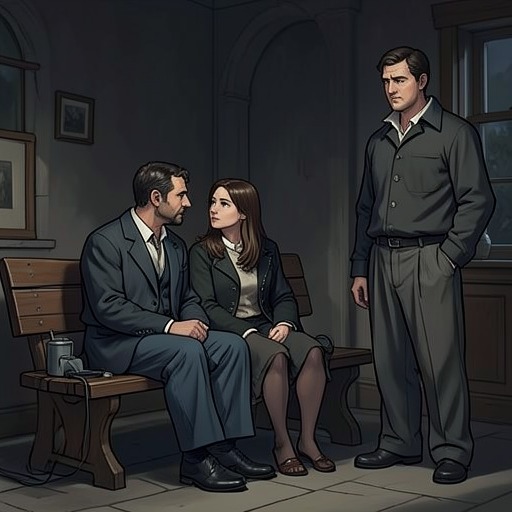
William reveals his marriage to Julia
Falling For The CEO: BAD BOY ROMANCEWilliam reveals his marriage to Julia as the second major disclosure in his relationship with Diana, after their attraction has already been damaged by mutual concealment. The revelation first appears as a shock delivered by Julia, then becomes William’s painful account of a whirlwind marriage, Julia’s pregnancy, the discovery that her child was not his, and the divorce that followed. It changes Diana’s understanding of both William’s secrecy and the danger that his unresolved betrayal may be reproduced in their relationship.
Causes and Hidden Identities
The confession is prepared by a chain of mistaken identities and withheld information. At the Grace Hotel welcoming event in Cape Town, William is introduced as the man taking charge of the hotel’s troubled operations, while Diana recognizes him as the stranger with whom she has already formed an intense connection. She identifies herself to him primarily as Connor’s sister, and when William learns that Connor is her brother, he assumes that her reluctance comes from the workplace boundary created by his position as Connor’s boss.
Diana later clarifies that the explanation was incomplete. She is a tour guide, but she failed to say that her work was at the hotel where William was her employer. She insists that the omission arose from fear rather than a plan to manipulate him, yet William experiences it as another lie. While reviewing employee profiles, he recognizes Diana’s photograph and realizes that she is not merely Connor’s sister or a woman who happens to work elsewhere: she is his employee. That discovery revives the injury caused by Julia’s deception and makes his own undisclosed history more consequential.
The two disclosures therefore mirror one another without being identical. Diana hides her workplace identity because she fears being judged or losing the possibility of intimacy; William hides his marriage because the past remains painful and because he has not worked through its consequences. In both cases, the withheld fact changes the balance of power between them. Diana is simultaneously a potential lover and an employee, while William is simultaneously a lover, a boss, and a divorced man whose former marriage still shapes his expectations.
The Revelation Through Julia
William does not control the timing of his confession. Diana meets Julia while interviewing at another company, and Julia tells her that the husband she once mentioned was William King. The disclosure also carries the claim that William has a child, causing Diana to return to him with the belief that she has discovered both an ex-wife and a fatherhood he concealed.
William’s reaction shows that the revelation has arrived before he can frame it himself. He understands from Diana’s expression that he has run out of time to explain his past on his own terms, and he apologizes before giving the full account. When Diana asks whether he was ever going to tell her that he was a father, he responds that he is not a father. He explains that Julia’s child is not his, immediately separating the fact of the marriage from the mistaken assumption of biological parenthood.
That correction produces temporary relief but not resolution. Diana cannot simply discard the principle involved because the child is not William’s. Her anger concerns the concealment itself: she had to learn that he had been married from Julia, just as William had learned that Diana worked for him by finding her profile in the hotel’s records. The episode makes the relationship’s central problem unmistakable. Love has developed while each person’s access to the other has been limited by an incomplete identity.
William’s Account of the Marriage
William says that the marriage took place a little over seven years earlier, when he was transitioning into the hotel business and his father still ran the hotels. He believed Julia was the person with whom he would spend his life. Her lively energy attracted him, and their courtship moved quickly into marriage. The relationship was happy for its first year, but the quality he had found charming in courtship became, in retrospect, part of her demanding nature.
Julia complained that William devoted too much time to work and that she was not receiving the attention she needed. William initially interpreted her demands as a desire for greater closeness, but later concluded that she wanted attention from someone rather than necessarily from him. This distinction becomes important to his later distrust: he believes he tried to meet her needs, yet still found himself blamed for her dissatisfaction.
The decisive reversal comes at a medical appointment arranged around Julia’s supposed twelve-week pregnancy mark. William had not considered that the child might not be his. At the appointment, however, he learned that the timeline was impossible because he had been away at a conference for two weeks during the possible period of conception. He withheld his reaction until they had left the doctor’s office, unwilling to humiliate Julia in front of the physician who would oversee her pregnancy. He then packed his bags, contacted their lawyer, and did not see Julia again after the divorce.
Julia first begged him to stay, saying that she had made a mistake and loved him. When he refused to accept this, she lashed out and blamed him for not giving her enough attention. William says that he might have believed her accusation if he had not been trying his hardest to give her exactly that. Instead, her response confirmed for him the selfishness he felt had been hidden during their courtship. His account presents the divorce not as a casual end to an old romance but as the aftermath of betrayal, humiliation, and a collapse of trust.
Consequences for Diana and William
Diana listens with growing sympathy because William’s brokenness helps her understand why the marriage was difficult for him to discuss. She no longer treats his silence as evidence of indifference, and she recognizes why he could not easily share the story. Yet sympathy does not erase responsibility. After acknowledging the suffering he endured, she tells him that his experience cannot serve as an excuse for lying to her.
The crucial issue is not whether William once loved Julia or whether Julia betrayed him; it is whether he can distinguish Diana from the woman who wounded him. When Diana asks whether he has spoken to anyone about what happened, William admits that he has not. His silence confirms her fear that the divorce remains psychologically unfinished. He has left Julia physically and legally, but he has not necessarily left the patterns of suspicion and fear produced by the marriage.
Diana therefore establishes a condition for continuing the relationship. She tells him that she is not Julia, but until he works through what Julia did to him, he may treat Diana as though she were. She loves him and does not want to lose him, yet she refuses to remain in a relationship where she could be punished for another woman’s betrayal. Her decision to separate is not a denial of their love; it is a demand that reconciliation be based on healing rather than on passion alone.
The scene ends with Diana opening the door for William and letting him leave. The physical movement gives the confession an immediate consequence: disclosure does not automatically restore trust. William has finally supplied the truth, but the truth exposes work that remains to be done. His marriage to Julia thus becomes both an explanation of his behavior and a test he must meet before he can ask Diana to begin again.
Narrative Significance
William’s confession reorganizes the romance around the difference between explanation and absolution. The history with Julia explains his fear of deception, his sensitivity to omissions, and his difficulty speaking about intimacy, but Diana does not allow explanation to become immunity from accountability. Her response insists that both partners’ secrets must be faced and that forgiveness cannot mean ignoring their effects.
The disclosure also completes a pattern of reciprocal revelations. Diana apologizes for hiding that she works at the Grace Hotel and explains that she acted to protect herself from being hurt. Later, William asks to start over without the lie between them, but his own concealed marriage proves that the relationship still contains another unspoken history. When Julia exposes that history, the apparent symmetry breaks: William is not merely the injured man reacting to Diana’s omission; he is also someone who has withheld a fact capable of changing her consent to the relationship.
For William, the confession is an act of vulnerability that replaces managerial control with emotional exposure. The man who arrives at the hotel welcoming event prepared to manage troubled operations and preserve the hotel’s public image must eventually acknowledge a private failure he has kept outside Diana’s knowledge. Yet the story gives the final authority over what that disclosure means to Diana. She hears him, understands him, and still sets a boundary. The revelation matters because it makes love contingent on truthful identity and genuine recovery, not simply on the intensity of their chemistry.