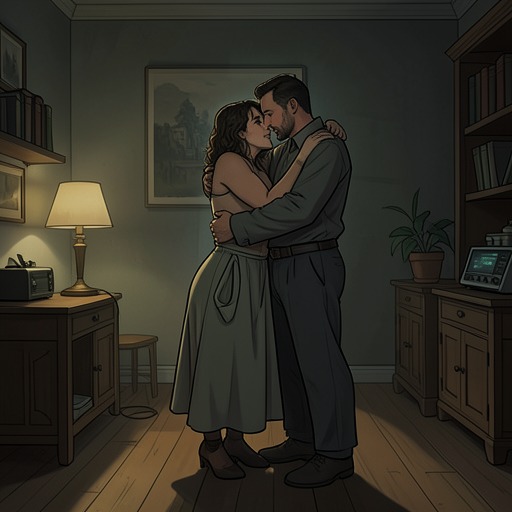
Derek Jones–Cora Jones marriage
Falling For The CEO: BAD BOY ROMANCEThe Derek Jones–Cora Jones marriage is presented as a devoted twenty-year partnership whose emotional warmth stands in stark contrast to the abandonment and instability surrounding the Jones family. Cora Jones’s generosity and Derek Jones’s steadfast love make their marriage the model of mutual care in Diana Jones’s memory; their sudden deaths leave Diana bereaved at nineteen and permanently alter the course of her adult life.
Marriage and Family Structure
Cora Jones is remembered by Diana Jones as the kindest person she had ever known. Her mother’s defining quality was self-sacrifice: Cora Jones consistently placed Diana’s happiness before her own and was imagined as capable of enduring considerable hurt if she had been tied to someone who dismissed her sensitivity or failed to value her. Derek Jones, however, was not that kind of husband. Diana understood him as a man who loved his wife more than life itself, and his devotion gave the marriage a moral and emotional stability that the wider family did not always possess.
The marriage also formed part of a complicated blended-family structure. Derek Jones had previously been married to Luna Jones, the mother of Connor Jones. That first marriage lasted only a few years before Derek Jones became increasingly alarmed by Luna Jones’s erratic highs and lows, particularly after the birth of their son. Luna Jones was initially thought to be suffering from postnatal depression, but she was eventually diagnosed with bipolar disorder. The diagnosis overwhelmed her, and she filed for divorce, leaving Connor Jones with Derek Jones. Derek Jones later married Cora Jones, who became Diana Jones’s mother and also embraced Connor Jones within the new family.
Loss and Its Immediate Consequences
The marriage ended not through emotional failure but through sudden violence. Derek Jones and Cora Jones were travelling home from a weekend away arranged to celebrate their anniversary, maintaining a yearly ritual of returning to the hotel where they had been married. They had been married for twenty years when a drunk driver overtook another vehicle illegally and crashed into them. Both died instantly.
Diana Jones was nineteen, on the eve of her final first-year university examination, when the crash occurred. She insisted on sitting the examination, but the determination that carried her through the immediate aftermath did not prevent the delayed collapse that followed. During the first week, denial allowed her to function sufficiently for relatives to praise themselves for supporting her through the funeral. Once she watched her parents’ coffins descend into the ground and saw mourners return to ordinary life, however, the reality of the loss began to take hold.
The death of Derek Jones and Cora Jones became more than a bereavement in Diana Jones’s biography. It disrupted her education, cost her a university scholarship, and contributed to the loss of several friendships when she could not motivate herself to return for her second year. She later understood that the depression into which she sank was not overcome by willpower alone. The marriage had represented the secure family life she believed she possessed; its destruction left her struggling to feel adult, independent, or protected.
Effects on Diana Jones and Connor Jones
Connor Jones became the family member who acted most decisively after the crash. When he saw Diana Jones living in prolonged chaos, he effectively compelled her to accept a job at the hotel, arriving at her house one morning and refusing to leave unless she came to work with him. At first, she went mainly to avoid the guilt of keeping him from his own responsibilities. The intervention nevertheless became the beginning of her recovery.
Through the hotel, Diana Jones discovered that she enjoyed communicating with guests and advising them about Cape Town. She gradually began planning excursions, then guiding them herself after Connor Jones arranged a trial period when the popularity of her informal assistance became clear. Her research into the city’s history and culture turned work into a form of renewed participation in life. The tours allowed her to move from merely surviving to living again, making her employment an indirect continuation of the care once associated with her parents’ home.
The marriage’s loss also affected the emotional balance between the siblings. Connor Jones had already experienced abandonment when Luna Jones left after the divorce, and Diana Jones believed that this history helped explain his family-oriented nature and protective role. He had supported her after the crash, while Cora Jones had attempted to make him feel fully included in the remarried household. Diana Jones admired him as the older brother who stepped up for her, yet she also felt that he had eventually built an independent life and merely fitted her into it after ensuring that she was safe. Six years after the deaths, she could still feel alone and abandoned, even while recognizing that her parents had never chosen to leave her.
Memory, Attachment, and Later Relationships
Diana Jones’s memory of the marriage becomes a standard against which later relationships are measured. She knew that Cora Jones and Derek Jones had loved one another with a completeness that made abandonment difficult to accept. Because her parents’ departure had been involuntary, Diana Jones felt ashamed of describing herself as abandoned, but the emotional fact remained: they had disappeared at precisely the stage when she was beginning to establish an adult identity.
That unresolved loss made later separation especially threatening. When Diana Jones feared that William King might leave her, the fear reached backward toward the nightmarish emptiness created by her parents’ deaths rather than belonging only to the immediate romantic conflict. She recognized that she had once been so afraid of being left alone that fear could make her act unlike herself. Her relationship with William King eventually forced her to distinguish love from panic: she could continue to love him while refusing to let the possibility of abandonment govern every decision.
This distinction marks a change from the helplessness that followed the death of Derek Jones and Cora Jones. Diana Jones learned to wait for William King to confront his own unresolved trauma instead of trying to secure him through fear or pleading. She chose to give him space to heal, even though she missed him and remained vulnerable to the possibility that he might never return. The emotional discipline of that choice is rooted in, and presented as a response to, the earlier collapse of security after her parents’ deaths.
Narrative Significance
The Derek Jones–Cora Jones marriage supplies the story’s clearest image of faithful love, but it is also inseparable from the damage caused by its sudden disappearance. The couple’s anniversary ritual, their twenty-year marriage, and the account of their mutual devotion establish a secure domestic ideal; the drunk driver’s collision destroys that ideal without warning. Their marriage therefore functions both as a memory of unconditional care and as the origin of Diana Jones’s fear that every beloved person may be taken away.
Its influence extends through the family’s successive patterns of attachment and loss. Derek Jones’s first marriage to Luna Jones produces abandonment and a protective bond between Derek Jones and Connor Jones; Derek Jones’s marriage to Cora Jones creates a loving household in which Connor Jones is nevertheless conscious of his complicated place; and the deaths of Derek Jones and Cora Jones transfer the burden of security to Connor Jones, who then helps Diana Jones rebuild a life through work. The marriage’s legacy is thus not limited to a portrait of the deceased couple. It organizes the emotional history of the surviving family and gives Diana Jones’s later movement toward independence, trust, and love its deepest context.