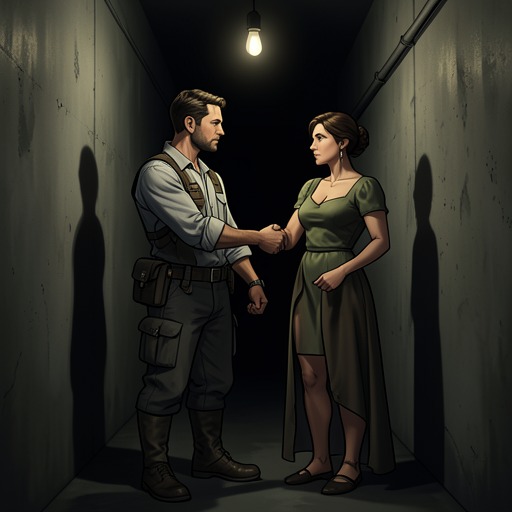
Diana Jones and William King's romantic relationship
Falling For The CEO: BAD BOY ROMANCEDiana Jones and William King's romantic relationship is a central emotional arc built from attraction, role confusion, concealment, rupture, and deliberate renewal. Diana Jones first encounters William King as a compelling possibility, then discovers that he is not only Connor Jones's employer but also her own boss. Their love becomes possible only after both confront the damage caused by hidden identities and William King's unresolved history with Julia, turning a workplace romance into a test of whether intimacy can survive incomplete truth.
Identity and Unequal Beginnings
Diana Jones and William King's connection begins under overlapping social and professional identities. At a formal gathering, Diana Jones learns that the man she has encountered is William King, while Connor Jones identifies Diana Jones as his sister. William King therefore sees her first through the family connection to his employee, whereas Diana Jones has to absorb the fact that the attractive stranger is also tied to the authority structure governing her work. Once she recognizes him, her earlier interest changes sharply: what had seemed like a possible romance becomes a danger to her employment and to Connor Jones's position.
Diana Jones tries to establish a boundary before the relationship can develop. She tells William King that the connection between them is not a good idea because he is her brother's boss, while the evidence also makes clear that he is her own boss. William King is disappointed but says that he understands, and the physical intimacy of his holding and squeezing her hand makes the refusal difficult rather than final. The scene defines the relationship's first contradiction: Diana Jones is trying to protect professional and familial obligations, even as desire makes the boundary emotionally unstable.
Emotional Histories Behind the Attraction
Diana Jones brings profound loss into the relationship. Her parents, Cora Jones and Derek Jones, died in a car crash the day before her final first-year university examination. She insisted on writing the examination, but after the funeral and the sight of her parents' coffins descending into the ground, she fell into a depression that disrupted her education and friendships. Her grief did not disappear when she began to love William King; instead, the relationship eventually gives her relief from an ache that had accompanied her for years.
Her recovery was closely connected to Connor Jones. When Diana Jones could no longer motivate herself to return to university, Connor Jones took her to work at the hotel and refused to leave her house unless she came with him. At first she went mainly to avoid the guilt of keeping him from his job, but she gradually discovered that she enjoyed communicating with guests, advising them about Cape Town, and planning tours. The work became a recovery structure through which she moved from merely surviving to living again. This history explains why her employment is not a minor practical concern in her romance with William King: the workplace is also the place where Connor Jones helped restore her life.
William King likewise carries abandonment into intimacy. He explains that his parents divorced because his mother did not want children, became furious when his father refused to agree to an abortion, and stayed only until William King was ten. He hears from her only on his birthday, if she remembers. His bond with his father and stepmother is strong, and his sister Tara King greets him with such enthusiasm that family commitment becomes a visible counterforce to his mother's absence. Yet the relationship with Julia has left him distrustful of romantic partners, even after the divorce, because he has not fully acknowledged the pain of what happened.
The two histories mirror one another without being identical. Diana Jones fears losing stability after bereavement and professional insecurity; William King fears being deceived and abandoned again. Their attraction therefore carries a bodily intensity before either person has a secure language for it: Diana Jones feels her body react when William King asks when he will speak to her again, while William King remembers the kiss that made him feel part of passion and then recognizes that his feelings for Diana Jones are inseparable from the effect she has on his heart.
Love, Disclosure, and the Break
After Diana Jones and William King decide to start over, their relationship enters a period of ease and mutual affection. The pressure created by what had come between them dissolves into laughter and flirting, and Diana Jones feels lighter because William King knows everything she has previously feared to reveal. They see each other every day, develop routines, exchange secret kisses in the passageway before shifts change, and become visibly different at work. Kate and Miranda notice the change, while Connor Jones responds with knowing smirks that show his happiness for them.
The relationship reaches an emotional turning point during William King's private picnic for Diana Jones. He chooses a field resembling the setting she had described from her past and orders a picnic basket, giving the outing a deliberate connection to her memories. As Diana Jones closes her eyes with a small smile, William King experiences his love as an overwhelming certainty rather than a gradual adjustment. He tells her, "I'm in love with you." She answers that it is about time, and their kiss becomes an acknowledgment of shared feeling before physical passion threatens to overtake the public setting.
Their happiness expands into imagined permanence. Diana Jones is delighted because William King has spoken of marrying her and starting a family, and he repeats that he is in love with her. She feels that she has found someone who loves her and whom she loves, while the relationship fills part of the emotional gap left by the death of Cora Jones and Derek Jones. The grief remains, but the ache is eased. Love is presented here not as erasure of bereavement but as a new attachment that makes continued life feel possible.
That security is then shattered by Julia's disclosure. Julia reveals that William King was her husband, a fact Diana Jones had not known. The revelation is especially devastating because it changes William King's identity from lover and employer into former husband, and because it arrives through another woman rather than through William King himself. Diana Jones also believes Julia has said that William King has a child; when confronted, William King replies, "I'm not a father." The confusion exposes how much of his past remains outside Diana Jones's knowledge and how quickly a relationship built on renewed openness can be destabilized by an older secret.
William King discovers the parallel injury from his side when he examines employee profiles during the hotel's restructuring. He recognizes Diana Jones's photograph and realizes that the explanation she gave for refusing him was incomplete: she had said she could not date him because he was Connor Jones's boss, but he understands that she is also his employee. He feels that she has lied to him as Julia did. The discovery transforms a workplace boundary into a question of identity and trust, making his reaction inseparable from the betrayal he associates with his former marriage.
Separation and Recognition of the Real Conflict
The resulting break is driven by more than a single lie. Diana Jones is frightened about her job while the hotel faces retrenchment, and she feels that Connor Jones has always had to rescue her. In an argument, she says that she cannot keep asking Connor Jones to save her and that she must face being laid off if necessary. Her refusal to depend indefinitely on her brother shows that professional autonomy is part of her emotional self-respect, not merely a financial matter.
William King initially treats Diana Jones's concealment as another instance of deception, but the separation forces him to reconsider what he is repeating. At lunch with John King, Gloria, and Tara King, he finally admits that Diana Jones and he are on a break. Gloria identifies the deeper pattern: William King responded to what Julia did by brushing aside his pain, then carried the unhealed injury into his relationship with Diana Jones. In Gloria's account, John King had also been damaged by Luna Jones's departure but eventually allowed himself to love again. Her advice is not that William King should deny the wrongdoing, but that he must acknowledge the pain and then allow his love for Diana Jones to have a future.
This recognition changes the meaning of the separation. Diana Jones's anger is justified by the withholding of material facts, while William King's anger is intensified by a trauma he has never worked through. Their conflict is therefore a collision between two forms of insecurity: her fear that love may threaten the livelihood and independence she fought to recover, and his fear that intimacy conceals another betrayal. Reconciliation cannot be credible until William King understands that punishing Diana Jones for Julia's actions reproduces the past rather than resolving it.
Reconciliation and Continuing Terms
When William King returns to Diana Jones, he begins with responsibility rather than seduction. After kissing her, he recognizes the defensive way she crosses her arms and tells her that he is sorry for the pain he has caused. He admits that he married the wrong woman, explains that meeting Diana Jones awakened feelings he had not experienced for a long time, and says that he understood her unique importance only when her discovery of Julia made him believe he might lose her.
William King does not demand immediate trust. He asks whether Diana Jones will give him another chance and promises that the future can be only the two of them if she allows it. When Diana Jones asks whether he is sure, he repeats that he has never been so certain. Her tears then change from pain to joy, and she accepts him. The reconciliation is sealed by a kiss and by her return to the practical world of work: she reveals that she did not take another job, and the two can once again joke about her dating the boss.
The relationship's ending is hopeful because it follows disclosure, remorse, and recognition rather than bypassing the rupture. Diana Jones and William King remain connected to the workplace hierarchy that first made their romance dangerous, but their renewed bond is founded on a more explicit understanding of the risks. Their love is therefore both intimate and institutional: private affection must coexist with employment, Connor Jones's family ties, the hotel's financial pressures, and the consequences of William King's previous marriage.
Narrative Significance
Diana Jones and William King's romantic relationship organizes the book's movement from attraction through distrust to a second beginning. Its recurring identity shifts—strangers, employee and boss, Connor Jones's sister and employer, lovers, former partners in a separation, and finally a couple asking for another chance—show how each social role redistributes power and alters what can be trusted. The romance is not sustained by chemistry alone; chemistry repeatedly draws them together, while concealed information repeatedly makes that closeness unsafe.
The relationship also links romantic healing with family experience. Diana Jones's love for William King eases, without eliminating, the grief left by Cora Jones and Derek Jones. William King's relationship with Gloria and John King gives him a model for surviving abandonment without permanently closing himself off. The contrast between their families makes their reconciliation part of a wider pattern: care, honesty, and the willingness to remain present can interrupt the inheritance of loss.
Most importantly, the relationship presents love as a form of healing that still requires accountability. William King must stop treating Diana Jones as a substitute for Julia or as the likely source of another betrayal, while Diana Jones must insist that love cannot make secrecy harmless. Their renewed relationship becomes convincing precisely because the story makes the damage visible, gives both characters language for it, and allows reconciliation only after William King asks for another chance with full awareness of what that request entails.