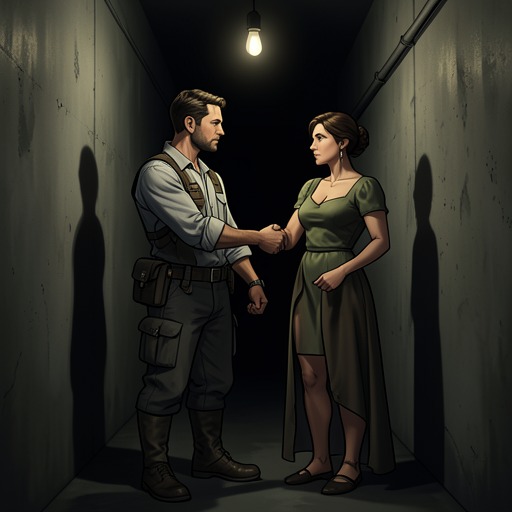
Diana Jones–William King relationship
Falling For The CEO: BAD BOY ROMANCEDiana Jones–William King relationship is the central romantic bond formed between a grieving hotel concierge and the executive whose professional authority threatens her livelihood. It begins with immediate physical attraction, becomes entangled with Diana Jones's fear of losing her job and William King's distrust after Julia's betrayal, and survives only when both are forced to distinguish the people they love from the identities and histories they have hidden.
Identity and First Encounter
Diana Jones first meets William King in a hotel elevator during the rush before a welcoming event. She is late, has had to dress in an empty room after her shift, and is running because Connor Jones would be furious if she missed the occasion. Her hurried entrance nearly collides with William King, but embarrassment gives way to fascination when she studies his wind-blown dark hair, blue-green eyes, height, tailored suit, and transforming smile. The encounter is charged before either person knows what the other represents.
The elevator's confined space turns attraction into vulnerability. When Diana Jones leans against the wall, its walls seem to close in and her breathing becomes difficult, revealing her claustrophobia. William King takes her hand and remains patient and steady while asking whether she has a boyfriend. Their eyes lock, and Diana Jones recognizes a physical intensity inconsistent with the controlled, closed-off self-image she has maintained. She gives him her name and experiences their handshake as unexpectedly intimate.
The first illusion of anonymity ends when Connor Jones arrives looking for William King and identifies him as the reason for the event. Diana Jones learns that the stranger is William King, Connor Jones's boss; she immediately identifies Connor Jones as her brother before he can disclose more. The same man who had seemed like a private romantic possibility is suddenly the executive connected to her family and employment. Her interest cools into hostility, and she dismisses him as an enemy rather than an attractive stranger.
Attraction Against Professional Boundaries
William King continues to seek contact, but Diana Jones initially refuses to pursue the connection because he is Connor Jones's boss and, as she understands later, also her own boss. When William King asks when he will speak to her again, she says that their relationship is not a good idea and that she cannot do this with him. He takes her hand, squeezes it, and accepts her decision even though his disappointment is clear. The moment exposes the conflict between restraint and desire: Diana Jones wants to protect her employment and her brother, yet the physical intensity of holding William King's hand makes refusal unstable.
Their attraction becomes harder to contain when Diana Jones explains that she lives in a small house inherited from her mother, Cora Jones. William King wants to date her, and his interest is not merely casual flirtation. Diana Jones nevertheless tries to control the risk by insisting that she speak to Connor Jones herself. She then asks William King on a date, partly because she wants to determine whether their connection is worth discussing with Connor Jones and worth risking her job for. William King agrees immediately, while the terms of the date show how thoroughly romance and employment have become inseparable.
A later kiss confirms that the relationship has moved beyond possibility. Diana Jones and William King kiss with tenderness that deepens into heat, and William King is nearly carried beyond his awareness of the public beach around them. He stops before the encounter becomes more private, then offers to take Diana Jones home. She refuses because she is not ready. Her refusal is not a rejection of him; it marks a boundary within a relationship whose emotional and bodily force is already outrunning the explanations available to them.
Concealed Identities and the First Break
The relationship's first major rupture arises from information rather than lack of feeling. While reviewing employee profiles during the hotel's downsizing process, William King sees Diana Jones's photograph. The image makes the earlier scenes fall into place: Connor Jones's reaction at the welcoming event, Diana Jones's surprise when William King entered her office, and her claim that she could not date him because he was only her brother's boss. William King realizes that Diana Jones works for the hotel and therefore works for him. In his eyes, her earlier explanation was a lie.
William King's discovery is intensified by his history with Julia. He has treated Diana Jones's concealment through the emotional template left by Julia's betrayal, so the professional secret becomes evidence of a broader pattern of deception. When he enters Diana Jones's office, he tells her that she has lied since the moment they met and asks how the fact that she works for him never emerged when he had asked what she did. Diana Jones answers that she did not intend to lie and that the concealment developed from fear, but William King hears the delayed truth as a direct assault on trust.
Diana Jones's fear is materially grounded. Kate offers to conceal Diana Jones's employment and organize colleagues to save her job, but Diana Jones refuses because protecting her would jeopardize everyone else's employment. She also tells Connor Jones that she cannot keep asking him to save her, even though he was the person who forced her back into work after their parents' deaths and helped establish her successful hotel-tour role. Her relationship with William King is therefore caught between two forms of dependence: emotional desire for William King and practical loyalty to Connor Jones, whose intervention gave her a life beyond grief.
The coworkers' response reveals that Diana Jones's work has created a reciprocal community rather than a one-sided favor. Kate and Miranda explain that they want to show Diana Jones the compassion she has shown them; she helped Jim find employment through Connor Jones and supported other colleagues in concrete emergencies. This network does not erase the ethical problem of her concealed status, but it demonstrates that the relationship's workplace consequences extend beyond the couple. William King's authority can affect Diana Jones, Connor Jones, and the people Diana Jones has made part of the hotel's social fabric.
Confession, Marriage, and Unequal Secrets
Diana Jones eventually admits that her initial concealment began with fear of losing her job but changed as her feelings deepened. She tells William King that she started falling in love with him and that the secret became less about protecting employment than about losing him. William King responds with painful hardness rather than reciprocal reassurance, saying that he is sorry she fell in love with him. The exchange makes the asymmetry of their knowledge unmistakable: Diana Jones has confessed the secret that made the relationship possible, while William King has not yet disclosed the history that makes his reaction so severe.
That history is revealed through Julia. Julia tells Diana Jones that she once worked at Grace and had been travelling with her husband, then identifies that husband as William King. Diana Jones is devastated to learn that William King was married to Julia. The revelation reclassifies him yet again: he is no longer simply a handsome stranger, employer, and lover, but also a former husband whose marriage was absent from the relationship's early disclosures.
The secret appears even larger when Diana Jones says that Julia described William King as having a child. William King insists that he is not a father. The contradiction between Julia's account and William King's denial introduces the unresolved consequences of his former marriage without allowing Diana Jones to understand them immediately. Her trust is damaged not only by the existence of an ex-wife but by the possibility that she has been excluded from a family history with direct relevance to their future.
William King's response to Diana Jones's concealment is later connected to his failure to process what Julia did. Gloria explains that he was hurt and that he had brushed aside the pain instead of dealing with it. She compares his withdrawal after his mother's abandonment with the emotional injury caused by Julia, arguing that both women occupied roles from which unconditional love should have been expected. Gloria believes that Diana Jones is special and that William King can move forward only by acknowledging the pain and wrongdoing rather than allowing them to govern his relationship with Diana Jones.
Reconciliation and the Demand to Begin Again
After time apart, William King returns to Diana Jones and kisses her gently before making a direct proposal: he asks her to start over with him, without the lie between them. The request is not presented as a simple restoration of the earlier romance. Diana Jones steps back, sits because her legs are too unstable to support her, and asks what has changed since he refused even to hear her apology. William King says that he has had time to think about what she said and recognized that her account of loss and its effects struck close to his own experience.
This attempted reconciliation changes the relationship's governing principle. At first, attraction repeatedly outruns knowledge: the elevator produces desire before identity is known, and the kisses make emotional commitment feel present before either person has disclosed the conditions shaping it. In the later encounter, William King explicitly asks for a relationship without the lie, while Diana Jones insists on understanding the reason for his change. Trust is therefore treated as something requiring explanation and renewed consent, not something automatically restored by physical tenderness.
The relationship is also supported by a wider network of care. Connor Jones's protectiveness is both a source of safety and a pressure that makes Diana Jones feel dependent. Kate and Miranda defend Diana Jones because her emotional labor has benefited the staff. Gloria urges William King toward honest self-examination rather than punishment. These relationships make reconciliation a social and ethical process: the couple must repair not only private hurt but also the damage created when romantic and professional roles overlap.
The renewed bond is marked by a lighter physical ease. Diana Jones tells William King that he makes her happy, and his playful response turns a simple drive into a promise of a surprise destination. Their restored intimacy is visible to Kate and Miranda, who know they have patched things up, and Connor Jones begins smirking whenever they occupy the same room. Diana Jones rolls her eyes at him but recognizes that he is happy for her. The scene does not erase the earlier lies, the threat to her job, or William King's unresolved trauma; it shows the relationship entering a new phase in which happiness can coexist with acknowledged history.
Narrative Significance
The relationship repeatedly changes meaning as the characters' identities are disclosed. William King moves from stranger to employer, romantic possibility, suspected deceiver, former husband, and man asking for another chance. Diana Jones moves from anonymous hotel worker to Connor Jones's sister, beloved colleague, hidden employee, and partner whose love is confessed under conditions of unequal power. Each reclassification redistributes trust: attraction is easy when the elevator hides their roles, but intimacy becomes ethically difficult once the roles are known.
The romance therefore links personal healing to institutional risk. Diana Jones's work rescued her from the depression that followed her parents' deaths, and William King's restructuring of the hotel threatens the stability that recovery depends on. William King's past with Julia makes him interpret concealment as betrayal, while Diana Jones's grief and fear of losing her livelihood make secrecy feel like self-protection. Their conflict is not caused by a lack of love; it is caused by the costs of trying to preserve love before the whole truth can be safely spoken.
Its eventual movement toward reconciliation depends on replacing punishment with recognition. Diana Jones accepts responsibility for hiding her employment, but William King must also recognize that his severe response is amplified by wounds he has never addressed. Gloria's counsel frames love as capable of healing only after pain and wrongdoing are acknowledged. The relationship's decisive promise is consequently not an uncomplicated happily-ever-after claim, but a conditional second beginning: William King asks to be with Diana Jones without the lie, and Diana Jones requires enough truth to decide whether that beginning can be trusted.