Diana attends Tara’s talent show and reconciles with Tara
Falling For The CEO: BAD BOY ROMANCEDiana attends Tara King’s talent show and reconciles with Tara, turning an uncertain appearance at a family event into a small but decisive act of repair. Gloria has invited Diana without William King’s knowledge, hoping to nudge him toward repairing their relationship, but Diana refuses to use the occasion to pursue him. She insists that William must be ready to come to her. Her presence therefore begins as an act of principle rather than a romantic maneuver, yet it becomes equally important because Tara experiences Diana’s absence as a personal rejection.
Causes and Circumstances
Gloria explains that Diana’s invitation was arranged behind William’s back because the King men sometimes need encouragement in the right direction. Diana immediately recognizes the ethical difficulty of appearing where William does not expect her. She accepts the invitation only conditionally, saying that she cannot remain if William does not know she is there and that he must be the one to approach her. This boundary preserves the meaning of their separation: reconciliation cannot be engineered entirely by relatives, and William must take responsibility for returning to her.
Diana’s decision is also shaped by her connection with Tara. Earlier, Tara had drawn Diana into rehearsing a Taylor Swift performance, teaching her most of the dance movements and part of the lyrics in a playroom. Diana had expected to sing and dance before William and his family, even though the prospect exposed how deeply she was falling in love with him. The talent show thus carries two overlapping stakes: William’s readiness to face Diana and Tara’s expectation that Diana will show up for her.
The Performance and Diana’s Witness
Diana watches the programme until Tara and William’s act is announced as a dance involving a surprise guest. William appears in a tracksuit that is too large for him, with the hood pulled over his head, while Tara wears a matching outfit. His dancing is conspicuously poor, but he continues trying to keep pace with his sister. The performance converts William’s usual image as a controlled, logical boss into a deliberately ridiculous public display. He knowingly makes himself look foolish for Tara, and the audience responds with laughter, applause, and finally loud cheering when he lifts his beaming sister onto his shoulders.
Diana laughs so hard that she has to wipe tears from her eyes, yet the comedy carries emotional force. William’s willingness to abandon dignity for Tara deepens Diana’s love for him rather than weakening it. His public failure as a dancer becomes a success as an act of brotherly care: he does not need to perform competence to prove devotion. Diana’s reaction also shows why the event matters beyond entertainment. She is not merely observing a family ritual; she is witnessing the tenderness and self-forgetting that make William’s family life intelligible to her.
During the interval, Diana remains restless, hoping that Gloria is right that William is ready for her. She goes to buy refreshments and returns carrying three cans of Coke, chips, and sweets. When William calls her name, he catches a can before it falls and takes some of the items from her instead of immediately giving it back. Their encounter is therefore practical and awkward rather than ceremonially romantic. William approaches her in the middle of an ordinary task, while Diana must manage both her uncertainty about him and the more immediate presence of Tara.
Tara’s Hurt and Reconciliation
Tara initially looks at Diana with curiosity and betrayal. When Diana praises the performance, Tara accepts the opening but then states the grievance plainly: Diana did not come to see her, and that absence made her sad. The emotional conflict is between a child’s expectation of dependable affection and Diana’s decision to stay away during the rupture with William. Tara does not treat the separation as an abstract adult matter; she experiences it as the loss of someone who had become her friend.
Diana does not defend herself or shift responsibility. She apologizes, crouches so that she is at Tara’s eye level, and offers a concrete remedy: she will come and play with Tara the following weekend or around that time if Tara wants her to. The promise matters because it turns regret into future action. Rather than asking Tara to understand the adult conflict, Diana gives the child a choice and acknowledges that continued contact depends on Tara’s willingness.
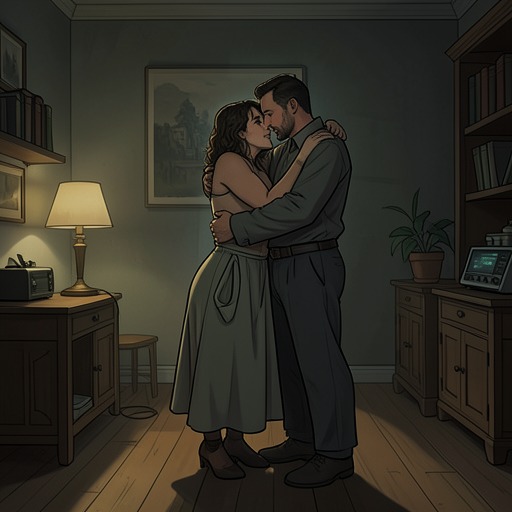
Tara responds by throwing her arms around Diana and whispering agreement in her ear. Diana hugs her back, then offers her hand and asks whether they are friends. Tara enthusiastically shakes it and answers that they are. The reconciliation moves through apology, proposed time together, physical embrace, and an explicit renewal of friendship. Tara’s quick but meaningful acceptance does not erase the hurt; it establishes a new trust through a promise that can be kept.
Consequences and Narrative Significance
The event separates two kinds of repair that the surrounding plot repeatedly brings into conflict. Diana refuses Gloria’s attempt to place her directly before William as a solution to the lovers’ estrangement, but she accepts responsibility for the injury her absence has caused Tara. Her boundary with William remains intact while her relationship with Tara is restored. This contrast makes the scene more than a subplot: it demonstrates that reconciliation must be addressed according to the particular relationship involved.
The talent show also reframes public performance. Tara’s formal performance gives way to William’s comic effort, and Diana’s role shifts from a potential performer to an attentive witness and then to an active participant in Tara’s emotional repair. The family’s laughter, William’s willingness to be ridiculous, Diana’s apology, and Tara’s embrace all transform vulnerability into connection. The scene’s decisive outcome is not that William and Diana immediately resolve their separation, but that Diana and Tara recover a bond strong enough to continue beyond the conflict between adults.