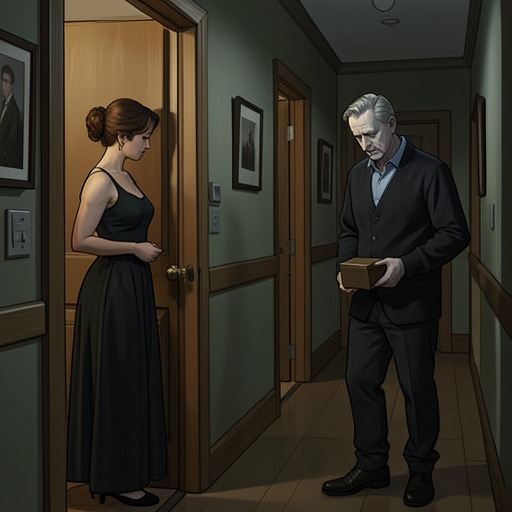
Diana separates from William until he heals
Falling For The CEO: BAD BOY ROMANCEDiana separates from William King until he heals because she understands that forgiveness alone cannot repair a relationship built on concealed histories and damaged trust. Although she loves him and does not want to lose him, she refuses to become a substitute for Julia or to let William’s unresolved pain dictate the terms of their intimacy.
Causes and Background
Diana and William’s relationship has already been strained by mutual concealment. At their first meeting, Diana is intensely attracted to the stranger in the elevator, admiring his dark, wind-blown hair, blue-green eyes, height, tailored suit, and transforming smile. The attraction becomes complicated when she learns that he is William King and that he is connected to her brother, Connor Jones. She tells William that Connor is her brother and later rejects the possibility of a relationship because William is her brother’s boss. In fact, William is also her own boss, a fact she has withheld.
William discovers the omission while reviewing employee profiles during the hotel’s impending staff reductions. A photograph reveals that the woman he has been thinking about over the weekend is Diana, and he realizes that her stated reason for refusing him was incomplete: she had not merely been avoiding a relationship with her brother’s employer; she had been avoiding a relationship with her own employer. The discovery activates his earlier betrayal by Julia. He feels that Diana has lied to him just as Julia did, and the professional hierarchy between them makes the concealment appear, to him, potentially connected to her fear of losing her job.
Diana later explains that she did not invent her occupation. She is a tour guide; she simply failed to say that the work was at the hotel. Her silence began in fear that William would believe she had deliberately misled him. She describes the relationship as something that happened after they became trapped together in the elevator, before she had fully processed who he was or what the workplace connection meant. When she apologizes, she accepts responsibility for the lie while insisting that it was defensive rather than calculated.
The deeper revelation comes when Julia Brown tells Diana that William was her husband. Diana then learns that Julia has a child and assumes William is the father, only to discover that he is not. William explains that he stayed with Julia through the pregnancy until a medical appointment revealed that the timeline made paternity impossible: he had been away at a conference for two weeks during the possible period of conception. He left after the appointment, contacted a lawyer, and did not see Julia again after the divorce. Julia first begged him to stay and said that she loved him, then lashed out and blamed him for not giving her enough attention. William’s account makes clear that the marriage ended not simply through separation, but through betrayal that he has never properly processed.
The Separation and Its Terms
Diana listens to William’s explanation and softens toward him. She understands why his marriage is difficult to disclose and says that she can forgive the lie, in part because she would be hypocritical to demand forgiveness while refusing to extend it herself. Yet she distinguishes between forgiving a deception and accepting its consequences. William’s account explains his guardedness, but it does not prove that he is ready to love Diana without filtering her through Julia’s betrayal.
When William admits that he does not know whether he has worked through what happened, Diana identifies that uncertainty as the central problem. She tells him that they cannot be together until he confronts his feelings about the marriage and its ending. Her concern is specific: although she is not Julia, William may treat her as though she were Julia if the earlier wound remains active. The separation therefore functions as a boundary against repetition. Diana will not allow the new relationship to become an arena in which William unconsciously punishes or distrusts her for another woman’s actions.
Her decision is painful rather than punitive. She tells William that she loves him and does not want to lose him, but love does not persuade her to abandon the condition she has set. She kisses him on the forehead, opens the door, and asks him to leave. The gesture combines tenderness with finality: she acknowledges the bond between them while physically ending the encounter.
The Final Exchange
William does not leave immediately. He lifts Diana’s chin, kisses her, and allows the moment to become as intense as the circumstances permit. Diana clings to him as though trying to memorize the sensation, but she ultimately pulls back because the kiss cannot alter the unresolved condition between them. The physical closeness makes the separation more difficult, not less; desire remains present even as trust requires distance.
At the door, William turns and asks whether Diana will wait for him. She answers, "Yes." The answer does not cancel the separation or promise that healing will be immediate. Instead, it preserves the possibility of reunion while leaving responsibility for change with William. Diana closes the door and sinks to the floor, finally allowing herself to cry, so the scene ends with hope held inside grief rather than with an easy restoration.
Consequences and Significance
Diana’s separation changes the meaning of reconciliation in the relationship. Earlier, William asks to start over without the lie between them, and Diana is moved by his recognition that her grief and fear resemble aspects of his own experience. But a fresh start cannot consist only of renewed attraction or a declaration of love. It must also include honest knowledge, accountability, and the work of distinguishing present intimacy from past injury.
The action gives Diana unusual authority within the romance. William is her boss, Connor Jones’s employer, and a man whose emotional history has shaped his responses to new partners. Diana’s refusal to proceed on his terms counters that imbalance. She does not deny his suffering, and she does not treat his past as irrelevant; she insists that he take responsibility for it before asking her to share its consequences.
The separation also completes a pattern of revelation and conditional forgiveness. Diana first explains her own concealment and apologizes for hurting William. William later reveals his marriage to Julia, the non-paternity discovery, the divorce, and the anger that followed. Each confession expands the other’s understanding, but neither confession automatically restores trust. The action’s decisive principle is that compassion must not become self-erasure: Diana can understand why William is wounded while still requiring him to heal before their relationship can resume.