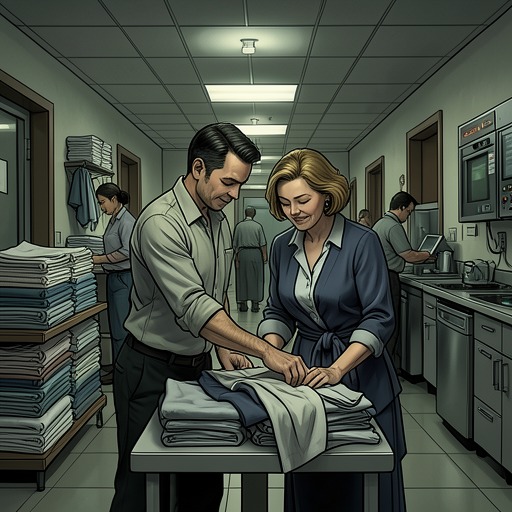
Jim Kruger
Falling For The CEO: BAD BOY ROMANCEJim Kruger is a reserved colleague at the Grace Hotel whose importance lies less in extended dialogue than in the dependable actions and relationships surrounding him. A chef preparing for the breakfast rush, Miranda's husband of a few months, and one of the employees who owes part of his position to Diana Jones, he belongs to the network of ordinary loyalties that counters the hotel's impersonal financial pressures.
Identity and Workplace Role
Jim is introduced in the staff lounge during an early-morning breakfast with Miranda. His presence is tied immediately to the practical rhythm of hotel work: after a brief exchange with Diana, he picks up his white chef's hat and prepares to face the breakfast rush. The hat provides the clearest concrete marker of his occupation, while his quiet conduct gives him a distinct presence among the more verbally expressive characters. He answers Diana's greeting simply, smiles shyly, and does not try to dominate the conversation.
His reserve is also registered socially. Diana describes his conversational style as predictably succinct, and Miranda jokes that he has a particular way with words. Yet his quietness is not presented as indifference. Before leaving, he kisses Miranda and gives Diana a squeeze on the shoulder, expressing affection through a small physical gesture rather than an elaborate declaration. The contrast between his limited speech and his fluent gestures establishes him as a character whose reliability is communicated through conduct.
Relationship with Miranda
Jim is married to Miranda, who describes him as her husband of a few months. Their relationship is affectionate and playful: they share breakfast, Miranda gives him bacon from her plate on her fork, and Diana teases them about the intensity of their love. Jim responds to the teasing with a shy smile rather than embarrassment or defensiveness, then leans down to kiss Miranda before returning to work.
The marriage is presented as a mutual achievement rather than a frictionless romantic ideal. When the hotel staff later encourage Diana after her professional and personal crisis, Miranda explains that Jim asked her to marry him even though she had once left him to find herself. The detail gives their relationship a history of separation and renewed commitment. It also makes Miranda's support for Diana more personally grounded: she speaks as someone whose own relationship survived a serious rupture, not as an observer offering easy advice.
Connection with Diana and the Staff
Jim's position at the hotel is connected to Diana's influence. Miranda states that Jim would still be looking for a job if Diana had not spoken to her brother, Connor Jones, about hiring him. This places Jim inside the chain of assistance that runs through the Grace Hotel: Connor gave Diana an opportunity after her parents' deaths, Diana helped Jim, and Jim subsequently becomes part of the workplace community that tries to protect Diana when her employment is threatened.
The staff's intervention is explicitly reciprocal. When Kate and Miranda assemble the employees to propose a plan for saving Diana's job, they describe their effort as a way of showing her the same compassion she has shown them. Jim contributes a concrete argument in her favor: the revenue she brings into the hotel. His interruption is characteristically quiet, but it is economically precise. He recognizes that Diana's emotional labor as a guide is also productive labor, because her customized tours generate value for the company and strengthen the guest experience.
This support matters because Diana's work began as an improvised role rather than a formally qualified position. Connor arranged a trial period after guests responded enthusiastically to her willingness to plan and lead trips around Cape Town. Diana's research into the city's history and culture eventually became a service that guests valued. Jim's emphasis on revenue helps translate that value into the language William King, as the hotel's decision-maker, must consider. His loyalty therefore has both an emotional and a practical dimension: he is grateful to Diana, but he also understands the business case for retaining her.
Work, Service, and Professional Solidarity
Jim's role as a chef places him alongside Diana in the hotel's service economy, though their forms of labor differ. He prepares food and faces the breakfast rush; she communicates with guests, designs itineraries, manages individual expectations, and turns local knowledge into an experience. Their shared workplace connects apparently different kinds of service, showing how the hotel's reputation depends on many forms of often-uncelebrated effort.
Diana's guiding is especially demanding because it requires continuous attentiveness to other people's personalities. During a custom tour, she notices that Dorian is uncomfortable around people and adjusts her approach, while also accommodating his sister Jasmine's enthusiasm. Jim's intervention on Diana's behalf recognizes the commercial result of this care. Guest testimonials describe her as making visitors feel like a top priority, customizing tours, and helping them feel part of Cape Town's history. William sees that the service she created has become an asset to the Grace Hotel, and Jim's point about revenue belongs to the same recognition of value.
The staff's solidarity also places Jim within a collective response to threatened retrenchment. Kate proposes gathering employee testimony and guest recommendations; Jim supplies the financial dimension of the argument, while others recall Diana's personal assistance. The effort reveals a workplace held together not only by managerial structures but by remembered acts of care. Jim is both beneficiary and participant in that system.
Narrative Function and Significance
Jim is a minor character with a concentrated narrative function. His shyness, white chef's hat, concise replies, and affectionate gestures create a quiet counterpoint to the tensions surrounding Diana's job, William's distrust, and the hotel's efficiency policy. He does not lead the central conflict, but his presence makes its stakes tangible: a decision about Diana's employment affects a community of workers whose opportunities and stability are interdependent.
His marriage to Miranda reinforces the book's interest in second chances and repaired bonds. Their history includes her departure and Jim's continued commitment, while their present life is represented through ordinary intimacy before work. That domestic warmth parallels the staff's collective defense of Diana and helps frame the Grace Hotel as a place where professional relationships can become forms of care.
Jim's most significant contribution is therefore one of recognition. By naming the revenue Diana brings in, he helps expose the contradiction in treating her as dispensable when the service she created has become one of the hotel's distinctive benefits. His understated voice carries an essential truth: emotional attentiveness, local knowledge, and individualized hospitality are not merely personal virtues but labor with measurable consequences. Through Jim, the novel gives that labor a witness from within the staff itself.