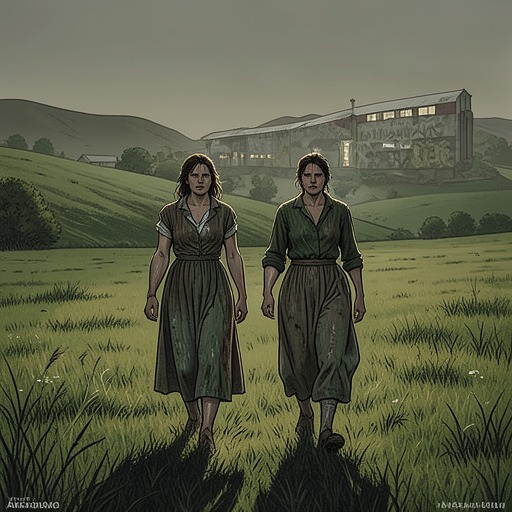
Amanda
Fever DreamAmanda is the first-person narrator of a story told through an intense, fragmented conversation with David. Her attention returns to Nina and to the distance between them, while the conversation’s recurring questions about what is important, how the poisoning began, and what happens to a spirit expose the limits of what Amanda can know. As her own illness deepens, the mother who has spent the story measuring how quickly she could reach Nina discovers that she may be unable to reach her at all.
Identity and Narrative Situation
Amanda speaks to David from a compromised physical state: she cannot always move, and she understands that she is going to die within hours. At the same time, she is trying to reconstruct what happened, and David’s questions steer her back through events she has already described. The conversation is therefore not a straightforward account delivered from a position of control; it is a pressured act of remembering, interrupted by uncertainty and by the condition of her body.
The dialogue opens with worms as an image Amanda must help clarify. She and the boy distinguish worms in the body from another kind, and David insists that they must wait for the precise moment the worms come into being because it matters to everyone. The explanation redirects the image toward poison and contamination: the sensation may feel like worms, but, as David reminds her, the story is not really about worms. Amanda’s effort to answer him makes her own experience part of a larger, still-unresolved account of harm.
Motherhood and Rescue Distance
Amanda names the imagined space between herself and Nina the rescue distance. She calculates how long it would take to get from the car to Nina if the child ran toward a pool, and says she spends much of the day making such calculations, sometimes taking risks herself. The term gives a precise name to a maternal habit: she watches not only where Nina is but how quickly she could intervene if danger arose.
At the vacation house, that distance changes with circumstances. At first Amanda wants Nina close, checks the house’s exits, notices splintered areas of floor and worries about the creaky stairs. She shows Nina the hazards. By the second day, the invisible tie between them has loosened enough to allow some independence. Later, after Amanda speaks with Carla, the tie tightens again; Nina’s movement toward the kitchen window and her bursts of energy make Amanda anxious. The changing distance registers both practical vigilance and the shifting pressure of Amanda’s fear.
Nina’s safety also shapes Amanda’s attention while she is sick. When Carla tells her that Nina is fine, that reassurance does not resolve Amanda’s concern about what is happening elsewhere. Even as Amanda tries to speak with her husband, she repeatedly asks where Nina is. By the time Carla is holding her hands, Amanda understands that Nina may be in danger at the Green House, and her wish to leave becomes an urgent effort to get her daughter out.
The Poison and the Proposed Migration
Carla’s account of David’s earlier illness gives Amanda a framework for the crisis, but not certainty. Carla recounts that David took a long time to speak again after his fever and then began answering ordinary questions with the same phrase: “That is not important.” Amanda suggests that he may have heard the woman at the Green House say it, or that it could be an effect of the shock he experienced during the fever. The repeated answer unsettles Carla because it is so unlike what she had known from her son; for Amanda, it is evidence that the aftermath cannot be reduced to the fever’s end.
Carla also describes the woman’s proposal to move David’s spirit into another body before it was too late. The woman believed that some of the poison would go with him, dividing its effects across two bodies and giving David a chance to survive. She did not promise success. Nor could she choose the family receiving David’s spirit or know where it would go. Carla says the exchange would leave something of each spirit in the other body, so David would not be the same and she would have to accept his changed being. Amanda wants to dismiss the explanation, but recognizes that her disbelief does not make the decision or its consequences disappear.
This story of migration shadows Amanda’s own worsening illness. When she is very sick, she tells her husband that it is not sunstroke, and Carla contacts the woman at the Green House, saying there is little time. Carla asks Amanda for agreement, but Amanda answers that she will stay in her own body. The exchange shows that Amanda understands what Carla is proposing even as she refuses it; the choice is bound up with the threat to Nina and with the uncertain consequences Carla has already described.
Illness, Repetition, and the Breaking Point
David says Amanda has told him four times how she came to be there. His insistence that they have already discussed the poison and contamination makes repetition part of the scene’s structure: Amanda’s account circles back, while her questions keep returning to Nina and to the moment things began. The conversation does not simply fill gaps in her knowledge. It makes the difficulty of holding a continuous account visible.
The scene marked as the beginning is modest: Nina is wet, and Amanda tells her that the dew will dry as they walk. Amanda challenges David’s claim that this is the decisive moment, asking whether that can really be all there is. David answers that this is how it starts. The contrast between the ordinary observation and the weight assigned to it leaves the origin of the danger disquietingly small and difficult to identify with confidence.
As Amanda’s condition comes and goes, she cannot act on what she has realized. She lets go of Carla’s hands and thinks about getting out of bed to reach Nina at the Green House, but David tells her it will be some time before she can move. Her rescue distance, ordinarily a calculation about how to protect Nina, knots up into helplessness. The passage ends with Amanda still in pain and still trying to contact her husband to tell him where Nina is; it does not establish that she reaches her daughter or changes what is happening at the Green House.
Relationships and Narrative Significance
Amanda’s relationship with Carla is shaped by a shared concern for children and by the pressure of an extraordinary decision. Carla’s account presents the migration as the only method she knew to try to save David, while its uncertain effects make consent and forgiveness central to the crisis. At the bedside, Carla says she is asking Amanda’s forgiveness for what is happening at the Green House, not simply asking her to agree. Amanda’s response is not abstract: her immediate thought is that she must get Nina out.
The conversation with David, meanwhile, is the form through which Amanda’s story can be told. He asks for particulars, insists on distinctions, and marks some subjects as unimportant, even as Amanda returns to what matters most to her. Their exchange holds two kinds of urgency together: the need to locate the beginning of the poison and the need to know where Nina is now. Amanda’s character emerges in that tension. She seeks an explanation, but when explanation conflicts with the possibility of protecting her daughter, she turns toward the rescue distance and the child at its far end.