Amanda and David’s dialogue
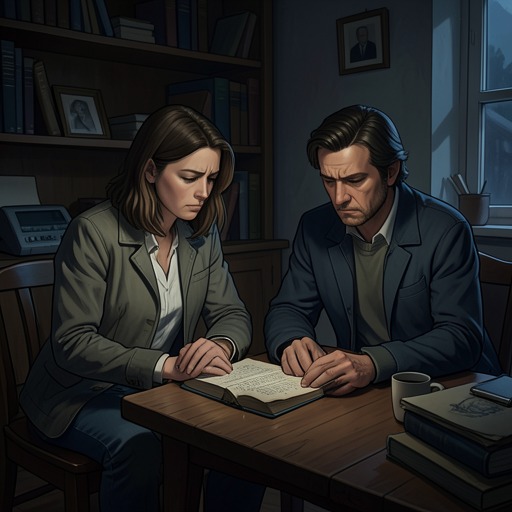
Fever DreamAmanda and David’s dialogue is the novel’s guiding but unstable conversation: as Amanda lies gravely ill, David questions her about the past and insists that they find the moment when the worms—or, as the account comes to clarify, the poison and contamination—began. The exchange is not simply a way to recount events. Its repeated questions, corrections, silences, and declarations of importance govern what can be remembered, what Amanda is asked to notice, and how close she comes to understanding her family’s crisis.
The conversation’s frame
The dialogue begins in darkness, with Amanda unable to move and David speaking close to her ear. She asks who the worms are and whether they are inside the body; David distinguishes these worms from that idea and tells her they must wait to discover the exact moment they come into being. His insistence that this matters to everyone gives the conversation a purpose before Amanda can grasp its circumstances. The reader learns the terms of the exchange gradually: Amanda can see the story but says she is stuck, while David keeps trying to move it forward.
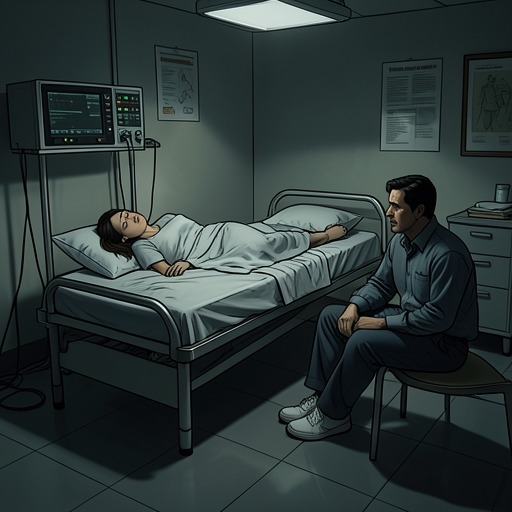
The frame becomes more concrete when David says that he is kneeling beside Amanda’s bed in a room at the Rural Emergency Clinic and that they have little time to find the moment. Amanda recognizes that she may die within hours, although David has not told her so directly. Her calm acknowledgment does not resolve the conversation; it sharpens its urgency. The dialogue proceeds between a present crisis and scenes recalled from earlier events, so that questions about what happened also become questions about what Amanda can still recover before time runs out.
Questions, corrections, and control
David directs attention through repeated prompts. He asks Amanda to focus and warns that he does not want to begin again from the start, implying that the conversation has already retraced its path. When Amanda asks whether they have done this before, she also asks where Nina is. David redirects her toward the search for the decisive moment. The repeated return to the same questions makes their exchange feel less like a linear interview than an effort to reconstruct an account that keeps slipping away.
The speakers do not agree on what deserves attention. Amanda wants to challenge the story as nonsense, but David answers that her opinion is not important. Later, when Amanda wonders how much her altered relationship with her son matters, David again rules that out as the central issue. These exchanges distribute conversational authority unevenly: Amanda supplies memories and questions, while David selects, redirects, and names the subject that must be pursued. His control is not evidence that he knows every answer; the dialogue repeatedly shows him demanding focus because the account remains incomplete.
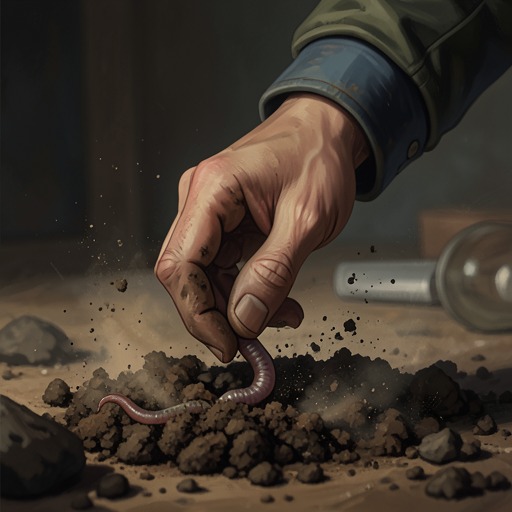
Their disagreement over worms illustrates the difference between an image and an explanation. Amanda returns to worms as a question, but David corrects her: it is not really about worms; it feels like worms in the body at first, while the underlying issue is poison and contamination. He also tells her she has already described how she got there several times. Repetition thus has two effects. It marks Amanda’s difficulty holding onto the narrative, and it gives David a way to separate the frightening sensation from the event he believes they need to identify.
Memory as evidence
The conversation opens onto Amanda’s memories of the earlier poisoning of David. In Carla’s account, David had knelt by a stream while a missing stallion drank nearby; he put his hands in the water and sucked his fingers. Carla saw a dead bird close to him, became frightened, and carried him away while struggling to lead the horse uphill. The stallion was gravely ill the next morning. Carla feared that David had drunk the same water and shut herself in a room with him, believing there might be only minutes or hours to find help. In the later dialogue, these details matter not as a self-sufficient explanation of the wider contamination, but as part of the evidence Amanda must revisit.
David’s childhood illness also returns through the change in his speech. Carla recalls that, after a fever, he was slow to speak again and began answering ordinary questions with the phrase “That is not important.” What had once been an unfamiliar response becomes a sign Carla cannot easily dismiss: its repetition makes her legs tremble because David had not spoken that way before. Amanda proposes that he may have heard the phrase from the woman in the Green House or that it might be a consequence of the shock of his illness. The conversation preserves this uncertainty rather than settling the cause, and the phrase echoes David’s own later authority over what Amanda should consider important.
Other recollections broaden the pattern beyond one child and one stream. David describes men unloading large plastic drums from a truck by a shed; one drum is left alone in the doorway. Amanda identifies the moment as significant, while David urges her to see that this is it. The dialogue then connects that scene to what happens around them: people in the area become ill, animals die or disappear, and a foal remains alone in a pasture after the horses are gone. Carla recounts that Omar woke to find the doors open and the horses missing; the foal stood motionless as he approached, and it was still there when the police inspector and his assistants left. These remembered observations accumulate as clues, but the exchange does not turn them into a precise chemical diagnosis.
Nina and the pressure of what matters
Amanda repeatedly pulls the conversation toward Nina. When David says they must find the crucial moment, Amanda asks where Nina is; when he insists that worms are only the beginning of the explanation, Amanda again asks what happened to her daughter and what the moment has to do with the worms. David answers by returning to poison and contamination. His redirection keeps the investigation moving, but it also leaves Amanda’s central fear unresolved within the exchange.
The concern is rooted in the closeness Amanda describes between herself and Nina. After a conversation with Carla, Amanda feels the rescue distance between mother and daughter become shorter. She wonders what could have made Carla no longer accept David as her son, but then recognizes that such questions are not the immediate point. The dialogue therefore sets one form of knowledge against another: the emotional and relational questions that seize Amanda’s attention, and David’s demand to identify the event that explains the poisoning. Neither cancels the other, but the conversation gives David the power to postpone Amanda’s questions about Nina even as those questions expose the stakes of the search.
That conflict returns in the late exchange. Amanda repeats Nina’s name and asks how she could have been without her for so long. She has previously told Nina to ring a house’s doorbell and ask someone to call her father, a remembered instruction that makes Amanda’s later uncertainty about Nina more painful without supplying a resolution. Near the end, Amanda says she is exhausted and asks David to tell her what the important thing is. She believes the ordeal is ending and wants the silence to remain. David answers by naming the Ducks, Mr. Geser’s dog, and the horses as lives he has pushed, before Amanda asks whether the poison is everywhere. The final turn gathers the recurring animal deaths and contamination into one question, while leaving the dialogue’s central explanation unresolved.
Narrative function
Amanda and David’s dialogue makes the act of remembering part of the plot. A question can open a memory; an answer can be corrected; and a detail that seems decisive can be displaced by the next demand to focus. The repeated searching also makes time feel unstable: Amanda encounters scenes from the past while speaking from a clinic bed in the present, and David’s warning against starting over suggests that the account has been told repeatedly. The structure asks the reader to compare fragments rather than receive a single, settled exposition.
The exchange’s most revealing tension lies in its use of importance. David says that finding the moment matters to everyone, rejects Amanda’s opinion as unimportant, and repeatedly insists on the central clue. Yet Amanda’s questions about Nina, her recollection of David’s changed speech, and her attention to the missing animals disclose the human consequences the investigation risks treating as secondary. By making the speakers negotiate both the content and priority of memory, the dialogue turns the search for a cause into a struggle over attention: what can be known, what must be said again, and whom the search is meant to save.