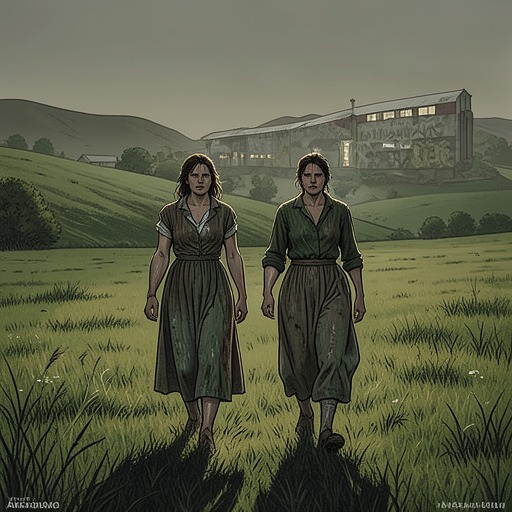
Amanda and Nina are misdiagnosed with heatstroke
Fever DreamAmanda and Nina are misdiagnosed with heatstroke during an episode that the narrative identifies as poisoning. Their trip to the Rural Emergency Clinic briefly appears to offer help, but the nurse’s reassurance and instructions to go home leave them in danger. For Amanda, already measuring the imagined “rescue distance” between herself and Nina, the mistaken diagnosis makes the distance between urgent need and effective care suddenly consequential.
The Journey to the Clinic
Before the diagnosis, Carla offers to fetch the car and jokes that the errand will help her find the courage to drive alone and bring Amanda over to her house for iced tea with lemon and ginger. Amanda recognizes that the drink will not cure what is wrong, although the discomfort comes and goes and she feels a little better for a time. Carla leaves Nina in charge while she goes to get the car, promising to return from the other direction along the dirt road.
Once they are in the car, the danger becomes visible in Nina’s condition. She is pale and sweating in the back seat. She sits with her legs crossed as usual and has fastened her seat belt without being told, but leans slowly toward the front before falling back. Amanda’s “rescue distance” feels so short that Nina’s body seems to pull on hers. Carla repeatedly straightens up but cannot relax, watching Amanda from the corner of her eye. She explains that they are going to the clinic to see whether someone can examine Amanda; the urgent trip is prompted by Amanda’s symptoms, even as Nina is also unwell.
Examination and Misdiagnosis
On the journey, Amanda experiences the world as altered and difficult to control. The heat is intense; sounds grow muffled, her clothing sticks to her with sweat, and nausea briefly forces her forward. When Carla is no longer in the driver’s seat, Amanda feels frightened and disoriented. She sees herself being led down the hallway behind the classroom, and Nina’s voice about the drawings reassures her that her daughter is still there. Inside a small room, Nina holds Amanda’s hand and leads her in. A nurse checks Amanda’s blood pressure and temperature, looks at her throat and pupils, and asks whether her head hurts. Amanda struggles to speak; Carla answers for her, and Amanda confirms that she has a severe headache. Once named aloud, the pain becomes sharply present to her.
The nurse dismisses the danger as too much sun. She tells Amanda and Nina not to worry, gives each of them a pill and a cup of water, and advises them to rest at home, avoid the sun, and take a nap in a dark room. She hands Carla a blister pack and instructs them to take one pill every six hours. The treatment and explanation are for heatstroke, not poisoning. The narrative states plainly that the two are poisoned, making the nurse’s confidence an instance of failed recognition rather than a resolution of the crisis.
Amanda asks Carla to call her husband. Carla says that she and Nina had already discussed it, but Amanda is troubled by Carla’s condescending tone and by her failure to stand immediately to make the call. The exchange shows how illness restricts Amanda’s ability to advocate for herself: she has only just managed to ask for help, while Carla is acting on a plan of her own. The nurse’s instructions nevertheless govern the immediate outcome, and the group leaves with the pills and a direction to rest.
The Return Home and Continuing Danger
Carla leads Amanda and Nina back to the car, holding one by each hand. They stop every few steps, and the account does not identify which of them needs to pause. On the gravel road Carla grips the steering wheel in silence. They pass the house they left that morning without speaking; Mr. Geser’s dogs run and bark alongside the car, but neither Amanda nor Carla appears to notice. With the sun overhead and heat rising from the floor, they return under the mistaken impression that rest and the prescribed pills are appropriate.
The narrative initially says that nothing important happens after the clinic, then immediately resists that apparent closure: Carla parks beside the three poplar trees at her house, and the account insists that further details matter. Later, as the effects come and go, Amanda recognizes the contradiction in the care they received: she and Nina are poisoned, yet the nurse gave them medication for sunstroke. The diagnosis has not ended the danger; it has obscured it and sent them back home while their condition continues.
Rescue Distance and the Stakes of Care
The episode echoes the earlier memory that gives Amanda’s “rescue distance” its name: the imagined gap between her and Nina, calculated against the possibility that Nina might suddenly run to the pool. In the car, that abstract measurement becomes immediate when Nina falters and Amanda feels their bodies connected by the short space between them. Even at the clinic, Nina’s hand remains on Amanda’s as though trying to restrain or steady her. Care moves in both directions, though Amanda is too ill to protect Nina as she wants.
The later crisis makes the clinic’s failure more than a mistaken label. Carla holds Amanda’s hands and asks for consent to act quickly, but Amanda understands that Carla is asking for forgiveness for what is happening at the Green House. Amanda lets go and thinks of getting Nina out, while the narrative makes clear that she cannot move yet. Set against that impending decision, the heatstroke diagnosis marks a decisive failure of ordinary care: the symptoms are examined, but their cause is missed, and the time lost intensifies the danger to both mother and daughter.