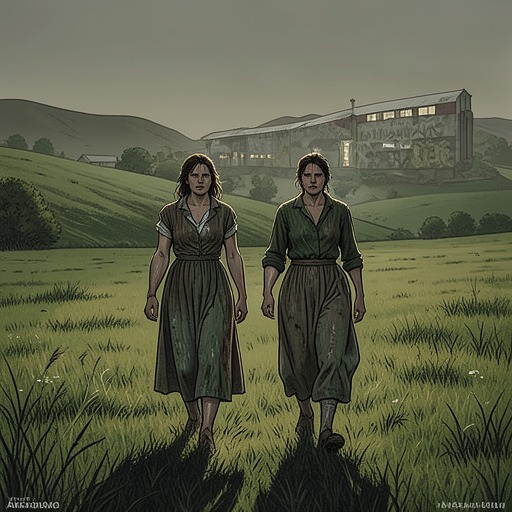
Amanda and Nina’s poisoning
Fever DreamAmanda and Nina’s poisoning is a gradual medical crisis that turns an ordinary visit into evidence of a larger environmental danger. Its unsettling force lies in the gap between what the women experience and what the available care recognizes: their symptoms intensify, but the clinic calls the problem sun exposure, while the surrounding story links human illness to dead animals, poisoned children, and the arrival of plastic drums. The evidence establishes poisoning, but does not identify a specific contaminant or prove exactly how Amanda and Nina were exposed.
Background and Setting
The episode unfolds during a visit to Carla, amid her effort to persuade Amanda to see Omar’s abandoned stables. Before the women set out, a truck arrives at the shed. Two men unload large plastic drums, carrying them with difficulty; the truck is full of barrels, and one drum remains by the shed doorway. The delivery is a concrete sign of activity in the immediate setting, but the account does not establish what the drums contain or make them a confirmed source of the women’s illness.
The unease builds through mundane details rather than an immediate collapse. After the men finish unloading and go back inside, Amanda checks the time: it is a quarter to nine. Nina notices that her clothes are wet. Amanda turns her to check and tells her the wetness is dew that will dry as they walk. Soon Amanda realizes that she, too, is soaked; as they continue, the breeze cools the damp clothing, and Carla estimates that the stables are about twenty minutes away. The women’s dampness is an observed circumstance, not proof of a particular exposure route.
Symptoms and the First Response
Nina first reports a clear, localized symptom: her hands sting and feel as though they are burning. Later, in the car, she appears pale and sweaty. She sits with her legs crossed, as she usually does, and has fastened her seat belt without being asked. When she leans toward Amanda and then falls back, the short distance between them makes the moment especially alarming to Amanda, who has named the distance separating her from her daughter the “rescue distance.” Carla, increasingly unable to relax, tells Amanda they are going to the clinic in hopes that someone can examine them.
At the clinic, the women are told that everything is fine. A nurse attributes their condition to having had too much sun, advises rest, and gives each a pill from a blister pack. She also fills two cups of water from a fountain. Amanda wonders whether Nina is receiving the same medication she is. The clinical reassurance is temporary rather than resolving: after they return, the effect of the pills comes and goes, and the narrative makes explicit that both women are poisoned. Its contrast between a confident heat-related explanation and persistent symptoms exposes the inadequacy of the diagnosis without supplying a medical identification of the poison.
Escalation on the Road
After the clinic visit, the account follows Amanda’s worsening condition on the road. The light reflecting from the asphalt and pipes along the boulevard bothers her eyes, and she searches the glove compartment for sunglasses. Driving takes great effort; her body stings, and she describes the sensation as minute worms moving over her. The bodily experience is paired with immediate concern for Nina: Amanda fears that she may soon be left alone in the car and struggles to keep her attention on the road.
The symptoms grow severe enough that Amanda’s sight begins to fail. She sees a group of children, though her eyes are burning and watering; after the last child and an accompanying woman pass, she opens the car door, and the scene turns white. She keeps rubbing her eyes and thinks that water might let her wash her face. Rather than simply recording a medical decline, the passage makes impairment a practical danger: Amanda has to give Nina an instruction to ring a house’s doorbell and ask its occupants to call Nina’s father. The evidence does not establish what happens immediately after that request, but the later account confirms that Amanda has fainted and been brought back to the emergency clinic.
Diagnosis, Wider Pattern, and Consequences
The clinic’s heatstroke explanation is set against details that point beyond an isolated episode. In the waiting room, Amanda notices a nurse’s children and wonders whether children seen there are also poisoned. The subsequent exchange distinguishes between children who undergo poisoning episodes and children who, in the narrative’s account, were already poisoned at birth through something their mothers breathed, ate, or touched. The clinic scene therefore broadens the problem from Amanda and Nina’s illness to children whose exposure may begin before birth, while leaving the precise circumstances of their cases unspecified.
The broader pattern is also visible in Carla’s recollections. She describes an earlier incident in which David drank from a stream beside a dead bird, and the stallion that had been drinking there was gravely ill the following morning. In another remembered episode, Omar wakes to find the horses gone and a foal left alone in the pasture. These events do not prove that the same substance caused every illness or disappearance, but they give Carla grounds to connect Amanda and Nina’s poisoning with animal deaths and the town’s other affected children. Carla also points to the limits of local medical help: rural doctors called to the clinic may take hours to arrive, and people go to the woman in the Green House when a case is serious. The story thus places the women’s failed reassurance within a setting where prompt medical care and clear explanations are hard to obtain.
Carla later visits Amanda after learning that she has been brought back to the emergency clinic. By then, seven hours have passed since Amanda fainted, and more than a day since the poisoning. Carla sees the episode in relation to the children in the waiting room, the deaths of horses, a dog, and ducks, and David’s changed place in her household after the soul migration. She believes that moving Amanda from one body to another has altered something small and invisible and holds herself responsible. The account reports her fear rather than confirming it: it calls the cause something worse, leaving the exact relationship among the poisoning, the animals, and the soul migration unresolved.
Narrative Significance
The poisoning develops through delayed recognition. Wet clothes, burning hands, difficulty driving, and trouble seeing accumulate before anyone provides a useful explanation; the clinic’s assurances briefly restore normality but do not account for the illness. That structure echoes the larger pattern of environmental harm in the story: its signs appear in separate bodies and places, and the evidence is difficult to assemble into a single proven cause. The barrels at the shed, the earlier stream incident, sick and missing animals, and children described as poisoned form a troubling constellation, not a confirmed toxicological chain.
The episode also puts care under pressure. Amanda calculates the distance she must cross to reach Nina, Carla decides to take the women to the clinic, and Amanda ultimately has to enlist a stranger’s help for her daughter when her own vision fails. Each response is concrete, but none can substitute for reliable diagnosis or immediate rescue. By linking a mother’s narrowing ability to care for her child with a community’s limited medical resources and a wider record of suspected contamination, the poisoning becomes both a personal emergency and an unresolved public danger.