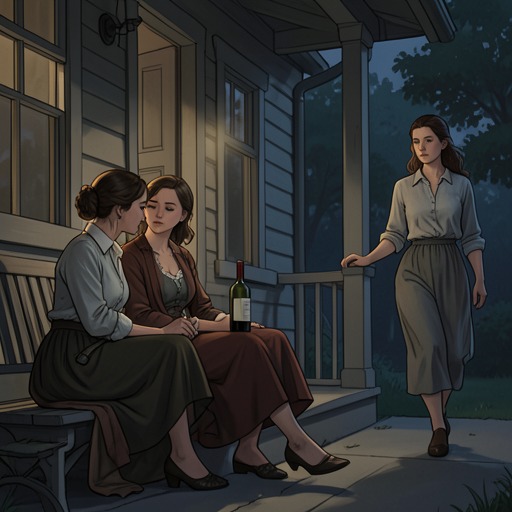
Amanda gives up leaving immediately and goes to find Carla
Fever DreamAmanda gives up leaving immediately and goes to find Carla because she cannot return to the city with an unresolved quarrel weighing on her conscience. She intends to apologize for yelling, reassure Carla, and explain that she and Nina are leaving. Instead, their meeting leads them toward Omar’s abandoned stables just as plastic drums are being unloaded nearby. The choice to seek reconciliation thus brings Amanda and Nina close to the material evidence of the contamination and to a crisis whose consequences Amanda does not yet understand.
The Decision to Turn Back
Amanda’s plan to leave is explicit: she shuts off the house’s main power, locks the front door, and leaves the keys in the mailbox, following the instruction Mr. Geser had given for departure. But she has another obligation in mind. She wants to tell Carla that everything is all right, apologize for the previous day’s argument, and leave without the guilt of having abandoned the conversation. In the exchange with David, he warns that talking to Carla is a mistake; Amanda answers that otherwise she will still be thinking about the situation after she has returned to the city.
At dawn, rather than leaving town by the direct route, Amanda drives in the opposite direction and stops at Carla’s house. She has never gone inside and would rather not, but finds it empty. Remembering that it is Tuesday, she guesses Carla may already be at Sotomayor’s offices, about a mile toward town. The empty house feels like a reassuring sign to Amanda, and she continues there with Nina. That small inference matters: Amanda reads the absence as confirmation that she is doing the right thing, even as the detour takes her farther into the events she hopes to put behind her.
The Visit to Sotomayor’s Offices
Amanda and Nina arrive at the manor-house property where Sotomayor’s fields begin. Amanda parks beside other cars on the grass. Inside, the place seems more like an office than a home: two men are drinking mate while a young woman signs papers and quietly reads each page’s titles. When the visitors enter holding hands, the activity stops, and the woman asks what they need. Amanda says she is looking for Carla.
When Carla finally sees them, she is surprised and frightened, glancing toward Nina as if she suspects something has gone wrong. Amanda tells her that nothing is wrong: she has come to apologize for the previous day and say that she is leaving. She says she and Nina are going back to the capital. The explanation begins as a farewell, not a request to join Carla or a decision to stay. Carla’s response changes the direction of the encounter: her hurt expression gives way, and she proposes showing them Omar’s stables. The stables are abandoned, but contiguous with Sotomayor’s land and easy to reach from the office.
The Drums and the Unintended Discovery
As Carla tries to persuade Amanda and Nina to go with her, a truck arrives outside. The men who had been drinking mate put on long plastic gloves and go out; another man’s voice, perhaps the driver’s, can be heard. Carla says she will drop off some papers and then take them to the stables, instructing Amanda and Nina to wait outside. A heavy plastic object falls without breaking. They leave Carla and go out to see two men unloading large plastic drums, struggling to carry one in each hand. The truck is full of barrels, and one drum is left by itself in the shed doorway.
The shift from an apology to the drums is central to the action. Amanda did not set out to investigate the fields, the offices, or the delivery; her decision to find Carla places her and Nina at the scene. The conversation calls this the moment they have been seeking, while the narrative’s earlier insistence on finding the exact point at which the worms come into being gives the discovery a wider significance. It connects the ordinary movement of people and vehicles around the property to the story’s growing concern with poison and contamination.
Consequences and Narrative Significance
The visit does not resolve Amanda’s relationship with Carla or secure a safe departure. Instead, the attempt to make peace exposes Amanda and Nina to circumstances whose importance becomes clearer only later. Amanda’s choice is therefore consequential without being presented as a deliberate investigation: she follows a moral impulse to apologize, accepts Carla’s invitation to the stables, and encounters the drums as they are being unloaded.
The action is also framed by the dialogue between Amanda and David, in which questions, corrections, and declarations about what matters control how events are understood. David says Amanda’s return to Carla is why she does not make it; Amanda’s decision is already being discussed as a turning point even before its consequences unfold. Elsewhere in their exchange, the search for the moment the worms begin is treated as necessary for everyone, while Amanda is at times told that a detail or opinion is not important. Against those shifting judgments, the abandoned stables and the single drum at the shed doorway become concrete signs that the seemingly private act of apology has led into the novel’s larger pattern of poisoned land, uncertain knowledge, and danger to the family.