Amanda’s husband visits Omar
Fever DreamAmanda’s husband visits Omar in search of an answer about Nina, whose illness has left him sensing that something more than her physical recovery is at stake. The meeting does not provide the explanation he wants: Omar says he has nothing to tell him, and David appears in the kitchen as a living sign of the mystery that neither man can explain. When the husband later finds David in the car, Omar removes him and takes him back to the house. The husband drives away alone, leaving the unresolved family crisis behind him and the rescue distance slack at last.
Approach to Omar’s house
The visit unfolds on a slow drive through town and out along a gravel road. Amanda’s husband passes the stoplight, plaza, supermarket, service station, and emergency clinic, then takes the road toward Carla’s house. At the house, he finds a patched roof, an open doorway screened by a plastic curtain, and a small bell whose rope he does not pull. He knocks twice. The sequence makes his arrival deliberate but hesitant: he has come to ask, yet does not know how to enter a household already marked by earlier visits and by what he cannot understand.
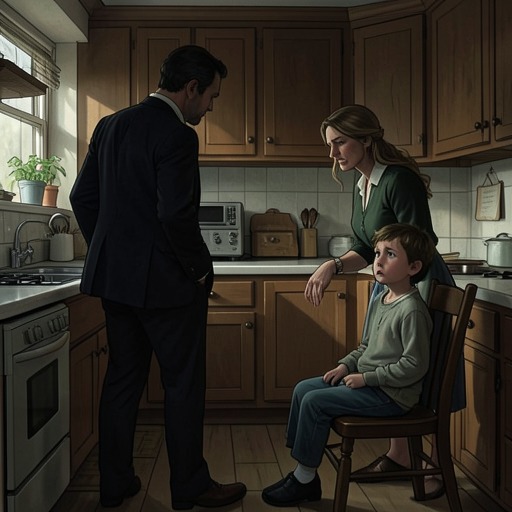
Inside, Omar is in the kitchen, searching the cupboards. The men are about the same age, but they do not seem to recognize one another. Amanda’s husband asks to speak with him; when Omar does not answer, he moves closer, cautiously, across the damp wooden floor. Omar’s stillness suggests that visitors are not new to him, although the account gives no further explanation of who has come before. His lack of response establishes the encounter’s guarded terms before the questions about Nina begin.
The question about Nina
Amanda’s husband opens with a report that his daughter is unwell. He says she has been under treatment for more than a month, that she is doing better, and that the spots on her skin hurt less. Yet he distinguishes this visible recovery from a further, inward change that he cannot identify. He pauses to give Omar time to take in the account, then asks whether Omar knows what happened to Nina. Omar answers that he does not.
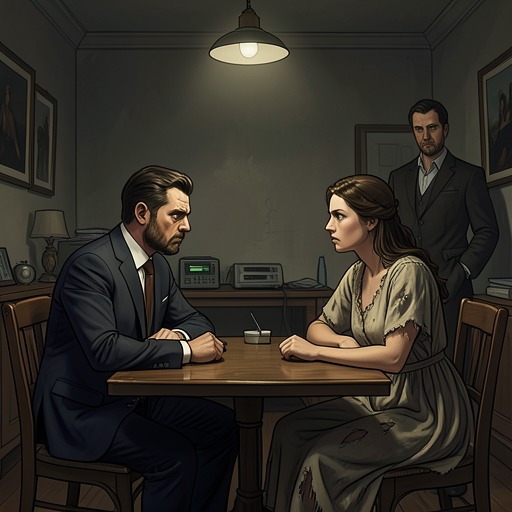
The answer leaves the husband without the knowledge he came to obtain. After a long silence, he presses again; Omar replies that there is nothing he can tell him. The exchange is marked less by argument than by withheld certainty: the father does not supply an explanation, and the husband has no evidence with which to challenge him. The husband’s frustration surfaces in a sudden movement at the table, which makes the sugar bowl jump and dislodges its lid. Omar then looks at him and repeats that he has nothing to tell. The conversation thus turns on the gap between the husband’s urgent need for an account and Omar’s inability or refusal to provide one.
David’s appearance
A noise from the hallway interrupts the standoff. David appears in the kitchen and looks at the visitors. The narration identifies him as Omar’s son, while noting the husband’s attempt to judge his age and his attention to David’s altered gaze and spots. David’s arrival changes the question from an abstract inquiry into an encounter with the person at the center of the family’s uncertainty. Omar gestures to him as an answer of sorts, saying that he too would like someone to ask.
That gesture does not solve the mystery. David waits quietly, attentive to Amanda’s husband, and the husband observes that David has begun tying everything. The brief remark points to a changed pattern in David’s behavior, but the visit does not establish its cause. Omar’s response makes the limits of his knowledge explicit: he can show the husband what is happening in his household, but he cannot explain it. The son’s presence is therefore both evidence and further uncertainty.
The departure and its consequence
The two men walk toward the car, keeping more distance between them. Amanda’s husband sees David sitting in the back seat, his head barely above the backrest. David wears his seat belt and looks at him as if pleading; one hand rests discreetly on Nina’s stuffed mole. The husband wants David to get out and leave with him. Omar opens the back door, unfastens David’s belt, and draws him out by the arm. David continues to seek the husband’s gaze, but Omar takes him back toward the house. The husband gets into the car, angry, and drives away without David.
The departure closes off the possibility that the visit will reunite the father and son or bring David away from Omar’s home. The husband returns toward the city, leaving the town without stopping or looking back. His route passes the house he rented with Nina, but he does not look at it; the return journey becomes increasingly slow amid traffic. The physical separation is plain, while the larger significance remains unresolved: the account does not say what David’s altered condition means or what has happened to Nina beyond the husband’s report of her treatment and partial recovery.
Narrative significance
The scene places a search for explanation beside a failed act of retrieval. Amanda’s husband asks Omar what happened to Nina, but the meeting offers no answer. He also encounters David, who appears to reach toward him, yet leaves without taking him. The contrast sharpens the difference between wanting to help and being able to change what is happening: the husband can ask and observe, but Omar controls David’s immediate departure from the house.
The visit also reframes the novel’s recurring rescue-distance image. Earlier, Amanda names the distance between herself and Nina as something she constantly calculates, an anxious measure of whether she could reach her daughter in time. Here, after the husband drives away, the narration says that the distance has finally slackened, while also describing a motionless calamity about to erupt. The release is therefore not reassurance. It marks a separation whose consequences remain suspended beyond the scene, and the final image holds departure and impending danger together without explaining either away.