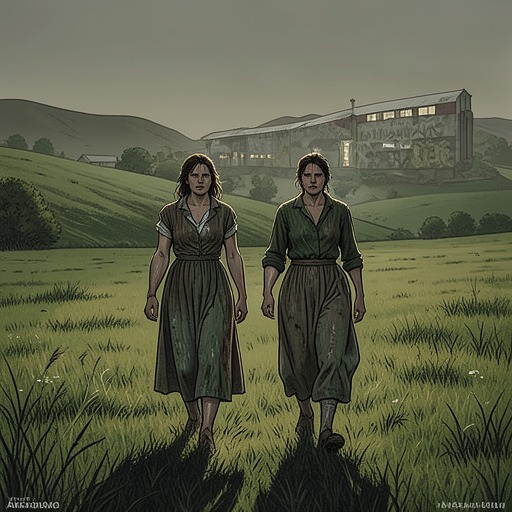
Carla
Fever DreamCarla, David’s mother and a friend of Amanda, becomes the keeper of a history that changes how Amanda understands the danger to her own daughter, Nina. Her account reaches from David’s childhood poisoning to the present emergency, where she has sought Nina and asks Amanda to accept what has happened. Across both crises, Carla acts under pressure and with incomplete options; the need to rescue a child is inseparable from the uncertainty over what rescue may cost.
Identity and Background
Carla lives in the house that once belonged to her parents. She recalls that her husband, Omar, bred racehorses and had hoped that success in the business would allow them to renovate it. She had wanted carpeted floors, a domestic aspiration that sits alongside the hazards and precariousness of their rural life. Her recollections establish her as both a mother and a witness to the changes in David, who once followed her around the house and called her Mom.
When Amanda first meets Carla at the vacation house, Carla is already grieving a changed relationship with her son. Wiping her tears with her knuckles, her gold bracelets jangling, she says that David was hers but is not hers anymore. The repeated distinction between having been his mother and no longer possessing that closeness expresses the estrangement without explaining all its causes. Carla’s account of David’s childhood makes the distance especially stark: she remembers carrying him, his first steps, and his voice calling to her, while in the present he no longer calls her Mom.
David’s Poisoning and the Migration
Carla recounts the event that first made her fear for David’s life. While helping Omar locate a missing stallion, she found the horse drinking from a stream. David, then a young child, had knelt in the water and put his hands into it, sucking his fingers. Carla noticed a dead bird nearby, became alarmed, and carried David back up the hill while managing the resistant horse. She did not tell Omar what had happened, believing the immediate problem had been dealt with.
The next morning, the stallion was gravely ill. Carla connected the horse’s condition with the water David had also touched and understood that waiting for a rural doctor might leave too little time. She describes having heard and seen too many things in the town to trust that help would arrive quickly. While Omar and neighbors focused on the horse and summoned a veterinarian, Carla took David and went to the Green House, seeking someone who might save him.
There, Carla was told that David’s body might not withstand the poisoning, but that a migration could be attempted. The proposed procedure would move his spirit to another body, taking some of the poison with it; divided between two bodies, he might survive. Carla was told it was uncertain, though it was the only method the woman knew that might save him. Her account presents the decision as an emergency response made amid fear, guilt, and a lack of viable alternatives, rather than as a confident or ordinary form of treatment.
Care, Responsibility, and Risk
Carla’s memories show care as practical labor performed under pressure. She searches for the horse, carries David, recognizes the danger when the animal falls ill, and leaves to seek help when she believes the clinic may be too far away. At the same time, her recollection of concentrating on the stallion rather than David becomes an expression of guilt: she wonders how she failed to see what mattered most. The crisis does not provide her with complete knowledge in advance; it forces her to act on a frightening inference about the shared exposure.
The novel places Carla’s experience beside Amanda’s own habit of calculating the rescue distance between herself and Nina. Watching Nina near a pool, Amanda measures how quickly she could reach her if the child ran toward the water. Carla’s story gives that calculation a history: the distance between a child in danger and the person trying to help is not merely physical, but also shaped by time, uncertainty, and the available sources of care. The phrase turns maternal vigilance into an ongoing assessment of what can be reached in time.
Carla’s caregiving also extends to Nina. When Amanda is unwell, Carla offers to fetch the car and jokes that the trip will help her finally find the courage to drive alone and bring Amanda to her house for iced tea with lemon and ginger. She leaves Nina in charge while she goes, telling herself that the drink will help. The reassurance is ordinary and affectionate, but the narration makes clear that it will not cure the poisoning. The contrast exposes the gap between the care Carla can offer in everyday terms and the seriousness of a condition that has not been recognized by those treating Amanda and Nina.
The Present Emergency and Its Consequences
As the account approaches the present, Carla wants to show the others Omar’s abandoned stables, which adjoin Sotomayor’s land. Their movement toward that place is interrupted by a truck delivering large plastic drums. Men wearing long plastic gloves unload them, and one drum is left alone in the shed doorway. The delivery forms part of the surrounding contamination crisis; the narrative’s insistence that this is the moment links the arrival of the drums with the onset of the danger, without making Carla’s personal knowledge of every aspect of the event certain.
The earlier poisoning remains a pattern in Carla’s present: a child’s danger is discovered amid delayed recognition, and help depends on acting before time runs out. In another account of the night, Omar wakes to find the doors open and all the horses gone except for a foal standing alone in the pasture, apparently frozen in fear. Carla says she saw the foal from the window but could not bring herself to go outside. The disappearance and the foal’s isolation deepen the atmosphere of unexplained loss around the household, while showing Carla’s fear as a limit on action rather than evidence that she has ceased to care.
When Carla learns that Amanda has been brought in for treatment, she asks after Nina. Unable to find the child at first, she and others search in Mr. Geser’s car and eventually find her sitting on a curb a few blocks beyond where Amanda’s car was parked. Carla then goes to Amanda, whose symptoms come and go and whose poisoning is being treated as sunstroke. The mistaken diagnosis leaves the people around Amanda responding to the wrong explanation while the danger continues.
Consent and the Limits of Rescue
In the final crisis, Carla holds Amanda’s hands and asks for consent to act quickly. Amanda initially thinks Carla means to take her to the Green House and says she will remain in her own body. Carla clarifies that she means Nina. By then, she says, she has learned that Nina may not survive many more hours. The correction reveals both the urgency of Carla’s plan and the fracture in communication between the two mothers: Amanda is too ill to understand at first which child Carla is talking about.
Carla tells Amanda that when she finds her real David, she will know him without doubt. Her statement connects the earlier migration to the present search for certainty, while confirming that the procedure has left a question about David’s identity unresolved. Amanda recognizes that Carla is not simply asking for permission; she is asking for forgiveness for what is happening at the Green House. Amanda lets go of Carla’s hands and thinks of reaching Nina, but her illness prevents her from moving. The scene leaves Carla’s act within a painful conflict among care, consent, and time: she is trying to save a child, while the child’s mother cannot intervene and does not grant the consent Carla appears to request.