Horses
Fever DreamHorses are not merely part of the rural landscape in the novel. Through Omar’s breeding business, a stallion’s encounter with the stream, and the later disappearance of the herd, they connect family history to the book’s central threat of poisoning and contamination. Their changing presence—from valuable livestock to vulnerable animals and finally an absence that cannot be explained—makes the fate of the animals a measure of how unsafe and unstable this countryside has become.
Omar’s Breeding Business
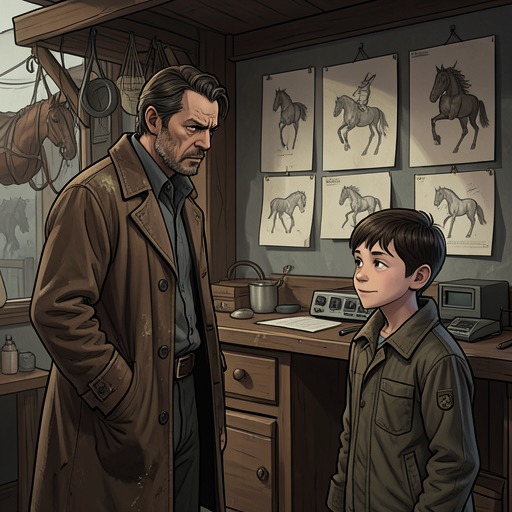
Before his life changed, Omar bred racehorses. He kept them beyond the lake, on the other side of town, but moved the operation near the family home when Carla became pregnant. Their arrangement relied on borrowing a quality stallion for a few days: the stallion’s owner would later receive a quarter of the proceeds from the foals. The young horses could sell for 200,000 to 250,000 pesos apiece, so the breeding work carried substantial financial hopes.
The operation grew around the land. Omar fenced off an area for the mares, built a corral for the foals, planted alfalfa, and planned to build a stable. Carla recalls two mares whose offspring became race winners, sold to run at Palermo and San Isidro; later came two fillies and a colt. Omar’s hopes for success were also bound up with their domestic future: he told Carla that if he made enough money, they could redo the house, and she particularly wanted carpeted floors. Horses therefore represented both a livelihood and the promise of a more comfortable home.
The Stallion at the Stream
One day, while Omar’s valuable borrowed stallion was with the mares, Carla noticed it was missing. She searched the windows for it, then went out carrying David, who had recently begun to walk. At the stream she found the horse drinking. David wanted to be put down, but Carla warned him not to approach the animal and moved carefully until she could take its reins. The recovery seemed, in that moment, to resolve an immediate crisis: the stallion was back in hand, and Carla imagined the loss of the horse as a possible threat to their home.
The apparent relief turned into alarm when Carla saw that David had knelt by the water, put his hands in it, and sucked his fingers. A dead bird lay close by. She rushed to get David away, bringing him and the resisting horse back up the hill. The next morning the stallion was ill, with severe swelling around its eyes and mouth and little strength. Omar called a veterinarian, while neighbors gathered and hurried about. Carla, believing that whatever the horse had drunk David had also swallowed, took her sleeping son into her room and prayed rather than wait for rural medical help. The horse’s condition did not prove what had happened to David, but it turned the stream into an immediate source of fear and made the animal’s illness a warning about the child’s possible exposure.
A Family’s Changing Relation to the Herd
Carla’s memories of the horses also register the deterioration of family life. Omar, once a smiling man who bred horses, later speaks and behaves differently; his remembered work with the animals contrasts with his strained relationship with David. He finds the boy unsettling, avoids sitting with him, and says David does not seem normal. When David sometimes disappears from the house at night, Omar and Carla search for him; later, Omar locks him in his room before bed. These details place the horses alongside the family’s growing fear, without making the animals the cause of Omar’s hostility.
The horses’ presence becomes an unsettling absence in another incident. Omar wakes Carla early one morning and tells her that the horses are gone. He had heard a noise, found David’s bedroom door open despite remembering that he had locked it, and discovered the front door open as well. Outside, the herd has vanished. Only a four-month-old foal remains in the pasture, standing alone and apparently frozen with fear. Omar approaches, touches its forehead, speaks to it, and nudges it, but it does not move. The foal stays in place until morning, including while a police inspector and two assistants visit and then leave. Carla watches from the window and cannot bring herself to go outside.
Animals as Evidence of Contamination
Across these episodes, the horses’ vulnerability gives the novel a way to make environmental danger legible without supplying a definitive diagnosis. The stallion drinks from a stream where David has also put his hands and mouth; the animal’s subsequent illness intensifies Carla’s fear for her son. Later, the herd’s disappearance leaves a lone foal behind, an event that remains unexplained. The text associates these occurrences with a wider pattern of poison and contamination, but the evidence does not establish a specific substance or a complete causal account of the horses’ fate.
The story’s attention to the animals is concrete and practical: breeding arrangements, fenced land, the value of foals, the search for a missing stallion, and the attempt to approach a motionless young horse. Yet these details also give the horses a narrative weight beyond property. Their illness and disappearance register consequences in a landscape where people struggle to identify danger and where ordinary routines no longer guarantee safety. Near the end, Omar tells David that he used to work with horses and asks whether David can hear his horses now. The question turns remembered work into a measure of what has been lost: the herd that once structured Omar’s life is absent, and the silence around it remains unresolved.