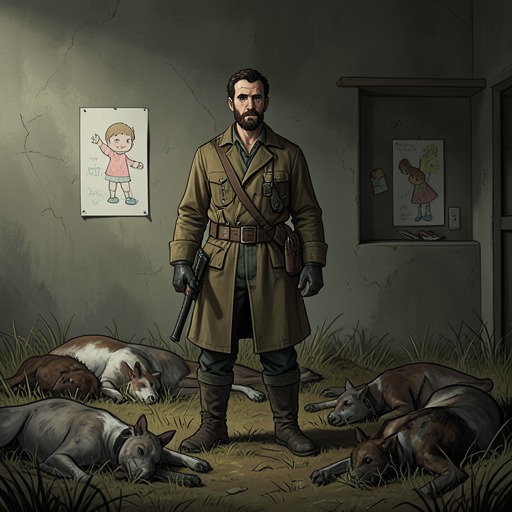
Mysterious deaths and disappearances of animals around David
Fever DreamMysterious deaths and disappearances of animals around David are the unsettling pattern at the center of Carla’s account to Amanda. A duck dies while David watches; more ducks appear dead, and he buries them; a dog waits at the house before dying; then every horse disappears except a foal. The events shift the story from an alarming change in a child’s behavior to a wider, unresolved disturbance in the animals and landscape around him.## David and the First DuckCarla’s account begins with an instinctive alarm: she sees David kneeling in the backyard, then realizes that he is burying a duck. He is four and a half. When she goes out to him, he does not look up. His face is red and his eyes are swollen from crying. He digs with the spoon-shaped part of a broken plastic shovel, while the duck lies beside the hole. David’s grief accompanies the act of burial, but Carla cannot yet tell what has happened to the animal or what his silence means.The explanation comes in stages. Carla recalls seeing David near the wheat field, small and still, his fists clenched as he looks toward it. A duck takes several steps, appearing unable to control its movement, then falls and dies. Carla describes the animal and David looking at one another before it collapses. That brief mutual attention is the episode’s most disquieting detail: the duck’s death is not narrated as an ordinary accident with an identifiable cause, and David’s presence does not explain whether he has harmed it or witnessed its decline.## More Deaths, and David’s Repeated AnswerA few days later, Carla sees three more dead ducks in the yard. She watches from the window while washing dishes, holding a half-washed saucepan, and cannot bring herself to go outside. David buries the ducks one after another and cries each time. When Amanda asks whether he killed them, David answers that he buried them, and that burying is not the same as killing. His response confirms what he did, but leaves the deaths themselves unresolved.Carla’s account of David’s speech makes that uncertainty part of a larger change. After a fever, he takes a long time to speak again and gradually begins using a few words. One answer in particular becomes a refrain: “That is not important.” He gives it when Carla asks why he is not eating, whether he is cold, or tells him to go to bed. Carla remembers the phrase not as an explanation but as an unnerving refusal of the concerns through which a parent usually reaches a child. The same question of importance runs through the animal episodes: David treats the burial as distinct from killing, while the adults struggle to decide what the deaths mean.## The Dog and the Breakdown of Familiar CareThe pattern extends beyond the ducks. A dog reaches the stairs of the house and sits there for almost an afternoon. Carla asks David about it repeatedly; each time, he says the dog is not important. He locks himself in his room and refuses to come out. Only after the dog collapses does he leave the house, drag it into the backyard, and bury it. The sequence echoes the duck burials, but the dog’s prolonged presence makes the repetition harder for Carla to set aside: David’s attention appears fixed on the animal only at the point when it dies and can be buried.The repeated deaths change Carla’s understanding of the child she is caring for. She describes an instinctive alarm at his movements and later says that the experiences have made her afraid of him. That fear is sharpened by the history of David’s nighttime absences: he sometimes is not in his room or anywhere in the house, and Carla and Omar go out looking for him. Omar carries a flashlight; Carla holds onto his shirt and listens for sounds. On one occasion Omar takes a knife. Eventually he locks David in his room at night. David bangs on the door and calls Carla by her name rather than calling her Mom. This background does not explain the animal deaths, but it shows how the household has already come to live in vigilance around David.## The Missing Horses and the FoalThe most extensive disappearance occurs when Omar wakes Carla before dawn, pale and rigid, and says only that the horses are gone. He tells her that a noise in the shed woke him. David’s bedroom door, which Omar remembers locking, is open; so is the front door. Omar goes outside without his flashlight or knife and looks across the fields. None of the horses is there. Only a foal, born four months earlier, remains in the pasture.The foal does not move. Omar approaches and touches its forehead, speaks to it, and nudges it, but it stays where it is. From the house, he had already been certain it was frozen in fear. The animal remains in the pasture until morning, including through the arrival and departure of a police inspector and two assistants. Carla witnesses it from the window but cannot bring herself to go outside. The event thus joins two kinds of disturbance: the horses’ unexplained absence and the solitary foal’s immobility. Neither Carla nor Omar can account for what has happened, and the presence of the police does not produce an explanation in her telling.## Retelling, Importance, and ContaminationThese episodes reach Amanda through Carla’s recollection, embedded in Amanda and David’s fragmented conversation. David repeatedly redirects her attention, saying that the animals or the stories about them are not what matters; Amanda, in turn, tries to keep Carla’s account in view. The struggle over attention shapes how the pattern is disclosed. The reader learns the episodes one by one, with each death or disappearance arriving after an earlier explanation has failed to settle the question of what David did and what the animals’ fate signifies.The account also sits within the novel’s talk of worms, poison, and contamination. David says that the feeling begins in the body like worms, but corrects Amanda: it is not really about worms, and they have already discussed the poison and contamination. The animal deaths therefore resonate with a threat larger than a child’s behavior, without establishing a direct cause for any particular duck, the dog, or the missing horses. The narrative preserves that gap. Animals are not merely background to Carla’s fear: each disappearance or death changes what the household can know, and the foal’s unexplained isolation remains an image of consequences witnessed but not understood.