Omar’s stables
Fever DreamOmar’s stables are the remains of a horse-breeding operation that once represented Omar’s ambitions and his family’s hopes, but later stand abandoned beside Sotomayor’s land. They matter to the novel not simply as a ruined rural workplace: the surrounding pasture and stream are where an early crisis involving David and a sick stallion first makes the danger of contamination legible, and the site later gathers together abandonment, animal disappearance, and Amanda’s wavering decision to leave.
The breeding operation and its decline
When Carla met Omar, he bred racehorses and still smiled. He moved the operation from the other side of town, past the lake, to the land around their home after Carla became pregnant. The house had belonged to her parents; Omar imagined that success in horse breeding would make them wealthy enough to redo it. Carla particularly wanted carpeted floors, a domestic hope she recalls against the harder life the business brought.
The enterprise depended on a borrowed stallion. Omar arranged to keep a highly valued horse for two or three days, with a quarter of the eventual sale price of the foals going to the stallion’s owner. A well-bred, well-cared-for foal could sell for 200,000 to 250,000 pesos. Omar fenced off land for the mares, made a corral for the foals, planted alfalfa, and planned to build the stable gradually. Two mares had already produced winners racing at Palermo and San Isidro; later, two fillies and a colt were born. The stables thus belonged to a working enterprise, not merely to Omar’s aspirations, even as the family’s hoped-for prosperity remained uncertain.
The stream and the first crisis
One afternoon, Carla noticed that the borrowed stallion had disappeared from view. She found it drinking from the stream, with David beside it. David had knelt in the water, soaked his shoes, and was sucking water from his fingers. A dead bird lay nearby. Carla frightened him by shouting, then took him back up the hill while managing the resisting horse. She did not tell Omar; in her account, she had recovered the animal and believed the immediate problem settled.
The next morning the stallion was gravely ill, its face swollen and its strength diminished. Omar called a veterinarian, and neighbors gathered around the animal. Carla, who believed David had drunk the same water, feared that waiting for the rural doctor would cost her son his life. The stable grounds and stream therefore become an early point of connection between an animal’s distress and the threat to a child. The account establishes the shared exposure Carla fears, but does not identify a specific contaminant or provide a medical diagnosis for either David or the stallion.
Carla’s recollection also measures how fear changes the meaning of an ordinary task. The previous day she had been relieved to catch the stallion, whose loss would have jeopardized the household’s hopes; afterward, she imagines that she would have surrendered the horse, the house, even her own life to return to the moment before David drank from the stream. At the stables, the economic value of the horse and the child’s immediate safety become inseparable, then painfully unequal.
Abandonment and the missing horses
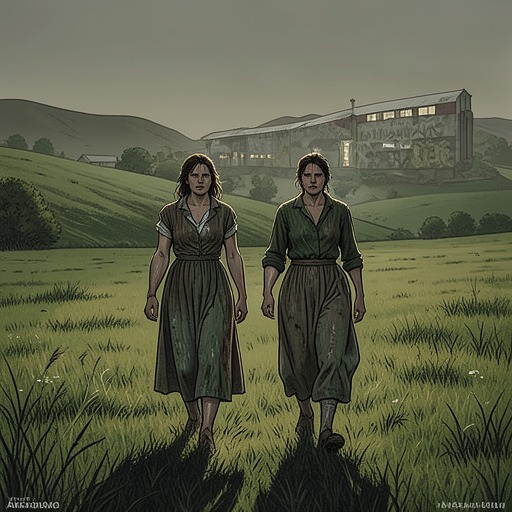
Much later in the narrative, the stables are described as abandoned and contiguous with Sotomayor’s land, accessible from where Amanda and Carla are staying. The building itself is no longer intact: Amanda sees burned bricks where the roofed structure should be. When she asks Carla how the stables burned, Carla responds that she has brought mate instead, leaving the question unanswered in that moment. The site remains part of the landscape, but its original function has vanished.
The disappearance of the horses is recounted through Carla’s memories of life at the property. Omar disliked David and said the boy did not seem normal; he was uncomfortable sharing meals with him and scarcely spoke to him. At night, David sometimes disappeared from his room. Omar and Carla went searching, listening in the darkness; on one occasion Omar brought a knife. Later, Omar began locking David in his room overnight. David would pound on the door and call for Carla by name, rather than calling her Mom.
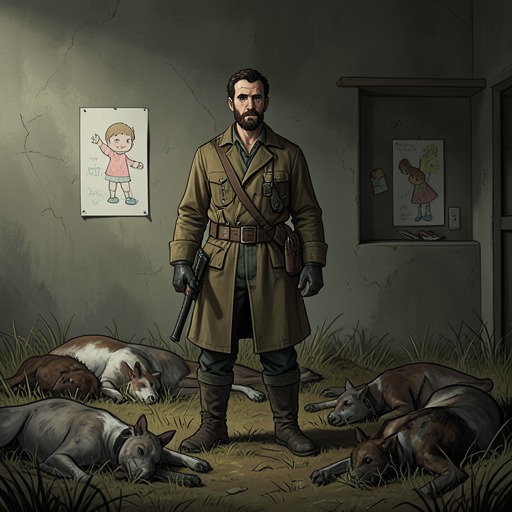
One morning Omar woke Carla with the words that the horses were gone. He had heard a noise, discovered David’s bedroom door open despite remembering that he had locked it, and gone outside. The front door was open too. In the pasture, not one of the horses remained; only a four-month-old foal stood by itself. Omar approached, touched its forehead, and tried to encourage it, but it did not move. It remained there through the morning, including the police inspector’s visit. Carla watched from the window, unable to bring herself to go outside. The stable’s disappearance of its animals is presented alongside the earlier stream episode and the family’s anxieties about David, but the account does not establish who took the horses or explain what happened to them.
A ruin within a larger crisis
The ruined stables re-enter the present as Carla tries to persuade Amanda to go there with her. Their proximity to Sotomayor’s land makes them part of a larger agricultural landscape. In another nearby scene, a truck arrives while men wearing long plastic gloves unload large plastic drums into a shed. The drums are handled with effort and fill the truck; one is left by the shed doorway. The narrative places this delivery within the same rural setting as the abandoned stables, but does not establish that the drums were stored at the stables or identify their contents.
The setting also gives Carla’s account of local medical access its force. Residents sometimes seek help from the woman at the Green House because doctors called to the Rural Emergency Clinic take hours to arrive and, in Carla’s view, cannot help in serious cases. She explains that the woman can read people’s energy, while clarifying that she is not a psychic. In recalling David’s crisis, Carla says that the woman offered a possible way to save him: moving his spirit into another body in time might divide the poison between two bodies, giving him a chance to survive. Carla describes it as the only option she knew. The stables’ story is consequently bound to a landscape where animals, children, and adults may face danger while formal medical help remains distant.
Ruin, care, and the rescue distance
For Amanda, the abandoned site is not only evidence of Omar’s vanished enterprise. While she is there with Carla and Nina, she finds herself less eager to drive the four and a half hours back to the capital; the view is beautiful but desolate, and she lingers over mate and conversation. When Nina runs toward a well, Amanda tells her to be careful. This quieter interval is shadowed by the larger crisis: Amanda habitually calculates the rescue distance, the distance between herself and Nina that would determine whether she could reach her in an emergency.
That measure returns with greater urgency when Amanda becomes ill and Carla holds her hands, asking her to agree to what must be done quickly. Amanda says she will remain in her own body. Carla later says she is looking for her real David and asks Amanda to understand that Nina was not going to survive much longer. Amanda realizes that Carla is asking not for consent but for forgiveness for what is happening at the Green House; the rescue distance tightens into a desperate wish to get Nina out. These events do not occur at the stables, but they deepen the site’s significance in retrospect: the ruined horse property belongs to a story in which care is repeatedly a race against distance, uncertain knowledge, and the scarcity of effective help. Its empty pasture and burned remains preserve the contrast between the family’s former plans for prosperity and the unresolved dangers that have overtaken the surrounding countryside.