Sotomayor’s farm
Fever DreamSotomayor’s farm is both a workplace and a consequential rural setting: Carla’s memories connect its fields and nearby stream to David’s childhood illness, while a later visit brings Amanda and Nina to its offices as plastic drums are unloaded nearby. The farm’s ordinary routines and open agricultural landscape become inseparable from stories of poisoned bodies, missing animals, inadequate medical help, and uncertainty about what has entered the environment.
Work and Landscape
Carla began working at Sotomayor’s farm when David was about six, roughly six years before she recounts the events. It was her first job. She describes the work as filing papers and helping with additions rather than formal accounting, but it gave her an occupation and a reason to dress up while running errands around town. The farm thus entered her life through paid work and a modest measure of independence, before its surroundings became bound to a family emergency.
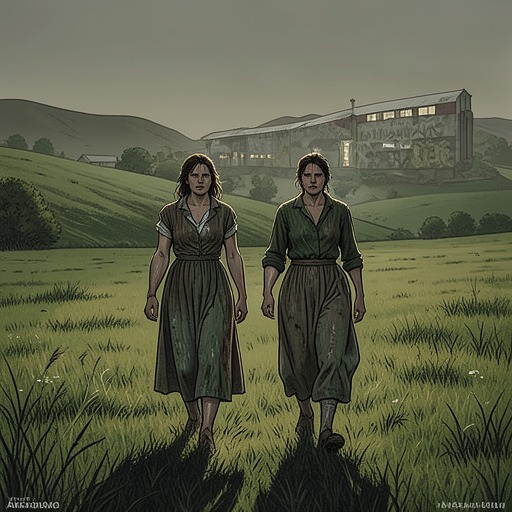
The property is described as a large rural estate. Its fields extend behind a manor house; two medium-sized sheds stand behind it, and seven silos lie much farther back, beyond the first fields. A stretch of grass separates the street from the house, though there is no sidewalk. The scale and arrangement make the farm a working agricultural site as well as a place through which people and vehicles pass.
The Stream and David’s Illness
In Carla’s account of an earlier incident, Omar’s valuable stallion disappears from its enclosure while she is at home with David. She searches for it and finds the horse drinking from a small stream running through a hollow. David, who has begun walking and is following her, points the animal out. Carla retrieves the stallion and takes him back, but David has knelt at the stream, soaked his shoes, put his hands in the water, and sucked his fingers. Nearby, she sees a dead bird.
Carla’s immediate fear comes from the possibility that David drank the same water as the horse. The following morning the stallion is gravely ill, with pronounced swelling around its eyes and mouth. A veterinarian is called, while neighbors gather and try to respond. Carla, convinced that David may be in danger too, takes him into a bedroom and prays rather than waiting for a rural doctor who might take hours to arrive. She later frames the episode as a moment of frightening misjudgment: her attention had been fixed on recovering the horse, and she had not recognized what David had done until she saw the bird and the animal’s condition. The farm’s water and animals therefore serve as clues to a possible shared exposure, though the account does not identify a specific contaminant or establish a laboratory diagnosis.
The story also situates that crisis within Omar’s horse-breeding business. He kept mares and foals on the property, planted alfalfa, and was gradually building a stable. The stallion was borrowed for a few days under an arrangement in which a quarter of the proceeds from later foal sales went to its owner; the foals could sell for 200,000 to 250,000 pesos each. The horse’s disappearance was consequently not only frightening but economically consequential. Carla’s remembered complaint that losing the animal could mean losing the house is later overturned by the much greater danger she fears for her son.
Offices, Stables, and Drums
Years later, Amanda drives Nina to the farm in search of Carla. They leave at dawn, find Carla’s house empty, and continue toward the farm, where Amanda knows Carla may be at work. The main building looks more like an office than a home. Two men are drinking mate while a young woman handles paperwork, reading document titles under her breath. Their routine is interrupted when Amanda and Nina arrive and ask for Carla.
Carla is there and proposes showing them Omar’s stables, which are abandoned but contiguous with Sotomayor’s land and easy to reach from the office. Before they go, a truck arrives. The men who had been drinking mate put on long plastic gloves and go outside; a driver and other men unload large plastic drums, carrying them toward a shed. The truck is full of barrels, and the men repeatedly pass them inside. One drum is left by itself at the shed doorway. The scene establishes the presence and movement of the containers, but does not identify what they hold or prove who is responsible for any poisoning.
While the unloading continues, Nina sits on the grass near the truck and watches. Amanda sits beside her, interpreting the quiet pause as a possible goodbye to the place. The ordinary, repeated labor of moving drums contrasts with the characters’ private alarm and with the farm’s earlier association with a sick horse and a child who drank from a stream. The containers become a concrete sign of potential danger, not a complete explanation of its source.
Medical and Environmental Context
The farm’s importance extends beyond Carla’s personal history because the surrounding community has limited access to timely medical care. Carla explains that local people sometimes seek help from the woman in the Green House: doctors called to the rural clinic may take hours to arrive and, in her view, may be unable to help in serious cases. This reliance on an alternative source of care places the farm’s agricultural setting within a broader landscape of constrained protection and uncertain information.
The novel later links illness in the area to more than a single acute episode. Amanda recognizes that she and Nina are poisoned, even as the nurse’s treatment assumes sunstroke; she also wonders about children who may have been poisoned before birth through what their mothers breathed, ate, or touched. The account describes a group of children with visible differences and notes that relatively few appear more typical. These details widen the meaning of the farm and its surroundings: the danger is not confined to one family, one animal, or one moment at the stream. At the same time, the text leaves the exact substances, exposure routes, and responsibility for the harm unresolved.
Narrative Significance
Sotomayor’s farm gathers several strands of the story into a single physical landscape. Its stream makes the connection between animal illness and David’s possible exposure immediate; its fields and buildings frame Omar’s breeding operation; its offices provide the destination for Amanda and Nina’s search for Carla; and its shed becomes the endpoint for a truckload of drums. These distinct scenes turn a seemingly ordinary agricultural property into a place where work, family memory, medical neglect, and suspected environmental harm meet.
The setting also sharpens a contrast between visibility and knowledge. The stream, dead bird, sick stallion, and drums can be seen, but what has contaminated the water or what the barrels contain is not disclosed. Characters must act under that uncertainty, often without timely medical support. The farm’s narrative force lies in this gap: concrete signs accumulate, while a definitive explanation remains out of reach.