The Green House
Fever DreamThe Green House is the home of a woman whom people in the area turn to when illness is too urgent for the rural clinic. Carla first seeks her help when David has drunk from a stream and appears to have suffered the same poisoning as a valuable stallion. The healer proposes a migration as a last chance to save him, explaining a supernatural exchange whose destination and consequences cannot be guaranteed. Years later, Carla again points a gravely ill mother toward the house: when Amanda and Nina are poisoned, she believes the woman there may be the only person who can help in time. The Green House thus stands between failed or inaccessible conventional care and a remedy that offers hope only by making the meaning of rescue uncertain.
A local alternative to the clinic
Carla explains that people who live nearby sometimes go to the Green House because doctors called to the clinic take hours to arrive and, in her view, may not know how to help. For a serious case, they go to the woman in the Green House instead. The house is therefore not introduced as an official medical institution but as a known local resource, sought out when the wait for ordinary care seems incompatible with the emergency.
That distinction is practical as well as spiritual. Carla does not leave home because she has a settled explanation for David’s illness; she leaves because the stallion has become gravely sick after drinking from the stream, and David had been drinking from that same water. She judges that a rural doctor could take too long to reach the clinic, while her son may have only hours, perhaps minutes, before his condition becomes fatal. The Green House enters the story at the point where limited time makes waiting itself feel like a decision.
Carla brings David for help
Before Carla reaches the house, the danger has taken shape through a troubling comparison. She finds David at the stream with wet shoes, his hands in the water and his fingers in his mouth. A dead bird lies nearby. The following morning, the stallion is severely unwell, prompting an urgent call to a veterinarian. Carla fears that whatever has affected the horse has also entered David’s body. The account links their exposure through the shared stream, but does not identify the poison or establish its source.
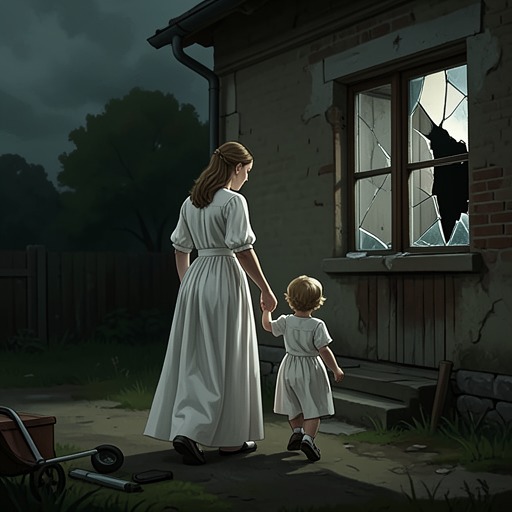
Carla leaves while Omar is occupied with the horse and arguing with two men. Carrying David, she goes out to the street and heads for the Green House. The decision follows her belief that professional help available through the clinic cannot arrive quickly enough; it is not a journey made after the danger has passed, but a desperate attempt to find another form of help before David’s condition worsens.
At the door, Carla thrusts David into the woman’s arms. The woman first puts him down, gives Carla a glass of water, and waits for her to calm herself. While David plays with decorative miniatures, arranging them in a line, the woman watches him closely, briefly examines him, and handles his face and shoulder. She tells Carla that the stallion is already dead, although Carla says she has not yet mentioned the horse. She predicts that David has only hours, perhaps a day, before he will need help breathing, and says the poison will attack his heart. The house becomes a place where Carla’s fear receives an answer, but the answer confirms the danger rather than dispelling it.
The proposed migration and its cost
The woman offers migration as the only way she knows to try to save David. According to Carla’s account, moving his spirit into another body in time would also move part of the poison; divided between two bodies, the poison might become survivable. The attempt is uncertain: the woman says it sometimes works, not that it is assured. The Green House is therefore associated not with a reliable cure but with a high-stakes possibility proposed after Carla has been told her son’s body cannot withstand the poisoning.
The healer cannot choose the family that David’s spirit would enter and would not know where he had gone. She also warns that the exchange would affect both bodies: a healthy body would receive David’s spirit, while an unknown spirit would enter the sick body. Something of each spirit would remain in the other. David would not be the same, Carla is told, and she would have to accept his new being. The proposed rescue carries consequences beyond survival, joining the unknown destination of the migration to the continuing responsibility for the body left behind.
Carla wants to know where David would go, but the woman says it is better not to know. She insists that Carla must still be responsible for the sick body, whatever happens. The house’s offer thus makes care inseparable from uncertainty: Carla is asked to consider saving David without knowing which family might receive him, what he would be like afterward, or what the exchange would leave in either body. The evidence establishes the proposal and its terms, not the outcome of the migration.
The house returns in Amanda and Nina’s crisis
Years later, the Green House again becomes the destination Carla considers during an emergency. When she sees Amanda weak, feverish, and hallucinating David, she concludes that the important thing is to speak with the woman there. The recurrence links Amanda and Nina’s poisoning to Carla’s earlier experience, while the circumstances differ: in David’s case Carla carried her child to the house; now she argues that Amanda should seek the woman’s help while Nina is also in danger.
Carla’s urgency bears on the question of consent. She takes Amanda’s hands and asks her to say that she agrees, saying that they must act quickly. Yet Amanda understands that Carla is not asking permission for what is happening at the Green House so much as asking forgiveness. Carla says that Nina may not survive many more hours. Amanda, still ill and unable to move freely, thinks of escaping the house to get Nina out. The episode presents the Green House as a possible route to rescue, but also as the center of a decision whose consequences Amanda fears and cannot control.
The story does not describe what happens inside the Green House during this later crisis or specify the outcome of Carla’s proposed intervention. What it does establish is the house’s repeated role in moments when illness outruns ordinary help: it is where Carla once sought a chance for David and where, years later, she believes she must turn again. Its promise is inseparable from a limit. The woman may offer a way to act when time is short, but she cannot guarantee safety, destination, or an unchanged life.