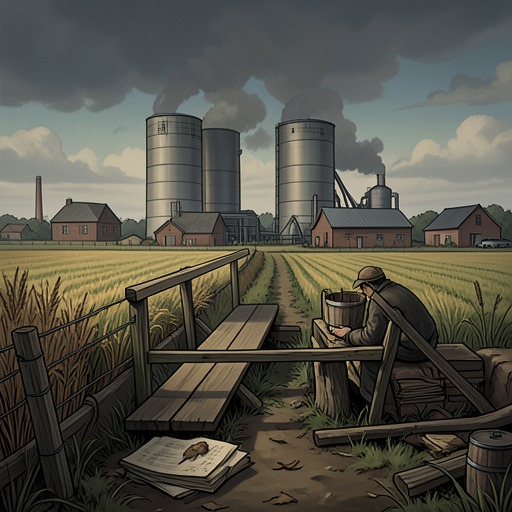
Unloaded plastic drums
Fever DreamThe Unloaded plastic drums appear briefly, but their arrival makes the story’s environmental danger tangible. A truck delivers a full load of large containers to a shed near the fields; one is left by itself in the doorway. The narration insists that this is the important moment, while withholding what the drums contain and whether they directly caused any particular illness. Their significance lies in that charged combination of physical presence and unresolved responsibility.
Arrival at the Shed
The drums enter the scene as Amanda, Nina, and Carla are discussing a possible visit to Omar’s stables, abandoned and adjoining Sotomayor’s farm. A truck pulls up while men drinking mate put on long plastic gloves and go outside. Carla says she will drop off papers before taking the others to the stables, and asks them to wait. A heavy plastic object falls without breaking; outside, two men are unloading the drums, struggling to carry one in each hand. The truck is full of barrels.
The account singles out one container: it is left alone in the shed doorway. The narration then repeats that this is the important thing. That emphasis turns what could have been incidental farm activity into a moment of attention, but it does not disclose the load’s contents, its intended use, who owns it, or whether anyone handles it beyond unloading it. The drums are concrete evidence of a delivery, not a confirmed explanation for the poisoning.
A Mystery of Exposure
The delivery gains force from the surrounding pattern of illness and contamination. Earlier, Carla recounts how David drank from a stream while a valuable stallion was there. The next morning the horse was gravely ill, its face swollen and its strength diminished; Carla feared that whatever it had drunk, David had drunk too. The sequence links water, animal sickness, and fear for a child, but does not identify a substance or establish that the later drums were connected to that earlier event.
Other details enlarge the possible scale of the danger without resolving its source. Carla says local people sometimes seek help from the woman in the Green House because doctors called to the Rural Emergency Clinic take hours to arrive and, in Carla’s view, cannot help in a serious case. Later, during a conversation about the horses, Carla describes Omar waking to find them gone and a young foal standing alone in the pasture. These episodes place animal vulnerability and limited medical access alongside the emerging pollution mystery; they do not provide a confirmed chain from the drums to any specific loss or illness.
Human Consequences
The narrative eventually states that Amanda and Nina are poisoned, while also showing that their condition is treated as sunstroke by medical staff. The mismatch between poisoning and the treatment they receive deepens the uncertainty around recognition and response. The story further suggests that exposure is not limited to acute episodes: some children, it says, were born poisoned through something their mothers breathed, ate, or touched. The account offers several possible routes of exposure, not a diagnosis tracing any child’s condition to the drums.
The children seen later make the threat communal rather than private. Amanda observes a group of thirty-three children, a number that changes, and describes many as visibly different, while noting that only a few resemble Nina. The narrative connects these children to the broader pattern of poisoning and to a place where doctors are scarce and the woman in the Green House does what she can. It does not establish that every child has the same condition or identify the source of their exposure.
Significance and Limits
Read beside the later assertion that the poison was always there, the drums become part of a landscape in which danger may precede any single dramatic discovery. Their delivery is observable; their contents, purpose, and relation to the illnesses remain unstated. That distinction matters: the scene invites suspicion, but does not authorize a definite chemical or causal claim. The narrative makes the reader attend to a material object and an act of transport while keeping responsibility unresolved.
The drums also sharpen the contrast between the visibility of a delivery and the difficulty of recognizing its consequences. The containers arrive in bulk, are heavy enough to require two hands each, and are unloaded beside land adjoining the stables; meanwhile, illness is misread, medical help is delayed, and the possible pathways of exposure range across water, air, food, and touch. The scene does not prove that this particular load caused the community’s harm. Instead, it gives the larger pattern a physical point of focus: a solitary drum at a doorway, present in the story, consequential in its framing, and unexplained in its contents.