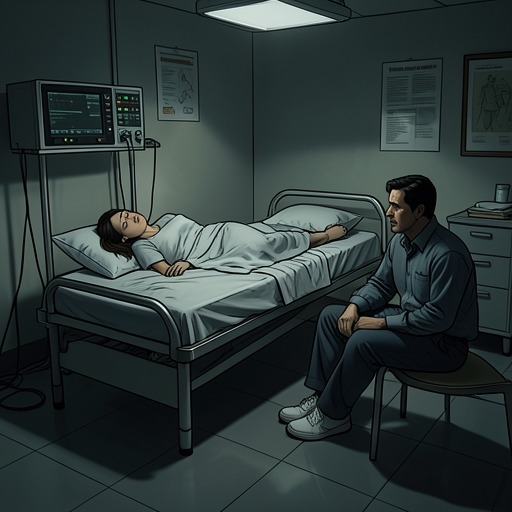
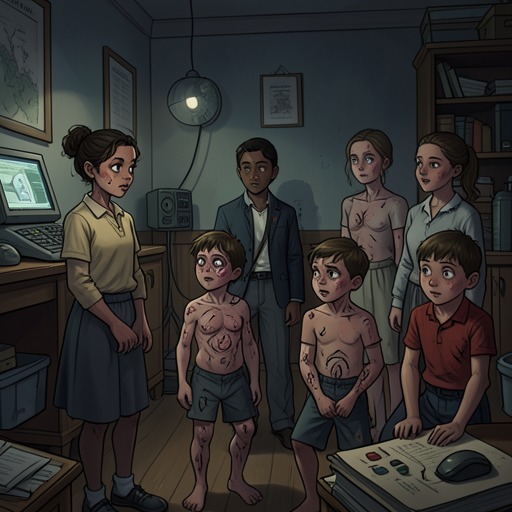
the waiting room
Fever DreamThe waiting room is where children are left before the day begins, and where the story’s private mystery opens onto a larger pattern of illness and care. Presented to Amanda by David as a classroom, it is corrected into a more consequential place: a room for waiting, marked by the names of those who have been there and by the limitations they live with afterward. Its ordinary institutional purpose and its unsettling narrative function meet in the same space.
A Place Between Home and the Day
David leads Amanda through a door and says he will turn on the light. She recognizes the room as a classroom and imagines Nina would like it; David corrects her, naming it the waiting room. The exchange makes the place familiar in appearance but difficult to interpret. Amanda’s attempt to fit it into a child’s everyday world does not match David’s account of what happens there.
The room belongs to a routine that begins before the day’s activities and may continue until night. Children are brought there together, accompanied across the street by women positioned at the corners to make the crossing safe. If they have a bad day, they may be taken home early; otherwise, they generally stay until evening. The arrangement is described in terms of practical care, but also of its limits: caring for the children at home is difficult, and some parents do not know how.
The Names on the Wall
David directs Amanda’s attention to the names on the waiting room wall. Amanda asks whether they belong to children who come there, and learns that some of those named are no longer children. The names therefore register a history extending beyond a single visit or a single day: the room retains the marks of people who have grown older while remaining connected to it.
The writing is done by one of the nurses because almost none of the people named can write. Some never learned; others did learn, but cannot reliably control their arms or heads. David also describes how fragile skin can make holding a marker difficult. The wall thus records both presence and an absence of agency: the names are visible, but the people they identify often cannot write them themselves. The room’s account of care is inseparable from the physical and practical barriers its occupants face.
Illness, Poisoning, and the Story’s Frame
The waiting room appears within a conversation whose structure is itself unstable. Amanda asks whether what is happening is because of the worms; David answers that it is related, then says the room is where she is. When she questions the name, he insists that they have already discussed poisoning and contamination and that she has told him several times how she arrived. Her resistance and his insistence make the room a setting where information must be revisited rather than securely learned once.
That pattern connects the waiting room to the book’s wider account of exposure without turning the room into a proven source of illness. In another remembered episode, Carla recounts David drinking from a stream near a dead bird; the next morning, the stallion that had also drunk there is gravely ill. Later, Amanda and Nina are identified as poisoned, though they are given treatment for sunstroke. These episodes supply the context for the waiting room’s population of affected children, but the evidence does not establish that the room itself causes their condition.
A Threshold Rather Than an Explanation
David’s direction to look at the names gives the waiting room a role beyond simple description. It is a place where the consequences of illness can be seen collectively, yet the names do not explain how each person came to be there. The room gathers those consequences into a record while leaving their individual histories—and the full extent of what has happened to them—only partly accessible to Amanda.
Its daily routine also places care between home and an institution. The children are escorted safely across the street and kept under supervision, while early return depends on whether a day goes badly. At the same time, the account acknowledges that families may struggle to provide care at home. The waiting room therefore stands at the intersection of need, routine, and constrained caregiving: a place meant to receive the children, but also a reminder of how much remains difficult to manage beyond its doors.