Aegon II Targaryen
Fire & BloodAegon II Targaryen was the eldest son of Viserys I Targaryen and Queen Alicent Hightower, and one of two principal claimants to the Iron Throne after his father’s death. His accession turned a dispute over inheritance into civil war. Aegon was crowned, lost control of King’s Landing, and eventually took Dragonstone, but neither military victory nor the death of his rival secured him a lasting reign: he was poisoned after two years as king, at the age of twenty-four.
Identity and the Succession Dispute
Aegon was born in 107 AC, the first son of Viserys and Alicent. His younger siblings included Helaena and Aemond; Daeron, the queen’s third son, also belonged to the generation that grew up amid the dispute over the succession. Aegon was ten years younger than his half-sister Rhaenyra, Viserys’s only surviving child from his first marriage. Their claims would come to embody competing principles of inheritance: Rhaenyra had been named her father’s heir, while Aegon was his eldest son by his second wife.
Viserys had earlier been chosen as heir by the Great Council, whose lords favored him over another candidate by a margin afterward reported to have exceeded twenty to one. That decision forms part of the political background to Aegon’s claim, but it did not settle the later question of whether the king’s daughter or eldest son should succeed him. Alicent argued for her son’s right to the throne. Viserys rejected a proposed marriage between the half-siblings and told Lyonel Strong that Alicent wanted Aegon to rule. The king’s death left that disagreement unresolved in practice, even as it became the basis for rival acts of succession.
The book distinguishes Alicent’s son from Rhaenyra’s younger son by referring to the former as Aegon the Elder and the latter as Aegon the Younger. That distinction matters in a conflict where the same dynastic name belongs to opposing branches of the family, and where the succession dispute repeatedly threatens to make kinship a source of confusion as well as allegiance.
A Divided Royal Household
Aegon and Rhaenyra’s hostility was part of a wider fracture between their households. The queen’s sons grew into bitter rivals of their Velaryon nephews, whom they resented as beneficiaries of a succession they believed should belong to Aegon. The boys attended the same feasts and celebrations, sometimes trained together under the same master-at-arms, and studied under the same maesters. Their enforced proximity did not reconcile them; it gave their mutual dislike repeated occasions to deepen.
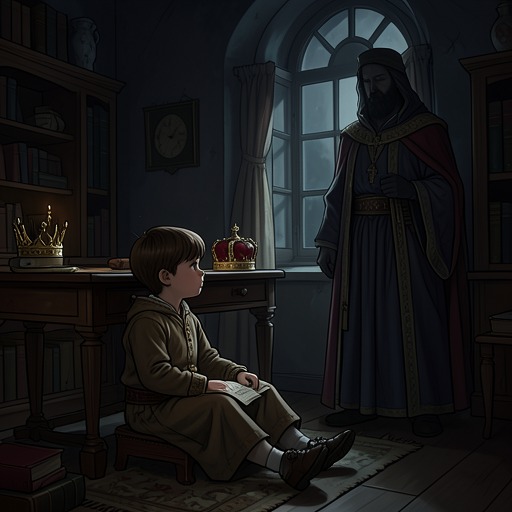
Following Targaryen marriage custom, Viserys married Aegon to his sister Helaena. Aegon was fifteen and Helaena thirteen. Septon Eustace describes the prince as lazy and sulky, with a hearty appetite for food and drink; Helaena is presented as pleasant and happy. Their marriage produced children, including twins and, in 127 AC, a second son, Maelor, who was given a dragon’s egg. Mushroom also claimed that Aegon fathered two bastards in the same year as the twins. The accounts establish that marriage and fatherhood did not resolve the wider family tensions or end the rivalries surrounding him.
Those tensions surfaced at a royal gathering attended by Rhaenyra and her sons. According to Mushroom, Aemond made a mocking toast to his Velaryon nephews, insinuating that their appearance and strength distinguished them from the rest of the family. Later that evening, Aegon took offense when Jacaerys asked Helaena to dance. The exchange nearly became a physical confrontation before Kingsguard intervened. Rhaenyra and her sons returned to Dragonstone the following morning. The episode captures the household’s fragile peace: shared ceremonies and family ties offered no assurance of loyalty.
Accession and Coronation
When Viserys died in 129 AC, Rhaenyra and Aegon became the principal claimants. Aegon’s supporters advanced the claim that the Iron Throne should pass to the king’s eldest trueborn son. On the tenth day of the third moon, bells announced the end of Viserys’s reign, and Grand Maester Orwyle was permitted to send ravens across the realm declaring Aegon’s accession. Riders carried the news through King’s Landing. The smallfolk responded in different ways: some wept, some cheered, and many remained wary or confused; a few voices called for Rhaenyra.
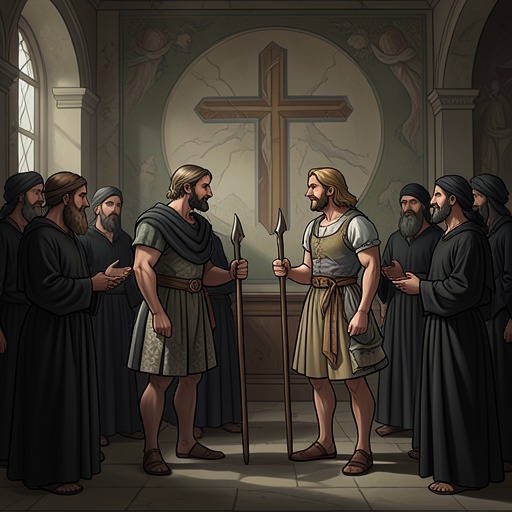
At Aegon’s coronation, Ser Criston Cole placed the iron-and-ruby crown of Aegon I Targaryen on his head and proclaimed him king. Alicent crowned Helaena as queen, then knelt before her daughter. The ceremony presented Aegon’s accession as a dynastic and public act, but its formal grandeur could not resolve the competing claim. On Dragonstone the following day, Daemon Targaryen crowned Rhaenyra with the crown of Jaehaerys the Conciliator. She named Jacaerys heir. The rival coronations made visible what the royal household had long contained: two branches of the family claiming the same throne.
Aegon’s claim was therefore not merely a matter of his birth. His mother and supporters asserted the precedence of a king’s eldest son; the coronation gave that claim a public ritual and a crown associated with the Conqueror. Yet Rhaenyra also received a coronation, and support for her remained present even among the people who heard Aegon’s accession proclaimed. The conflict that followed exposed the limits of ceremony when rival lines of succession could each gather supporters and act in the king’s name.
War, Defeat, and the Turn to Dragonstone
Aegon’s reign unfolded amid battles and reversals. At Rook’s Rest, he and Sunfyre fought alongside Vhagar against Meleys. When the fires had subsided, Vhagar alone had emerged unharmed: Meleys was dead, Sunfyre was badly injured, and Aegon had suffered catastrophic injuries. The king survived, but his capacity to rule and fight was permanently diminished. He lived in great pain afterward and refused milk of the poppy when Grand Maester Gerardys offered it, mistrusting the treatment because he believed Gerardys served his sister.
As Rhaenyra’s forces took King’s Landing, they found Helaena confined to her chamber, but Aegon had escaped. His young children, Jaehaera and Maelor, had also gone, along with Willis Fell and Rickard Thorne of the Kingsguard. Even the Dowager Queen did not know their whereabouts, and Luthor Largent swore that none had left through the city gates. The disappearance concealed a flight whose details became known through later testimony rather than through the queen’s account of events.
Aegon’s escape was arranged by Larys Strong. Disguised in a salt-stained fisherman’s cloak, the king was hidden among codfish aboard a fishing skiff, under the care of a bastard knight with kin on Dragonstone. Larys reasoned that Rhaenyra would send hunters looking for Aegon, but that a boat left no trail and few would expect him to seek refuge on his sister’s island, close to her stronghold. Grand Maester Orwyle learned the account from Larys himself, and Grand Maester Munkun later included it in his True Telling. Aegon reached Dragonstone and won the ancestral seat, but the escape did not restore his health or the life he had known: Sunfyre could never fly again, and Aegon remained in severe pain.
There, Sunfyre killed Rhaenyra after she was delivered to the dragon. Aegon then ended his concealment and announced that the realm should learn of her death and of his return to reclaim his father’s throne. The moment reversed the balance between the rivals: the king who had fled was now able to declare his sister dead. Yet the victory did not end the war or turn his damaged position into secure rule. Sunfyre died in Dragonstone’s outer yard on the ninth day of the twelfth moon of 130 AC. Aegon grieved and ordered that Baela be brought from the dungeons for execution, but changed course when reminded of her Velaryon parentage and her connection to Corlys Velaryon. He then sent a raven to Driftmark demanding that Alyn of Hull do homage within a fortnight, with Baela’s life made the condition of refusal.
Death and the End of the Reign
By the last months of his reign, Aegon was gravely disabled. The burns from Rook’s Rest left lasting scars, and the later fall from Sunfyre further damaged his legs. He could not walk normally and was carried by litter; only near the end did he regain enough strength to use a crutch. Mushroom also claimed that his injuries had left him impotent. While plots gathered around him and enemies closed in, the king was described as oblivious to the danger. His body had survived battles that destroyed his dragon and his rival, but it could not restore his ability to govern securely.
Aegon died by poison after two years on the throne. He was twenty-four. The circumstances brought the surviving lords and knights under scrutiny, and Cregan Stark judged those implicated in the king’s death. Ser Gyles Belgrave was condemned because he had either administered the poison or allowed it to be given through negligence or deliberate blindness. Three Kingsguard who had been present at Aegon’s death were also condemned, although their part in the plot could not be proved; the three absent from the city were judged innocent.
Corlys Velaryon admitted that he had acted for what he believed was the realm’s good and said he would do the same again. Larys Strong neither confirmed nor denied the accusations that he had supplied the poison and directed his agent. Cregan found both men guilty of murder, regicide, and high treason. Larys and Belgrave were executed, and their heads were displayed at the gates of the Red Keep; the other condemned men were held until arrangements could be made to send them to the Wall. The account presents Aegon’s death not as a settled peace but as the final act of his bitter reign, followed by judgment on those who had ended it.
Aegon’s death also left consequences within the royal family. At the wedding of the young Aegon III and Jaehaera, the Dowager Queen Alicent was conspicuously absent. She could not accept the murder of her last son and remained hostile to the new king. The regents feared that executing her might rekindle the war, but judged her too dangerous to leave at court: she had cursed Aegon III and urged Jaehaera to kill her husband. Alicent was confined to her apartments in Maegor’s Holdfast. Aegon’s succession thus ended in a court still governed by the wounds of his reign, with his mother’s grief and the child queen’s safety both shaped by the conflict he had embodied.