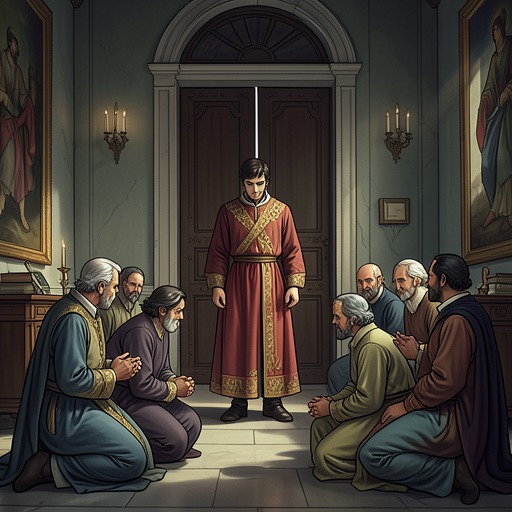
Aegon III Targaryen
Fire & BloodAegon III Targaryen was the child king who inherited a realm exhausted by the Dance of the Dragons and a private life shaped by loss. A son of Rhaenyra Targaryen and her uncle and second husband, Daemon Targaryen, he came to the Iron Throne at ten, after losing his mother and all four of his brothers. His reign lasted twenty-six years, but the names by which people remembered him—Aegon the Unlucky, Aegon the Unhappy, the Dragonbane, and the Broken King—point to a ruler defined less by triumph than by the grief he carried into kingship.
Identity and early circumstances
Aegon was Rhaenyra’s fourth-born son and her eldest child by Daemon. When he was ten, the conflict that had divided the royal family left him a living political prize. Ser Alfred Broome argued that he should be killed, but King Aegon II forbade it, judging that the boy might prove valuable as a hostage while Rhaenyra’s remaining supporters were still in the field. Aegon was taken in chains to the dungeons beneath Dragonstone. The queen’s noble-born ladies-in-waiting were confined separately in Sea Dragon Tower, where they were to await ransom. His survival at this point depended not on any power of his own but on his usefulness to the victor.
Aegon II later rejected the proposed marriage between Aegon and his daughter, which Queen Alicent had accepted without the king’s consent. He wanted to marry Cassandra Baratheon himself and intended to prevent his nephew from fathering heirs who could complicate the succession. His stated alternatives were for Aegon to take the black or be made unable to have children; in either case, Aegon II meant to end his half-sister’s line. The episode shows how the boy’s dynastic identity made him both a target and a bargaining piece. He was not simply confined: his future, marriage, and capacity to continue his family were treated as matters for the reigning king to decide.
Accession and the end of the war
Aegon II’s reign ended after two years, when he died at twenty-four. Two days later, as Lord Tully’s vanguard reached King’s Landing, Corlys Velaryon rode out to meet it with Prince Aegon solemnly at his side. The public appearance made the transfer of authority visible: the captive child was now the prospective king presented to the arriving army. The account marks the moment with the announcement that the old king was dead and a new one would reign, turning Aegon’s survival into a political succession.
On the seventh day of the seventh moon in 131 AC, Aegon married Princess Jaehaera, daughter of Helaena Targaryen and Aegon II. The High Septon of Oldtown performed the vows at the top of Visenya’s Hill, since the Dragonpit remained largely in ruins. Grandstands gave the nobility a view of the ceremony, while tens of thousands of smallfolk filled the streets and cheered the children. Afterward, Aegon and Jaehaera were carried in an open litter to the Red Keep, where Aegon was crowned with a plain yellow-gold circlet and proclaimed king. The marriage joined the rival branches of House Targaryen and was presented as an end to two years of treachery and bloodshed. Its public scale promised reconciliation, although it could not undo what the two young people had endured.
The political quiet that followed was described as a grey calm. Aegon sat the Iron Throne when required but was otherwise little seen. Lord Protector Leowyn Corbray bore responsibility for defending the realm, while the day-to-day work of government fell to the blind Hand, Tyland Lannister. Tyland, disfigured by the queen’s torturers, wore a silken hood at formal occasions to spare new court ladies from fainting; the covering instead gave him a threatening appearance, and stories about a masked sorcerer began to circulate among the smallfolk. Aegon’s early kingship thus unfolded amid the damaged bodies, uneasy popular imagination, and delegated burdens left by the war.
A private life marked by grief
The royal marriage was troubled from its beginning. Aegon was eleven and Jaehaera eight; the children had little contact beyond formal occasions, and Jaehaera was reluctant to leave her chambers. Grand Maester Munkun described both as broken. Jaehaera had witnessed the murder of her twin brother by Blood and Cheese. Aegon had lost all four of his brothers and had seen his uncle feed his mother to a dragon. Munkun emphasized that neither child laughed or played, and that Jaehaera suffered distress and regressed in her behavior. These details make the marriage’s political purpose stark: the ceremony united rival lines in public, but the children at its center remained isolated by their losses.
The names attached to Aegon’s later reputation likewise register the distance between office and feeling. The smallfolk called him Aegon the Unlucky and Aegon the Unhappy, most often remembering him as the Dragonbane; Munkun’s description, the Broken King, was judged more fitting still. Aegon was a shadowy monarch who spoke little and did less, and whose life was steeped in melancholy. As an adult he did not hunt or hawk, rode only when travel required it, drank no wine, and was so indifferent to food that he often had to be reminded to eat. He permitted tourneys but took no part, as competitor or spectator. His plain dress, usually black, and the hair shirt he wore beneath royal velvets and satins made a visible contrast between the sumptuous obligations of kingship and his personal austerity.
Yet his reserve did not mean an absence of attention to other people. During an epidemic, Aegon visited the sick despite the concern of his Kingsguard. He spent long hours with them, sometimes holding their hands or cooling their fevered brows with damp cloths. He listened as they spoke about their lives, asked forgiveness, or recalled their children and deeds. Most of those he visited died; survivors credited the king’s healing hands with their recovery. The account does not present this as a cure, but it does show how his silence could become a form of company: a king associated with withdrawal sat beside the sick and gave them time.
Loyalty, return, and change
Aegon’s decisions also reveal a capacity for clemency. When counsel urged action against Corlys Velaryon, Aegon not only spared him but restored his offices and honors, including a place on the small council. The restoration turned survival into renewed service and made Corlys’s return a matter of royal policy, not merely personal safety. Aegon’s willingness to reverse the threatened punishment shows that his rule could be shaped by counsel and persuasion, even when the kingdom’s politics remained unsettled.
His deepest change came much later, when his lost brother Viserys returned. Viserys, the youngest son of Rhaenyra and Daemon, had been presumed dead since the Battle of the Gullet and had been missing for nearly five years. When the boy threw back his cowl, Aegon wept and embraced him fiercely. The scene breaks through the king’s customary restraint: for a moment, the reunion of brothers displaces the ceremony and maneuvering of court. Viserys’s return also answered a private accusation Aegon had carried for years. He had been nine when he fled the Gay Abandon on dragonback before the battle, leaving Viserys behind. Though only a child himself, he believed that, as a boy raised on tales of warriors and heroes, he had failed the standard those stories set. He had not saved Viserys, his mother, or Jaehaera, and therefore felt unworthy of the Iron Throne and incapable of saving a kingdom. The return of the brother he had mourned changed that conviction and brought about what Munkun called a wondrous change in the king.
Reign and narrative significance
Aegon’s story places the spectacle of dynastic restoration beside its human cost. His crowning and marriage offered the realm an image of unity, but both monarch and queen were children whose grief could not be resolved by ceremony. His later habits—silence, withdrawal, and austere self-denial—are presented alongside occasional acts of intimacy and mercy, especially his visits to the sick and his embrace of Viserys. These contrasts resist a simple portrait of an inactive or indifferent ruler: the same king who was seldom seen could sit for hours with dying subjects, and the man who believed himself unworthy of rule could still pardon a powerful lord and restore him to office.
Aegon ruled from 131 AC until his death of consumption in 157 AC, after twenty-six years on the throne. He took two wives and fathered five children, two sons and three daughters, but the account says he found little joy in marriage or fatherhood. His legacy is therefore deliberately shadowed. The king was a dynastic survivor and the emblem of a settlement after civil war, yet neither survival nor sovereignty erased his grief. The return of Viserys offers a rare release from that burden, while the names Dragonbane and Broken King preserve the lasting contradiction at the heart of his reign: Aegon held the highest place in the realm, but remained a man who believed he had failed those he loved and could not protect.