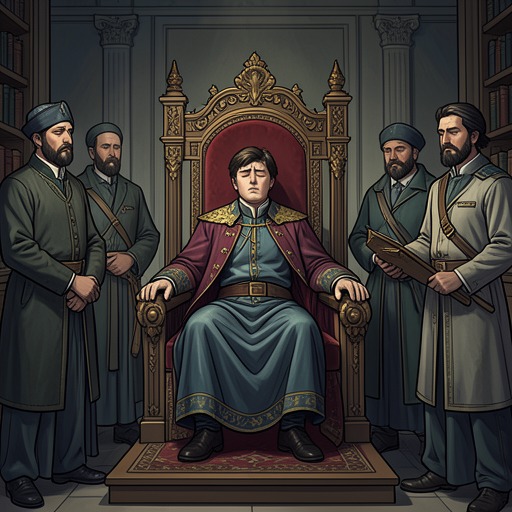
Aegon III and Tyland Lannister's Lord-and-Hand Relationship
Fire & BloodAegon III’s bond with Tyland Lannister was forged in the unsettled years after the Dance of the Dragons, when a child sat the Iron Throne and the work of governing fell to others. Tyland, a blind and visibly disfigured survivor of the queen’s imprisonment, served as Hand with an unexpected steadiness. The king’s regard for him emerged not through grand declarations, but through the daily labor of rule, the care they showed the sick during the Winter Fever, and Aegon’s presence at Tyland’s deathbed.
Service in a Divided Court
By the end of 131 AC, Aegon III sat the Iron Throne when required but was otherwise little seen. The Lord Protector, Leowyn Corbray, was charged with defending the realm, while Tyland managed the day-to-day burdens of government. Though the Hand and Lord Protector were both formally subject to the regents, Tyland’s influence grew as the regents met less often. The account describes him as tireless: despite his blindness and the consequences of his imprisonment, he gathered more authority over time, while Corbray’s practical dominance receded.
That authority rested partly on Tyland’s ability to serve without turning past injuries into an open demand for revenge. Queen Alicent had sent him to the torturers, yet Tyland claimed not to remember which lords had been black or green and remained loyal to her son. His apparent refusal to settle old factional scores helped him serve a king whose household and court had been shaped by those same divisions. It also made him difficult to place within the simple categories of the civil war: former enemies could distrust him, but his conduct in office gave the young king reason to rely on him.
A Contested Record of Loyalty
Tyland’s relationship with Aegon III carried the weight of his earlier political choices. During Aegon II’s accession, Tyland had been appointed master of coin and moved the Crown’s wealth out of King’s Landing. It was divided among the Iron Bank of Braavos, Casterly Rock, and Oldtown, with the remainder reserved for gifts, bribes, and the possible hiring of sellswords. The account later connects that decision to Queen Rhaenyra’s defeat, and says that it cost Tyland his eyes, ears, and health. His service to Aegon III therefore followed a chain of actions that had helped bring down the king’s mother’s rival and left Tyland permanently changed.
Nor had Tyland’s service been free of choices that alienated both sides. After Rhaenyra’s death, he urged Aegon II to put her son to death; after Aegon II’s death, he stayed to serve that same son. The account presents this as one reason Tyland was hated by both blacks and greens. Aegon III’s reliance on him did not erase that history, but it placed the relationship on a different footing: the king’s Hand was judged by the work he did for the reigning king, not solely by the faction he had once served.
Rule and Mutual Dependence
The regency placed unusual demands on both men. Aegon was still a boy, and Tyland’s office required him to carry the routines of government while the king remained largely withdrawn from public life. His authority was not unlimited: the regents retained formal power, and the Lord Protector held a separate charge. Yet Tyland’s persistence, combined with the council’s increasingly infrequent meetings, allowed him to shape the conduct of rule in practice.
The relationship also appears in the king’s actions during the Winter Fever. While the disease moved through King’s Landing, Aegon spent his days visiting the sick, sometimes remaining with them for hours and holding their hands or cooling their brows with damp cloths. Tyland, meanwhile, worked day and night from the Tower of the Hand, trying to help the afflicted despite his blindness and other impairments. The king’s visits were not merely a public gesture toward the suffering: his last bedside visit was to Tyland. The account sets the two men’s work alongside one another, with the king offering his presence to the sick and his Hand continuing the struggle against the epidemic until his own strength failed.
Death and Continuing Influence
When Tyland’s condition worsened, he died within two days. Septon Eustace was present, as was Aegon, who held his Hand as he breathed his last. That final gesture gives the relationship its clearest personal expression. The king did not merely lose an administrator: he remained beside the man who had carried the burdens of rule through the regency and had served him despite the bitterness of the preceding war.
Tyland’s influence continued in Aegon’s decisions after his death. When choosing a new Hand, the king passed over Ser Marston Waters and summoned Lord Thaddeus Rowan, explaining that Tyland had thought well of Rowan and that this was enough for him to trust the lord. The remark shows Aegon relying on his dead Hand’s judgment as a guide to the next appointment. Tyland’s tenure thus outlasted him in a practical form: his assessment of a potential ally helped shape the young king’s government. Their relationship, marked by political inheritance, hard service, and care at the end, became one of the ways Aegon began to exercise judgment of his own.