Aegon III and Unwin Peake's Power Struggle
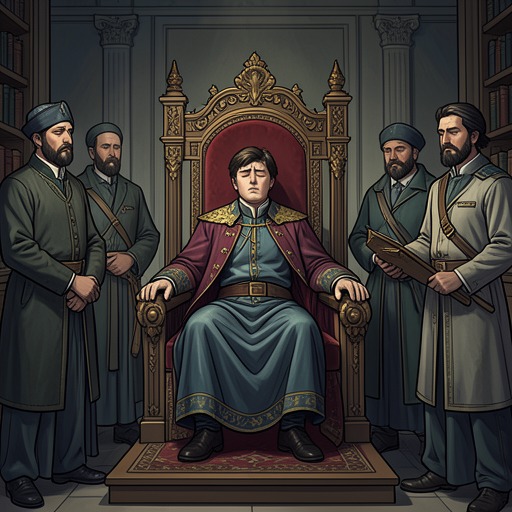
Fire & BloodAegon III and Unwin Peake’s power struggle was a conflict over whether the boy king would exercise any authority during his minority or serve chiefly as the seal on decisions made by his regents. Peake possessed the offices and influence to impose his will; Aegon’s resistance was often expressed through silence, withdrawal, and, at crucial moments, a choice Peake could not undo. Their unequal contest was therefore fought less through open confrontation than through appointments, access to government, and the question of who could decide the king’s future.
The regent’s authority over the king
When Ser Tyland Lannister died, Aegon moved to shape his court without consulting the council of regents. He wanted Lord Thaddeus Rowan as Hand, recalled Baela to court, and proposed Alyn Velaryon as admiral. The remaining regents—Unwin Peake, Manfryd Mooton, and Grand Maester Munkun—disputed the king’s freedom to act. Mooton, bedridden after the Winter Fever, asked that decisions wait until absent regents returned, but Peake argued that those who had left King’s Landing had surrendered their places. With Munkun’s support, the council set aside Aegon’s appointments on the ground that a twelve-year-old could not judge such matters.
The reversal was comprehensive. Marston Waters became Lord Commander of the Kingsguard, while Robin Massey and Robert Darklyn were ordered to surrender their white cloaks. Orwyle was returned to his cell to await execution. Rowan was offered offices on the council, but Alyn received no comparable place. Peake combined the offices of Hand and Protector of the Realm in his own person. In this arrangement, the king’s preferences could be heard and then nullified, while Peake concentrated the government’s authority around himself.
Silence, discipline, and resentment
The accounts differ over how Aegon received the council’s decrees. Mushroom describes a sullen silence broken only by the king’s protest at Massey and Darklyn’s dismissal: “Kingsguard serve for life.” Peake answered, “Only when they have been properly appointed, Your Grace.” Septon Eustace instead depicts Aegon accepting the decision courteously and acknowledging that he was still a boy in need of instruction. Whichever account is credited, the political outcome was the same: Aegon did not reverse the regents’ decision. For the rest of his minority he took little part in ruling, signing documents Peake presented and appearing at court when required, but rarely being seen beyond the Red Keep.
The struggle also reached into the king’s daily life. Aegon disliked and distrusted the new Kingsguard, and his antipathy toward Peake’s household deepened after Tessario the Thumb killed Robin Massey in a quarrel over a horse. Peake’s master-at-arms, Gareth Long, was a stern instructor; Aegon, a sullen student with little interest in martial training, would lay down his sword and shield and walk away when Long spoke too harshly. Peake’s system of discipline made Gaemon Palehair, the king’s young cupbearer and food taster, Aegon’s whipping boy. Punishment of his friend affected Aegon where the instructor’s threats had not, and the king improved in the yard, but his dislike of Long only grew. Governmental power and private feeling thus converged: the king’s companions and routines were shaped by men appointed under Peake, while Aegon’s resentment remained largely without an official outlet.
Peake’s manner contrasted with that of Tyland, who had treated Aegon deferentially and sought to guide rather than command him. Peake was brusque, impatient, and unwilling to include the king in ordinary decisions. When Aegon withdrew into silence and solitude, his Hand was content to leave him there except when a formal appearance was needed. Peake’s own public display of authority reinforced the contrast: he presented himself as a forceful successor to Tyland and made clear that the king’s participation was not necessary to the work of government. Aegon’s passivity was not proof that the tension had disappeared; it was also the condition that allowed Peake to rule with little interference.
The queen’s choice becomes a test of power
Seven days after Jaehaera’s death, Peake came with Munkun, Septon Bernard, and Marston Waters to tell Aegon that he must marry again for the realm’s good. Peake had already chosen his daughter, Myrielle, as the bride. He described her as the king’s age, courteous, and well educated, and presented her suitability for producing heirs as a political argument. Aegon asked what would happen if he did not like her. Peake replied, “You do not need to like her,” and compared the marriage to turnips the king ate despite disliking them. The story spread, and Myrielle acquired the name Lady Turnips.
The exchange exposed the core of their conflict: Peake treated the king’s marriage as an instrument of policy to be directed by the Hand, while Aegon’s question asserted that his own wishes mattered. Peake’s plan also provoked resistance among the regents and lords. Rowan and Mooton objected that so important a matter belonged to the council; Jeyne Arryn sent a critical note, Kermit Tully called the betrothal presumptuous, and Cregan Stark warned that the North might disfavor it. Munkun, who had supported Peake’s earlier assumption of authority, now cautioned that others might suspect the Hand of choosing his daughter for his own power or for House Peake’s glory.
Aegon’s choice of Daenaera Velaryon overturned the plan. At the Maiden’s Day selection, he returned her smile and praised her appearance; Gaemon then announced that the king would marry her. Peake had no choice but to accept the decision. At the next council meeting, he argued that a six-year-old bride would leave the succession uncertain for years and that the regents should set aside the king’s choice in favor of a bride old enough to bear children. Rowan answered, “Such as your daughter?” The other regents stood firm, and the marriage proceeded. Aegon’s decision did not end Peake’s authority, but it showed that the king could make a consequential choice when others on the council supported it.
A limited return to government
Daenaera’s presence coincided with a period in which Aegon appeared more often at court, showed interest in his studies, and even left the castle on three occasions to show her the city. His interest extended briefly to government: he began attending council meetings. Munkun welcomed his presence, as did Mooton and Rowan, but Peake took the attendance as a rebuke. When Aegon asked questions, Peake bristled, accused him of wasting the council’s time, or said the matters were beyond a child’s understanding. Aegon soon stopped attending.
The episode marks the limits of the change. Aegon’s presence could hearten some councillors, and the earlier dispute over Daenaera had demonstrated that the king’s wishes could prevail when the regents resisted Peake. But Peake still controlled the conduct of government and could discourage the king from taking part without openly removing him from the council. The struggle therefore left Aegon with moments of agency, not a settled share of power: his refusal to marry Myrielle thwarted Peake’s dynastic plan, while his retreat from council left the Hand’s practical dominance intact.