Aegon Targaryen
Fire & BloodAegon Targaryen, remembered as Aegon the Uncrowned, was the elder brother of Jaehaerys and a claimant to the Iron Throne whose death did not settle the succession. Killed while attempting to overthrow his uncle Maegor I, he left behind two young daughters and a question that could not be separated from the contested legitimacy of Maegor’s rule. His brief political presence therefore endured chiefly as an unresolved alternative: if Maegor had no lawful right to reign, the crown might have been Aegon’s, and then passed through his elder daughter rather than to his younger brother.
Identity and Claim
Aegon was the only surviving son of King Aenys I, but his younger brother Jaehaerys was not the first to claim the crown. Aegon had claimed kingship before him. His title and standing were bound up with the conflict over Maegor I, who had taken the throne as their uncle. The account describes Aegon as the elder brother and a prior claimant, but does not portray him governing the realm or establish the details of a coronation. His epithet, Aegon the Uncrowned, captures that distinction: he claimed the kingship, yet died before the succession could become secure in his hands.
The question of Aegon’s claim remained conditional on how Maegor’s reign was judged. Some maesters argued that Maegor was only a usurper and had no right to rule. On that interpretation, Aegon had been the true king, and his claim could not simply be set aside when he died. The account presents this as a disputed line of reasoning, not a settled verdict; the uncertainty over Maegor’s legitimacy made the order of succession uncertain too.
Defeat and Family
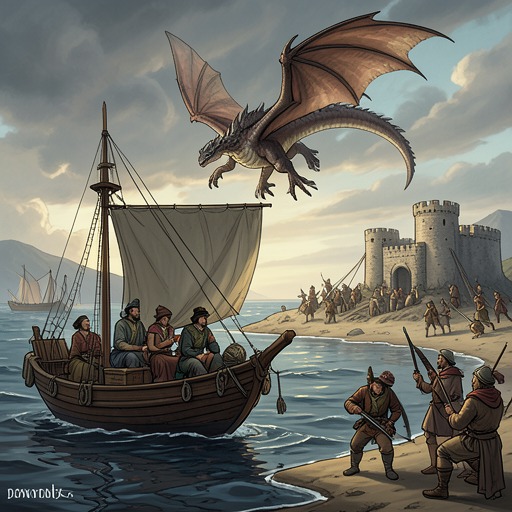
Aegon’s attempt to unseat Maegor ended at the Battle Beneath the Gods Eye, where he died with his dragon. His defeat removed him from the struggle but left his family at its center. Before his death, he had married his sister Rhaena Targaryen and fathered twin daughters, Aerea Targaryen and Rhaella Targaryen. Their existence gave his claim a possible continuation beyond his own lifetime.
For his mother, Alyssa Targaryen, Aegon’s death was one catastrophe in a succession of losses. She had already seen her husband, Aenys I, die after his reign collapsed; then her eldest son rose against Maegor and was killed alongside his dragon. Her second son was later tortured to death by Tyanna of the Tower. Alyssa and her two youngest children were held as virtual prisoners, and she was made to witness her eldest daughter’s marriage to Maegor. Aegon’s defeat thus belongs not only to the contest for the throne but also to the destruction of his mother’s family under the ruler he had opposed.
The Succession After His Death
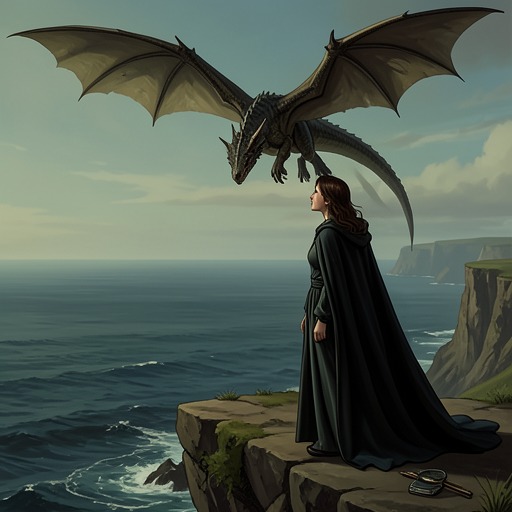
Under the interpretation that Maegor had been a usurper, the succession should have passed from Aegon to his elder daughter, Aerea, rather than to Jaehaerys. That possibility rested on a direct dynastic consequence of Aegon’s marriage and children: his death did not, by itself, erase the line he had left. Yet the twins were only six when Maegor died, and their sex weighed against their claims. Contemporary accounts described Aerea as timid when young, while Rhaella was bolder and more robust, a novice at the Starry Sept and promised to the Faith. The account reports these descriptions as factors in the political assessment of the girls, not as proof that either was incapable of rule.
Rhaena, their mother, ultimately agreed that the crown should go to her brother Jaehaerys rather than to her daughters. Her acceptance helped clear the way for Jaehaerys’s accession, but it did not make the alternative claim disappear: the succession depended both on a family decision and on judgments about Maegor’s right to rule. Aegon’s death therefore left a legacy that was at once personal and constitutional, with his daughters’ place in the line entangled in the larger question of who had lawfully held the throne.
Rhaena herself was also proposed by some as a possible claimant, since she was the firstborn child of Aenys I and Alyssa. Some even whispered that she had somehow contrived to free the realm from Maegor, though the account says no means by which she could have arranged his death was ever established. Her sex counted against her claim, and she had no wish to return to the court at King’s Landing. These arguments show how Aegon’s death opened several possible lines of succession, while none could be considered apart from custom, political circumstance, and the competing claims surrounding Maegor.
Dynastic Memory
The name Aegon continued to carry political charge in the family. In 120 AC, Rhaenyra Targaryen named her son by Daemon Targaryen Aegon. Queen Alicent Hightower took the choice as a slight against her own son, also named Aegon; the account notes that Mushroom’s testimony supports the interpretation that the slight was intended. This later naming does not establish a direct reference to Aegon the Uncrowned, but it illustrates how a repeated royal name could become a point of rivalry within the dynasty.
Aegon’s significance rests less on a long reign than on the succession he failed to secure and the descendants whose claims survived him. He was a brother who claimed the crown before Jaehaerys, a son lost in Alyssa’s family tragedy, and a father whose elder daughter might have inherited under one reading of the law. His death ended his own challenge to Maegor, but left the legitimacy and order of the royal succession open to argument.