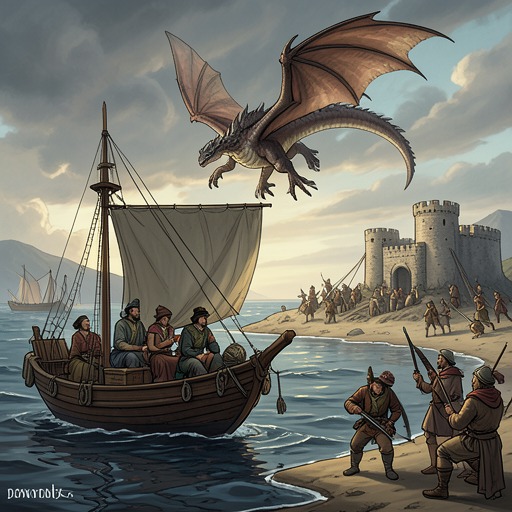
Aegon’s Oldtown Coronation
Fire & BloodAegon’s Oldtown Coronation was the Conqueror’s second crowning and the ceremony that came to mark the beginning of his reign. Held in the Starry Sept after Lord Hightower submitted Oldtown, it joined religious authority to royal power before a far larger audience than had witnessed Aegon’s first coronation. The ceremony proclaimed dominion over the Seven Kingdoms, although Dorne had not submitted, and its later place in the historical record made it more consequential than the earlier crowning at the Blackwater.
Oldtown and the decision not to resist
Oldtown was the greatest city in Westeros and the center of the Faith. Its massive walls enclosed the seat of House Hightower, while the High Septon and the Starry Sept gave the city religious importance extending across the realms, apart from the North, where the old gods still held sway. The Faith Militant also had a presence there. Aegon’s approach therefore confronted a city with the means and standing to make its resistance significant.
Instead, the gates stood open, and Lord Manfred Hightower rode out to meet Aegon and offer his sword, city, and oath. The High Septon had spent seven days and nights shut within the Starry Sept, living on bread and water and praying for guidance. On the seventh day, he understood a vision of the Crone’s raised lamp as a warning that resistance would bring destruction to Oldtown, the Hightower, the Citadel, and the sept. Manfred, a cautious and devout lord whose younger sons served the Faith, chose not to oppose Aegon by force. As a result, no Oldtown men died on the Field of Fire, despite House Hightower’s allegiance to the Gardeners of Highgarden. The submission was thus a political choice with an immediate consequence: Oldtown’s institutions and people were spared a battle.
The crowning in the Starry Sept
Three days after Lord Hightower’s submission, the High Septon anointed Aegon with the seven oils, placed a crown on his head, and proclaimed him King of the Andals, the Rhoynar, and the First Men, Lord of the Seven Kingdoms, and Protector of the Realm. The titles gave sacred and formal expression to a claim that had first been announced by conquest. Yet the style of Seven Kingdoms described an ambition as well as a fact: Dorne had not yielded, and would remain outside Aegon’s rule for more than a century.
This ceremony followed Aegon’s earlier crowning at the mouth of the Blackwater, where Queen Visenya had placed a Valyrian steel circlet set with rubies on his head and Queen Rhaenys had hailed him as king. There, the red three-headed dragon on a black field had signaled his entry into Westerosi heraldic custom; lords, knights, and smallfolk had cheered. At Oldtown, the High Septon’s anointing supplied a different kind of recognition. The two ceremonies did not simply repeat one another: the first announced Aegon’s kingship at the site of his landing, while the second placed that kingship within the religious heart of Westeros.
A wider witness and a lasting date
Only a handful of lords had attended the first coronation. Hundreds witnessed the ceremony at Oldtown, including the maesters and archmaesters of the Citadel, and tens of thousands cheered Aegon afterward as he rode through the city on Balerion. Accounts differ on whether Lord Hightower also offered the hand of his youngest daughter; the version that records the offer says Aegon politely declined, wishing not to offend his two queens. The reported proposal underscores how submission could include personal and dynastic overtures as well as an oath, though it did not alter the ceremony’s public purpose.
The number of witnesses and the presence of the Citadel helped determine which coronation posterity treated as decisive. It was the Oldtown crowning, rather than the ceremony at the Blackwater on the day Aegon landed, that became fixed as the beginning of his reign. The choice of date reveals how the account of kingship was shaped not only by the moment a ruler claimed power, but also by the institutions and witnesses that recorded and recognized that claim.
Coronation as an instrument of rule
Aegon’s ceremony formed part of a broader effort to reconcile conquered territories to Targaryen rule. In King’s Landing, former enemies’ children served at court as pages, cupbearers, squires, handmaidens, and companions to the queens; there they could witness the king’s justice and encounter themselves as subjects of one realm rather than as members of separate regions. A coronation at Oldtown extended that project through a public gathering in a city central to the Faith and the Citadel. Its authority rested not on conquest alone, but on the visible participation of religious leadership, local rulers, learned witnesses, and a cheering population.
Later royal ceremonies preserved the political force of crowns and public recognition, while also showing that they could mark competing claims. During the Dance of the Dragons, Aegon II was crowned in the Dragonpit with the Conqueror’s iron-and-ruby crown, while Rhaenyra was crowned on Dragonstone with the crown of Jaehaerys the Conciliator. Those rival ceremonies underscore what made the Oldtown event different: it was not presented as one side’s claim against another, but as a widely witnessed confirmation of a realm being brought under one ruler. Its proclamation nevertheless exceeded the territory actually secured, leaving the unresolved case of Dorne embedded in the very title it announced.