Aegon’s failed occupation of Dorne
Fire & BloodAegon’s failed occupation of Dorne was the Conqueror’s first attempt to rule the principality by force, and its collapse exposed the difference between declaring a conquest and holding a land. Aegon’s armies took castles and accepted submissions, but the Dornish refused the pitched battle on which their invaders’ strength depended. By the time the king proclaimed Dorne part of his realm, its lords had withdrawn beyond his reach; once he left, they recovered their strongholds and destroyed the occupation he had appointed to govern them.
Causes and Invasion
The campaign followed a failed attempt to secure Dorne through negotiation. Aegon had sent high lords, maesters, and septons to Sunspear to persuade Princess Meria Martell to join his realm. Their discussions lasted for much of a year without agreement. The First Dornish War is generally dated to 4 AC, when Rhaenys Targaryen returned to Dorne and attacked Planky Town, setting its boats alight. Many inhabitants escaped by taking to the river; fewer than a hundred died, mostly by drowning. The attack nevertheless marked the beginning of open war.
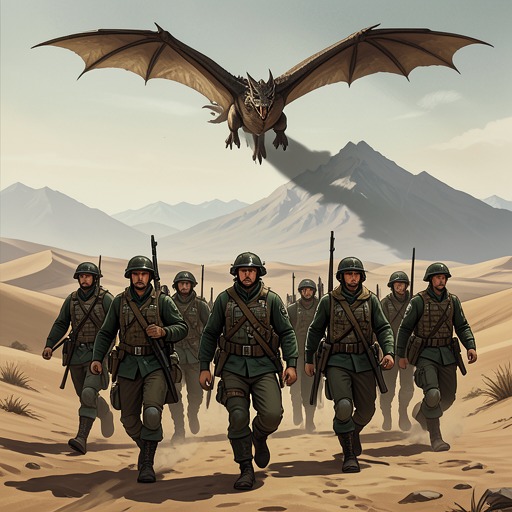
The invasion advanced along two routes. Orys Baratheon led one thousand selected knights up the Boneway, while Aegon marched through the Prince’s Pass with thirty thousand troops, including nearly two thousand mounted knights and three hundred lords and bannermen. Harlan Tyrell, Warden of the South, believed the host could defeat any Dornish army even without Aegon and Balerion. That confidence went untested: the Dornish did not offer battle.
A Campaign Against the Land
Instead, Dornish defenders withdrew, burning crops and poisoning wells. The watchtowers in the Red Mountains had been abandoned, and Aegon’s vanguard encountered a barrier of rotting, shorn sheep carcasses in the high passes. By the time the army emerged from the Prince’s Pass, its supplies of food and fodder were already dwindling. Aegon split his forces: Harlan Tyrell marched south against Uthor Uller at Hellholt, while the king turned east to besiege Lord Fowler at Skyreach.
The season offered no relief. It was the second year of autumn, and the invaders expected winter to bring cooler desert weather and more available water. Instead, the heat persisted, and poisoned waterholes and oases made each advance more costly. Horses died, followed by their riders; knights cast aside banners, shields, and armor. Harlan lost a quarter of his men and almost all his horses before reaching Hellholt, which he found deserted. The castle’s later position offered no easy remedy: the sulfurous river made its fish unsafe for the Highgardeners, while Qorgyle spearmen to the west and Vaith forces to the east attacked foraging parties and patrols that ventured too far.
Orys’s route through the Boneway was similarly shaped by terrain and ambush. His horses struggled on narrow, twisting slopes and balked at steep sections where steps had been cut into the mountains. Rocks fell on his knights from unseen defenders. At the crossing of the river Wyl, Dornish archers attacked the column as it crossed a bridge; when Orys ordered a retreat, a rockfall blocked the way back. Trapped between obstacles, the stormlanders were overwhelmed. Orys and a dozen other lords were spared and taken captive by Wyl of Wyl, the mountain lord known as Widow-lover.
Aegon’s Declaration and the Counterattack
Aegon’s own advance initially brought more tangible results. Moving through foothills where runoff and game supplied his army, he captured Skyreach by storm and won Yronwood after a short siege. The Lord of the Tor had recently died, and his steward surrendered without resistance. At Ghost Hill, Lord Toland sent a man to meet Aegon in single combat. Aegon killed him, only to learn that the challenger had been Toland’s fool; the lord himself had already disappeared.
Meria was likewise absent when Aegon reached Sunspear on Balerion. Rhaenys had taken Lemonwood, Spottswood, and Stinkwater after burning Planky Town, but found no enemy at those places. Sunspear’s Shadow City was half-deserted, and those who remained claimed not to know where the Dornish lords or princess had gone. With no ruler before him to submit, Aegon gathered the remaining dignitaries in Sunspear’s great hall and declared Dorne part of his realm. He named its absent lords rebels and outlaws, offered rewards for their heads, and appointed Jon Rosby castellan of Sunspear and Warden of the Sands. Stewards and castellans were installed in the other lands and castles his army had taken. The king then departed west through the foothills and the Prince’s Pass.
The declaration proved more fragile than the occupation. Before Aegon’s host had been back in King’s Landing long, Dornish spearmen reappeared and retook Skyreach, Yronwood, the Tor, and Ghost Hill within a fortnight, killing their royal garrisons. The appointed stewards and castellans were captured and died after prolonged torment. At Sunspear, men from the Shadow City retook the castle; Jon Rosby was bound, taken to the Spear Tower, and thrown from a window by the aged Meria herself.
Collapse and Significance
Harlan Tyrell remained at Hellholt after Aegon’s departure, in a position the king had judged useful for suppressing revolt. When news reached him of Rosby’s death, he gathered his remaining strength and marched east across the sands. His announced plan was to take Vaith, follow the river east, retake Sunspear and the Shadow City, and punish those responsible for Rosby’s death. Somewhere east of Hellholt, amid the red sands, Harlan and his entire army disappeared. None of them was ever seen again.
The failed occupation turned Aegon’s initial territorial gains into a demonstration of how little they secured. His armies could take castles, but their numbers and royal appointments could not compel the absent Dornish lords to submit or make the conquered strongholds holdable after the main host withdrew. The campaign’s decisive reversals came not through a single pitched battle, but through the denial of food and water, the use of difficult terrain, and the timing of the Dornish return. Dorne remained beyond the Conqueror’s effective rule, and the disappearance of Harlan’s force completed the ruin of the occupation.