Aegonfort
Fire & BloodAegonfort was the rough first castle of the Targaryen conquest and the original seat of the new monarchy at the mouth of the Blackwater Rush. Built on Aegon’s High Hill, it served as the setting for the conqueror’s first coronation and the submission of defeated lords. As the settlement around it became King’s Landing, the fort grew beyond its first walls, only to be torn down in 35 AC for a more imposing stone castle. Its history traces the rapid shift from military encampment to royal capital—and the limits of a fortress raised in haste to house a kingdom.
Foundation and First Royal Ceremony
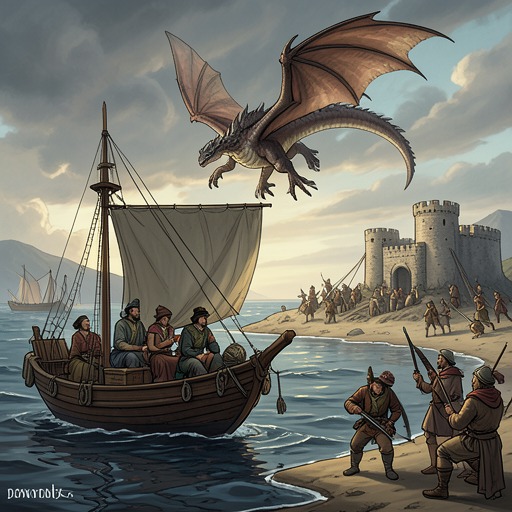
Aegonfort began as a crude castle of wood and earth atop the hill that would henceforth be known as Aegon’s High Hill. It stood within the emerging settlement at the mouth of the Blackwater Rush, where Aegon and his sisters had first set foot in Westeros. The fort was a practical foothold as well as a royal residence: from this new position, the conqueror had taken a dozen castles and secured both sides of the river’s mouth.
After those victories, Aegon summoned the lords he had defeated to the fort. They laid their swords at his feet; he then restored them to their lands and titles. The ceremony established a pattern of rule in which surrender did not necessarily mean dispossession. Aegon also rewarded his oldest supporters with offices: Daemon Velaryon became master of ships, Triston Massey master of laws, and Crispian Celtigar master of coin. He named Orys Baratheon his strong right hand, making him, in the reckoning of the maesters, the first King’s Hand.
Aegonfort was also the setting of Aegon’s first coronation. Its significance extended beyond the walls of the hastily raised castle: the ceremony presented the conqueror as a king of Westeros, while the submission of the defeated lords gave that claim a political and public form. The stronghold’s modest scale contrasted with the authority gathering around it.
The Capital Takes Shape Around the Fort
After the wars, Aegon surprised those who expected him to rule from Oldtown or Dragonstone by choosing the new town on the three hills as his court’s home. It would be called King’s Landing. He intended to rule there from the Iron Throne, fashioned from the melted, twisted, beaten, and broken swords of his fallen foes. The choice made the fort’s location the centre of royal government, even though the fort itself was never grand enough to match that role.
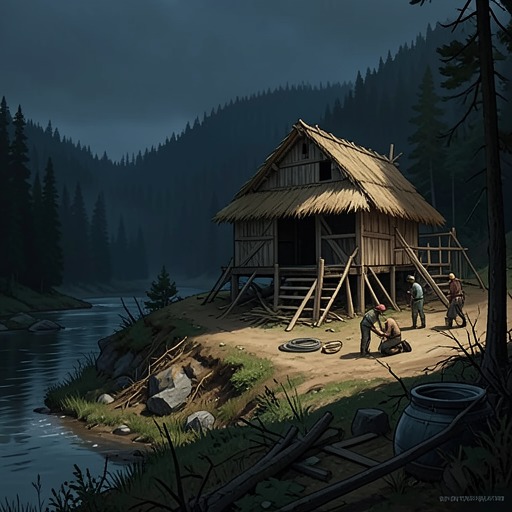
The settlement grew quickly, and the Aegonfort expanded with it. Its first motte-and-bailey defenses could not house the king and his court, so building began even before the Conquest was complete. A new, fifty-foot log keep rose above a cavernous longhall. Across the bailey stood a stone kitchen roofed with slate as a precaution against fire. Stables and a granary followed, along with a watchtower twice the height of the older one. As these additions crowded the original enclosure, a new palisade enclosed more of the hilltop, making room for a barracks, an armory, a sept, and a drum tower.
The city below the hill developed into a centre of trade and settlement. Wharves and storehouses appeared along the riverbanks, where merchants from Oldtown and the Free Cities tied up beside the ships of the Velaryons and Celtigars. Trade formerly passing through Maidenpool and Duskendale increasingly came to King’s Landing. Markets, a customs house, and septs took shape among its growing neighborhoods; wealthy residents built walled manses on the hillsides, while poorer inhabitants lived in low-lying mud-and-straw hovels. The fort’s enlargement and the city’s growth were closely linked, but they also made its inadequacy harder to ignore.
Demolition and the Unfinished Successor
By 33 AC, King’s Landing had a hundred thousand inhabitants and was larger than every Westerosi city but Oldtown and Lannisport. Yet its growth had been haphazard. The settlement remained dirty, unplanned, and makeshift, and the Aegonfort had spread halfway down Aegon’s High Hill without ceasing to be a confusing mixture of wood, earth, and brick. Its old log palisades no longer sufficed as walls, and the stronghold was judged unfit for a great king.
In 35 AC, Aegon moved his court back to Dragonstone and ordered the fort torn down so that a new castle could be built of stone in its place. He entrusted the design and construction to the King’s Hand, Alyn Stokeworth, and Queen Visenya. The work had begun by the time Aegon’s successor arrived at King’s Landing: the Iron Throne still stood amid rubble and mud, while pits and tunnels marked the hill where workers were digging the Red Keep’s cellars and foundations. The new castle had not yet begun to rise. Thousands nevertheless came to cheer the new king as he claimed his father’s seat.
Historical Significance
Aegonfort was not the enduring royal castle, but it established the site on which the royal capital and its later stronghold would stand. Its first ceremonies joined conquest to government: defeated lords were confirmed in their holdings, royal offices were assigned, and a new king was acclaimed. Its successive enlargements register the pressure of a court and city growing beyond a provisional military fort. Its demolition, before its stone successor had risen, made the change visible: the monarchy had outgrown the rough enclosure that first secured its hold on the Blackwater, even as the Iron Throne remained amid the unfinished works.