Aemond Claims Vhagar and the Driftmark Conflict
Fire & BloodAemond Targaryen’s claim to Vhagar transformed a private act of daring into a family conflict with consequences for the royal court. At Driftmark after Laena Velaryon’s funeral, the prince took the largest dragon in the world for his own; the confrontation that followed left him a dragonrider but sharpened the hostility between Queen Alicent’s children and Princess Rhaenyra’s sons.
Background and the Claim
The events unfolded at High Tide after Laena’s funeral, when King Viserys and his court travelled to Driftmark. So many dragons were present that Septon Eustace compared the island to the ancient Valyria. Helaena Targaryen already rode Dreamfyre, and Aegon Targaryen had Sunfyre. Daeron Targaryen also had Tessarion, a young blue she-dragon, though he had not yet ridden her. Aemond, at ten, was the only one of the king’s sons still without a dragon.
Viserys hoped to remedy this by suggesting that the court visit Dragonstone after the funeral, where Aemond might choose from dragon eggs or young hatchlings. The king’s teasing suggestion that the boy would need to be bold enough to claim one did not persuade Aemond to wait. Vhagar, recently without a rider and present at High Tide, seemed to him a more worthy choice than an egg or hatchling. Knowing his parents would forbid him to approach her, he slipped from bed at dawn and went alone to the outer yard where the dragons were kept.
Joffrey Velaryon, Rhaenyra’s three-year-old son, was already there to see his own dragon, Tyraxes. When Joffrey called out to stop Aemond, Aemond shoved him aside, then climbed onto Vhagar before anyone could alert the adults. Vhagar shook off her chains and took flight. Aemond circled twice above High Tide’s towers and returned as a dragonrider.
The Fight and Its Political Consequences
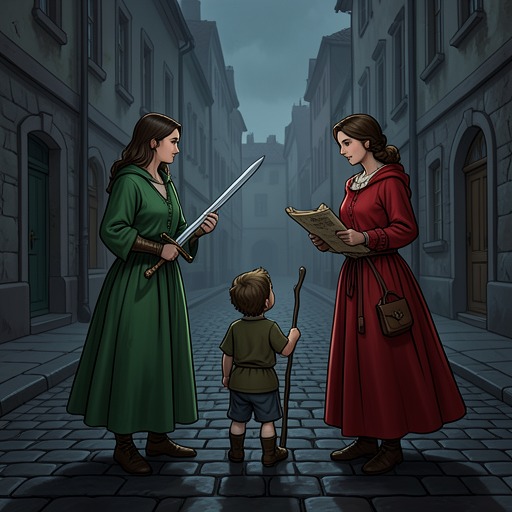
When Aemond returned from his flight, Joffrey had summoned his older brothers, Jacaerys Velaryon and Lucerys Velaryon. The three boys, aged six, five, and three, confronted the ten-year-old prince with wooden swords from the training yard. Aemond fought them off, then mocked them with an insult that questioned their legitimacy: their mother’s sons were widely known as “the Strongs.” Jacaerys renewed the attack, and Lucerys intervened with a dagger, costing Aemond his right eye. The stableboys separated the children; Aemond had gained Vhagar, but the claim was now bound to a family feud.
King Viserys attempted to settle the dispute by requiring each boy to apologize to the others. The gesture failed to appease either mother. Queen Alicent demanded that Lucerys lose an eye in return, while Princess Rhaenyra opposed that punishment and pressed the king to discover who had taught Aemond to call her sons “Strongs.” The insult carried a larger charge than a childhood taunt: it implied that Jacaerys and Lucerys were bastards and that Rhaenyra had committed high treason. Under questioning, Aemond named his brother Aegon as the source; Aegon said that the truth was commonly recognized by looking at the boys.
Viserys ended the inquiry without ordering either child mutilated. He instead threatened severe punishment for anyone who repeated the slur, and commanded Alicent and Rhaenyra to exchange professions of affection. Their outward compliance concealed no reconciliation. The king’s decree could forbid the accusation, but it could not erase what the accusation exposed or the resentment produced by the fight.
The king then separated the households to forestall further conflict. Alicent and her sons returned with Viserys to court, while Rhaenyra withdrew to Dragonstone with her sons. Ser Erryk Cargyll became her sworn shield, and Harwin Strong returned to Harrenhal. The separation pleased neither side, and Mushroom suggested that the closeness of Dragonstone and Driftmark would give Daemon Targaryen opportunities to visit Rhaenyra without the king’s knowledge. In the account’s wider chronology, the episode marks how the Dance’s bloody divisions were already taking root years before Viserys’s death.
Chance, Boldness, and the Dragon
The account refuses to reduce Aemond’s success to courage alone: it sets boldness beside madness, fortune, divine will, and the caprice of dragons, then admits that Vhagar’s mind cannot be known. Her response is nevertheless decisive. She roars, breaks her chains, and flies, turning a boy’s secret attempt into an irreversible change in his standing. The uncertainty belongs to the cause, not the outcome: Vhagar has accepted a rider, while the human consequences of that flight unfold in conflict and division.
A Private Triumph and a Public Rupture
Aemond’s success belonged first to the language of individual courage: he had secured the greatest dragon at Driftmark and described the exchange of his eye for a dragon as fair. Yet the quarrel made that private achievement inseparable from a public dispute over Rhaenyra’s sons and their place in the succession. Viserys could punish the use of the insult and command gestures of affection, but his response left its underlying allegation unanswered. The episode therefore turns on a sharp imbalance: Aemond’s bond with Vhagar is settled in a single flight, while the divisions exposed by the fight persist beyond the king’s attempted settlement.