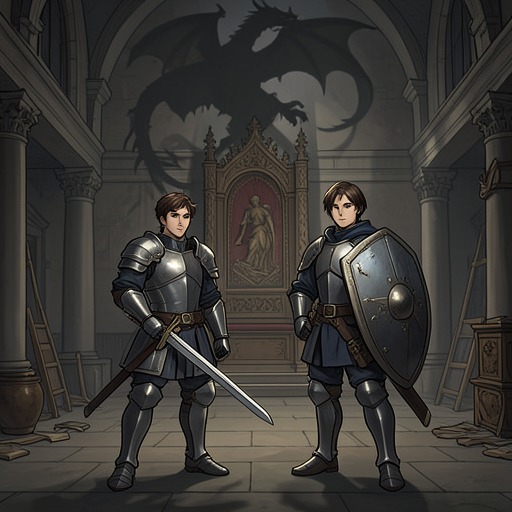
Aenys I and Maegor I
Fire & BloodAenys I and Maegor I were half-brothers whose relationship moved from an uneasy promise of joint rule to open estrangement and a contested succession. Aenys crowned his brother’s military service with the office of Hand and entrusted him with Blackfyre, but Maegor’s defiance over his second marriage ended their cooperation. After Aenys died, Maegor claimed the throne over the claim of Aenys’s son, making their family conflict inseparable from the question of who had the right and strength to rule.
Brothers and a Shared Crown
When Aenys succeeded their father, he made a conspicuous gesture of fraternal trust. At his coronation on Dragonstone, Aenys drew Maegor to his feet rather than allowing him to kneel, then declared that his brother need never do so again and that they would rule the realm together. He gave Maegor Blackfyre, the ancestral Valyrian steel sword, saying that Maegor was more fit to bear it. The choice placed a potent symbol of royal authority in the hands of the man whose strength and martial reputation would increasingly be set against Aenys’s claim to the crown.
The transfer had an immediate dynastic consequence: Maegor already possessed Dark Sister, given to him by his mother, Queen Visenya, and from then on he wielded Blackfyre while Dark Sister remained in his chambers on Dragonstone. In the eyes of those who doubted Aenys’s fitness, the sword seemed to confirm that Maegor was the stronger prince. At Aenys’s anointing in the Starry Sept, Visenya was reported to have argued that Aenys’s gift of Blackfyre proved he himself understood Maegor to be the one with the strength to rule. That interpretation turned a brother’s act of generosity into a political argument against him.
For a time, the brothers nevertheless worked together. Their father’s conquests had left resentment across the realm, and revolt tested the new king’s rule. After Maegor returned from a campaign against rebels, Aenys greeted him publicly as a hero and named him Hand of the King. The appointment, following Aenys’s earlier gift of the sword, was another effort to make Maegor’s formidable power serve the crown rather than compete with it. The account describes their amity as lasting for the best part of two years, but also marks its end as the point from which their relationship could no longer be treated as secure.
Temperament and Political Tension
The brothers differed sharply in character and in their conception of authority. Aenys valued his wife, children, and people, and wanted their affection in return. He turned away from martial pursuits and took pleasure in learning, music, dance, fine clothing, and the company of scholars and religious men. When confronted with difficulty, he tended toward soft words and conciliation. Maegor was physically imposing, impatient with those pursuits, and devoted to war, tourneys, and battle. He was renowned as a knight, but also for ferocity in combat and severity toward defeated enemies.
Their difference was political as well as personal. Aenys sought to please and was described as readily influenced by the counselors around him; Maegor was portrayed as rigid and unyielding. The contrast left Aenys vulnerable to the charge that he could not command even his own brother. That perception mattered beyond the family: a king who had entrusted Maegor with the royal sword and the office of Hand appeared to be balancing his authority against his brother’s, even as the realm looked for a decisive ruler. Their early cooperation therefore contained its own tension: Maegor’s service strengthened Aenys’s government, while his reputation also made him a rival measure of royal strength.
The Marriage That Ended Their Cooperation
The decisive rupture followed Maegor’s announcement that his first wife, Ceryse, was barren and that he had taken Alys Harroway as a second wife. The marriage was performed on Dragonstone in a Valyrian rite, without Aenys’s permission, knowledge, or presence. The castle septon refused to officiate, and the High Septon condemned the union. Maegor defended it by invoking the marriage customs of the dragonlords and insisting that the Faith’s strictures did not bind his family.
Aenys gave Maegor a choice: set Alys aside and return to Ceryse, or accept five years of exile. Maegor chose exile. In 40 AC he left for Pentos with Alys, Balerion, and Blackfyre. The departure made the private breach public and removed the king’s most powerful military ally from the realm. Ceryse, left behind in King’s Landing, soon went to Oldtown to rejoin her father, Manfred Hightower. Aenys appointed Septon Murmison as Hand, a choice that appears to have been intended to appease the Faith, but did not end the High Septon’s denunciations or the lords’ talk of the king’s weakness. Aenys’s attempt to discipline Maegor had thus failed to restore either their partnership or confidence in the crown.
Succession and the Fracture’s Aftermath
Aenys died before Maegor’s exile had run its course. When Maegor returned to Dragonstone, he claimed the crown rather than recognizing the claim of Aenys’s son, Aegon, whom the laws of inheritance entitled to succeed. Grand Maester Gawen alone dared to object. Maegor answered that the throne would go to the man strong enough to seize it, then killed Gawen with Blackfyre. The sword Aenys had entrusted to his brother had become an instrument of the very challenge to succession that the gift could not prevent.
Aenys’s widow, Queen Alyssa, had taken her children from Dragonstone to Driftmark before Maegor’s coronation, so they did not witness his claim. Maegor then sent letters to lords throughout the realm and flew to King’s Landing with Visenya. The ensuing struggle was not simply a continuation of the brothers’ personal quarrel: it set Maegor’s possession of the crown and military force against the inheritance claim of Aenys’s son. In that sense, the relationship’s decisive legacy was institutional. Aenys’s trust, appointment, and gift of Blackfyre had not bound Maegor to his reign; after Aenys’s death, the same brother who had been promised a share in ruling asserted power against the succession his brother left behind.